

Algorithmic Trading Strategies: 6 Types Explained, With Rules You Can Test
The main algorithmic trading strategies retail traders use: trend following, mean reversion, breakouts, momentum, session and liquidity sweep strategies, with example rules.
By Hristo Skulev · Updated · 8 min read
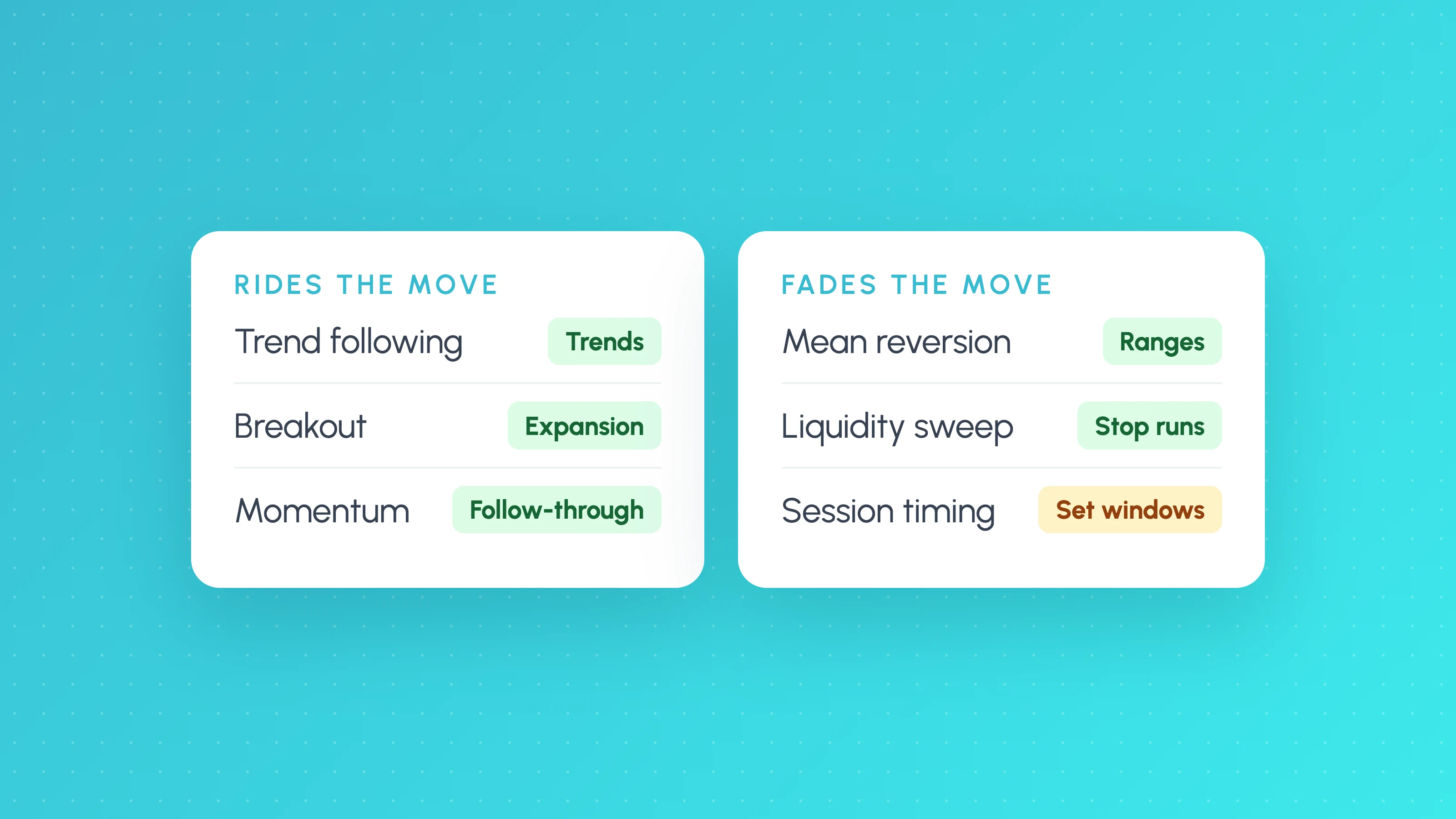
An algorithmic trading strategy is a set of exact rules for when to enter, where to put the stop, when to take profit and how much to risk, written precisely enough that a computer can follow them without judgement. Most strategies retail algo traders run fall into six families: trend following, mean reversion, breakouts, momentum, session and time-based strategies, and liquidity sweep strategies. Each one makes money in a different kind of market and loses money in the opposite kind, which is why the type matters less than whether you have tested it properly.
This guide explains each family, gives an example rule set you could test, and says where each one usually fails. There are no backtest results here on purpose: a result for someone else's market, timeframe and costs tells you little about yours. The aim is to give you rules precise enough to test yourself.
Strategy descriptions are educational, not recommendations. Backtests are not future results, and leveraged trading carries a high risk of loss.
The six families at a glance
| Family | The idea | Works best when | Usually fails when |
|---|---|---|---|
| Trend following | Buy strength, sell weakness, hold until the trend ends | Markets make long, sustained moves | Price chops sideways |
| Mean reversion | Fade stretched moves back towards an average | Markets range and overshoot | A real trend starts |
| Breakout | Trade the break of a defined range or level | Volatility expands after a quiet period | Breaks fail and reverse (false breakouts) |
| Momentum | Ride an indicator's acceleration, such as a MACD or RSI shift | Moves follow through for a few bars | Signals fire late in a move |
| Session and time-based | Trade a repeating time window, such as the open | A market behaves differently at a set time | The time edge fades or costs eat it |
| Liquidity sweep | Fade a run beyond an obvious high or low | Stops get taken, then price reverses | The sweep is the start of a real move |
1. Trend following
Trend following is one of the oldest systematic approaches. Richard Donchian traded channel breakouts in the 1960s, and the "Turtle Traders" that Richard Dennis and William Eckhardt trained in 1983 followed a breakout-based trend system with fixed rules for entries, sizing and exits.
Example rules to test:
- Market and timeframe: a liquid index or currency pair on 4-hour or daily candles.
- Entry: buy when the 50-period moving average crosses above the 200-period, or when price closes above the highest high of the last 20 bars.
- Stop: 2 x ATR below entry.
- Exit: a trailing stop, or the opposite crossover.
- Risk: a fixed 0.5% to 1% of the account per trade.
What to expect: trend systems typically win less than half their trades and rely on a few large winners. That makes them hard to sit through, and it means a short backtest with only a handful of trends in it can look far better or worse than the long run. Our trend following strategy guide goes through the rule choices in detail.
2. Mean reversion
Mean reversion assumes that price stretched far from its average tends to snap back. Typical tools are the RSI (J. Welles Wilder, 1978), Bollinger Bands (John Bollinger, 1980s) and distance from a moving average.
Example rules to test:
- Market and timeframe: an index or major currency pair on 15-minute to 1-hour candles.
- Filter: only trade when a market-regime filter says the market is ranging, not trending.
- Entry: buy when the 2-period RSI drops below 10 while price is above the 200-period moving average.
- Exit: when price closes back above a short moving average, or after a fixed number of bars.
- Stop: a wide ATR stop or a time stop. Tight stops tend to get hit before the reversion happens.
What to expect: a high win rate with occasional large losses when a range turns into a trend. Costs matter a lot because the average win is small. See the mean reversion strategy guide.
3. Breakout strategies
A breakout strategy defines a range or level and trades when price leaves it: the opening range, the prior day's high or low, a swing high, or a volatility squeeze.
Example rules to test:
- Level: the prior day's high and low.
- Entry: buy on a 15-minute close above the prior day's high, sell on a close below the low.
- Filter: only trade when a Bollinger or ATR squeeze shows volatility was compressed.
- Stop: the middle of the range, or 1 x ATR.
- Target: 2R, or exit at the session close.
What to expect: false breakouts are the main cost. A filter that waits for a candle close, or for higher-timeframe agreement, usually trades less often but gets fewer fake-outs. The best-known version is the opening range breakout.
4. Momentum
Momentum strategies enter when an indicator shows a move accelerating, such as a MACD signal-line cross, a Stochastic RSI turn or a moving-average crossover on a short timeframe, usually in the direction of a higher-timeframe trend.
Example rules to test:
- Bias: only long when price is above the 1-hour 50-period EMA.
- Entry: a MACD cross up on the 5-minute chart.
- Stop: below the most recent swing low.
- Target: 1.5R to 2R, with break-even after 1R.
What to expect: many signals, so costs and slippage decide whether there is an edge at all. Momentum signals that look good on one market often fail on others, so test across several markets.
5. Session and time-based strategies
Many markets behave differently at set times: the London open, the New York open, the hour after a data release or the close. Session strategies only trade inside a chosen window.
Example rules to test:
- Window: the London session only, or the first two hours of the New York session.
- Entry: any of the setups above, but only inside the window.
- Exit: a fixed target, or a clock exit at the end of the window.
What to expect: time filters can turn a mediocre strategy into a decent one, but they are also the easiest way to overfit. If you test 24 different hours and keep the best one, the "edge" may be luck. Our guide to analysing a backtest by session and weekday shows how to check this honestly.
6. Liquidity sweep strategies
Popularised by "smart money" and ICT-style trading, these strategies wait for price to run beyond an obvious high or low, where stop orders are likely to sit, and then trade the reversal, often entering on a retest of a fair value gap.
Example rules to test:
- Level: the Asian session high or low, or the prior day's high or low.
- Trigger: price trades beyond the level, then closes back inside it.
- Entry: on a retest of the fair value gap the reversal leaves behind.
- Stop: beyond the sweep's extreme.
- Target: the opposite side of the range, or 2R.
What to expect: the rules are often described loosely, which makes them hard to test and easy to fool yourself with. Pin down every term (what counts as a sweep, how big a gap must be, how long a retest can take) before you test. See the liquidity sweep strategy guide.
Strategies retail traders usually can't run
Some algorithmic strategies depend on speed or infrastructure that individual traders don't have: high-frequency market making, latency arbitrage and most statistical arbitrage between instruments. They also tend to be banned by prop firms. If a strategy's edge depends on being faster than everyone else, a retail account will not have that edge.
How to choose and test a strategy
- Pick the family that matches how you already see the market. You will stick with a strategy you understand through its bad months.
- Write the rules so there is nothing left to judgement: market, timeframe, session, entry, stop, target, sizing and costs.
- Backtest with realistic costs, then hold back an unseen period. Our step-by-step guide to building an algo strategy covers this.
- Check it isn't overfit: enough trades, stable results when you nudge the settings, and results on other markets. See how to tell if a backtest is overfit.
- Stress test it, with Monte Carlo and higher costs, and if you trade a prop account, against the firm's rules.
- Paper trade before going live, and compare live results with the backtest.
In Strategy Lab you can build any of the six families without code. Describe the strategy to TES, the AI strategy coach, or assemble it from setups such as opening range breakouts, prior-day levels, RSI, MACD, moving-average crossovers, Bollinger squeezes, liquidity sweeps and fair value gaps, with session, regime and higher-timeframe filters. Strategy Lab reads the rules back in plain English before it runs, holds back the last 30% of the data as an unseen period and offers Monte Carlo, price noise, cost, other-market and prop-firm account tests.
More strategy guides: London breakout, ICT Silver Bullet, RSI trading strategies and moving average crossovers.
Free tools for this: use the profit factor calculator to work out profit factor from your own trades and the Monte Carlo simulator to see the range of drawdowns your trade results could produce. They run in your browser, with no account needed.
Frequently asked questions
- What are the most common algorithmic trading strategies?
- Trend following, mean reversion, breakouts (including the opening range breakout), momentum, session or time-based strategies and liquidity sweep strategies. High-frequency market making and arbitrage are also algorithmic, but they need speed and infrastructure most individual traders don't have.
- Which algorithmic trading strategy is best for beginners?
- A simple breakout or trend-following strategy on a liquid market, because the rules are easy to state exactly and easy to check on a chart. The best strategy is one you can define without judgement and test properly, not the one with the best-looking backtest.
- Do algorithmic trading strategies work?
- Some do for a time, many don't, and most stop working if they were overfit to past data. Regulator data shows most retail traders lose money. Testing on unseen data, with realistic costs and across several markets, is what separates a real edge from a lucky backtest. See is algo trading profitable?
- Can I build an algorithmic trading strategy without coding?
- Yes. No-code builders let you assemble rules from setups and filters, or describe a strategy in plain English. Tessera's Strategy Lab does both and backtests on 1-minute to daily candles. On the Free plan the smallest candle is 5 minutes.
Keep reading
 Algo trading
How to Build an Algo Trading Strategy: From Idea to Rules to Running Bot
How to build an algo trading strategy: turn an idea into exact rules, backtest with costs, validate, paper trade, deploy with limits, then review and improve.
 Algo trading
Systematic vs Discretionary Trading: Which Suits You, and the Hybrid Path
Systematic vs discretionary trading compared: speed, testing, emotion and flexibility, how to turn your playbook into testable rules, and the hybrid path.
 Algo trading
Is Algo Trading Profitable? What the Evidence Actually Says (2026)
SEBI found 87.7% of individual F&O traders lost money in FY26. When algo trading is profitable, whether it's worth it, and how to test your own strategy first.