

Liquidity Sweep Strategy: Rules for Sweeps and Fair Value Gap Entries
The liquidity sweep strategy explained: what a sweep is, sweep then fair value gap entries, killzone filters, the definitions you must pin down, and how to backtest it.
By Hristo Skulev · Updated · 4 min read
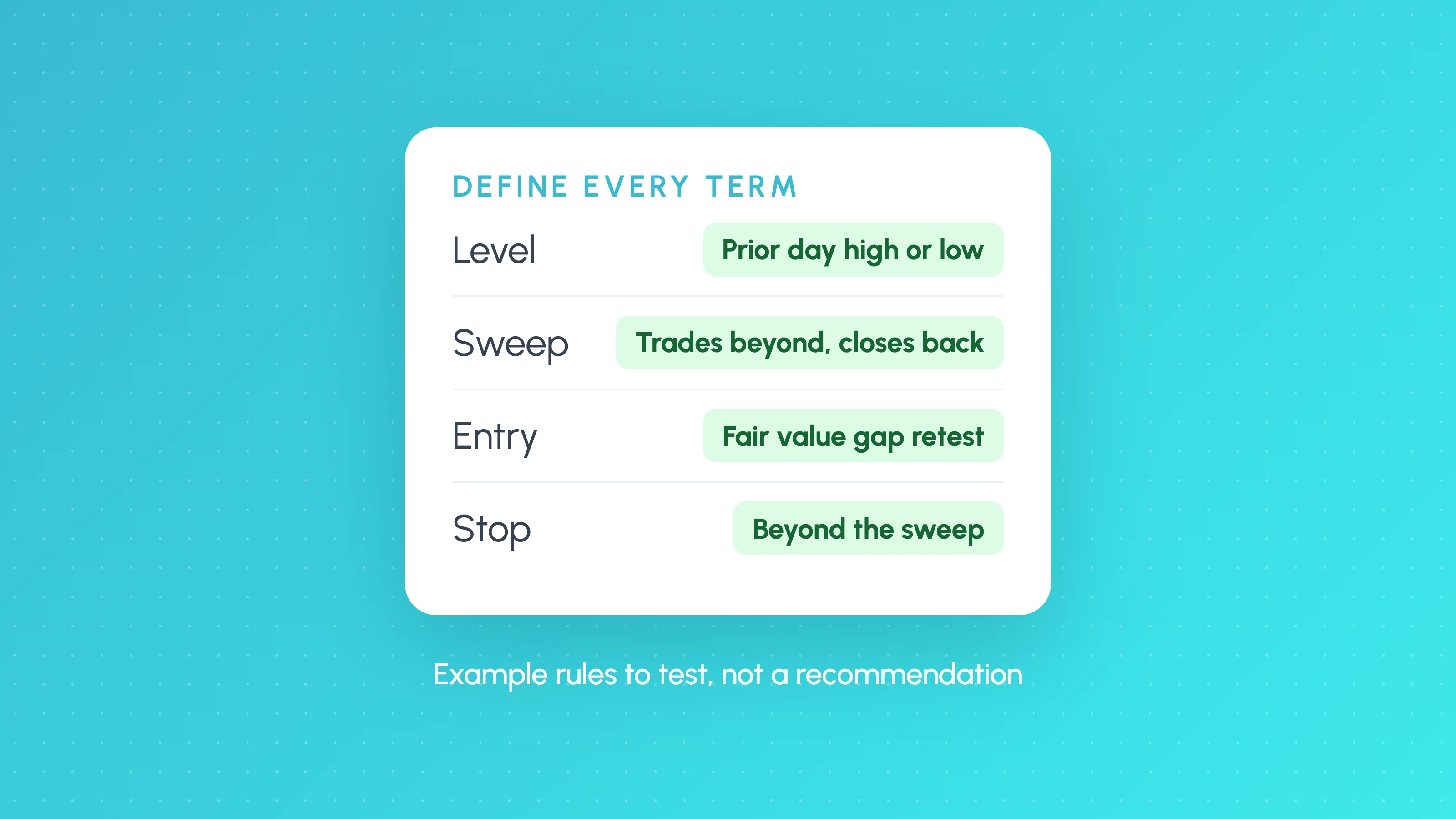
A liquidity sweep strategy waits for price to push just beyond an obvious high or low, where stop orders and breakout entries are likely to be resting, and then trades the move back the other way. The usual version, popular in ICT and "smart money" trading, is: price sweeps a prior high or low, closes back inside it, leaves a fair value gap on the way back, and you enter when price retests that gap, with a stop beyond the sweep.
The idea behind it is that obvious levels collect orders, and a quick run through those orders can exhaust the move. Whether that produces a tradable edge on your market and timeframe is a question for testing, and this strategy is unusually easy to test badly because its terms are often described loosely.
This is an educational description, not a recommendation. Backtests are not future results, and leveraged trading carries a high risk of loss.
The terms you have to define
Before you can test a sweep strategy, every one of these needs an exact definition:
| Term | Questions to answer |
|---|---|
| Liquidity level | Prior day high or low? Session high or low? A swing high from the last N bars? |
| Sweep | How far beyond the level must price trade? Does a single tick count? |
| Rejection | Must the candle close back inside the level? On which timeframe? |
| Fair value gap | A gap between candle 1's high and candle 3's low (or the reverse). How large must it be, in ticks or ATR? |
| Retest | How many bars may pass before the gap is no longer valid? Must price touch the gap or reach its midpoint? |
| Stop | Beyond the sweep's extreme, plus a buffer? |
| Target | The opposite side of the range, a fixed R, or the next liquidity level? |
| Time window | Which sessions or killzones, in which timezone? |
If you can't answer each question with a number, the strategy can't be tested yet, and a discretionary trader looking at charts will tend to remember the clean examples and forget the rest.
An example rule set to test
- Market and timeframe: a major currency pair or index, with the setup on 5-minute or 15-minute candles.
- Level: the prior day's high and low.
- Sweep: price trades beyond the level by any amount, then a candle closes back inside within 3 bars.
- Entry: on the first retest of a fair value gap left by the move back inside, within 10 bars.
- Stop: beyond the sweep's extreme.
- Target: 2R, with break-even at 1R.
- Window: London or New York session only.
- Higher-timeframe filter (optional): only take sweeps against the daily bias, such as a sweep of the low when the daily trend is up.
Where it usually fails
- When the sweep is a real breakout. Sometimes price runs through a level because the market is starting a trend, and the "reversal" never comes. A higher-timeframe filter can help, but it also removes trades.
- Loose definitions. Changing what counts as a sweep or a gap after seeing results is overfitting, even if it feels like learning.
- Few trades. Strict versions can trade only a few times a month, so a backtest may hold too few trades to mean much. See how many trades a backtest needs.
- Fills at the gap. Entries on limit orders at the gap assume you were filled. In fast markets you may not be.
How to test a liquidity sweep strategy
- Write every definition above as a number before you look at results.
- Backtest it on several years of intraday data, including sessions and markets you didn't use to design it.
- Hold back an unseen period and look at it once. See out-of-sample testing.
- Compare it with a simpler version, such as the same entry without the fair value gap. If the gap rule doesn't improve results on unseen data, it may be decoration.
- Check it isn't overfit: results should survive small changes to the definitions. See how to tell if a backtest is overfit.
- Stress test it with Monte Carlo and realistic slippage.
In Strategy Lab, liquidity sweeps, fair value gaps, inverse fair value gaps, order blocks and killzones are built-in building blocks, and "sweep then FVG retest" is one of the starter packs. You can also describe your version to TES, the AI strategy coach. Strategy Lab reads the finished rules back in plain English, so you can check each definition before the backtest runs, then test it on an unseen period, with Monte Carlo and on other markets.
Free tools for this: use the profit factor calculator to work out profit factor from your own trades and the Monte Carlo simulator to see the range of drawdowns your trade results could produce. They run in your browser, with no account needed.
Frequently asked questions
- What is a liquidity sweep in trading?
- A quick move beyond an obvious high or low, where stop orders and breakout orders are likely to sit, followed by price moving back inside the level. Traders who use them expect the sweep to mark exhaustion and trade the reversal.
- What is a sweep and fair value gap strategy?
- A strategy that waits for a liquidity sweep, then enters when price retests the fair value gap (a three-candle price imbalance) left by the move back inside the level, with a stop beyond the sweep's extreme.
- Can you backtest ICT liquidity sweep strategies?
- Yes, once every term is defined precisely: the level, what counts as a sweep, the size of a valid gap, how long a retest can take, the stop, target and session window. Loosely defined versions can't be tested fairly.
- Do liquidity sweep strategies work?
- Some versions may on some markets and sessions, and many don't once they are tested on unseen data with realistic costs. Test your exact rules rather than relying on chart examples.
Keep reading
 Strategies
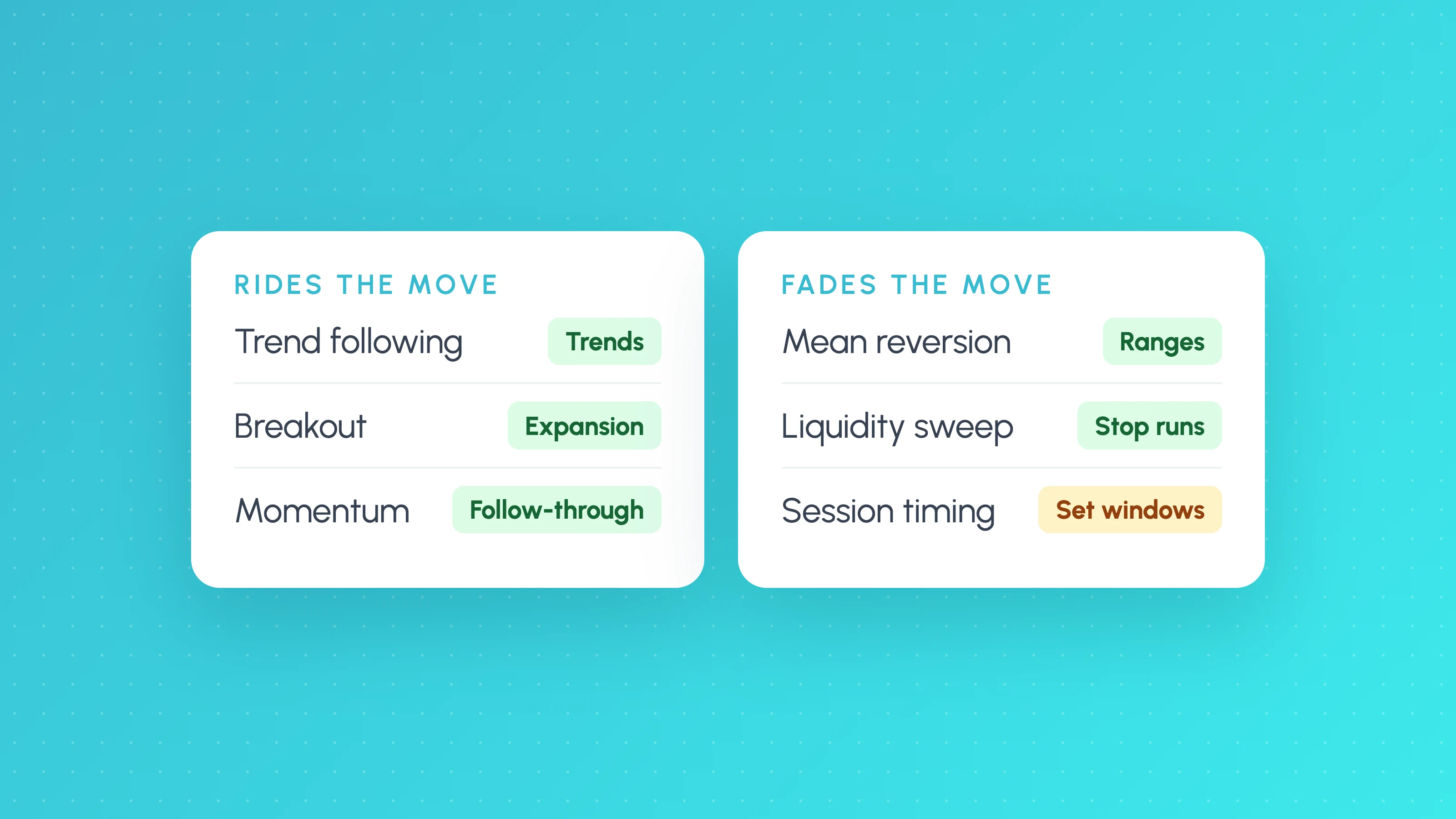
Algorithmic Trading Strategies: 6 Types Explained, With Rules You Can Test
The main algorithmic trading strategies retail traders use: trend following, mean reversion, breakouts, momentum, session and liquidity sweep strategies, with example rules.
 Strategies
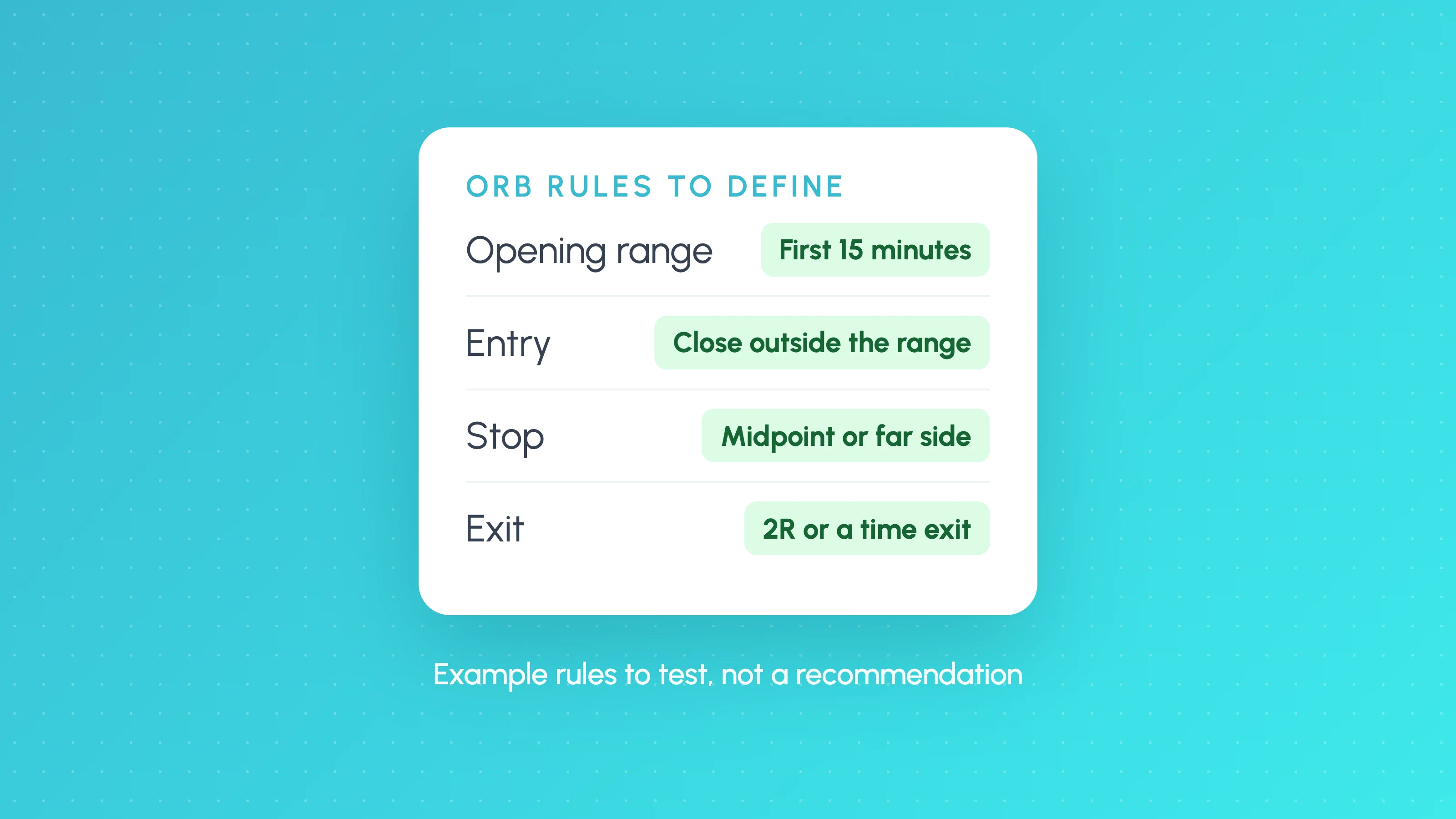
Opening Range Breakout Strategy: Rules, Variations and How to Test It
The opening range breakout (ORB) strategy explained: the 5, 15 and 30-minute range, entry, stop and target rules, the filters that cut false breakouts, and how to test it.
 TradingView backtests
Is My Backtest Overfit? A Practical Checklist for Traders
How to tell if a backtest is overfit: too-good metrics, thin samples, fragile inputs, useless filters, out-of-sample and walk-forward tests, plus a checklist.