

ICT Silver Bullet Strategy: Times, Rules and How to Backtest It
The ICT Silver Bullet strategy explained: the three one-hour windows in New York time, the sweep and fair value gap entry, the definitions to pin down, and how to backtest it.
By Hristo Skulev · Updated · 4 min read
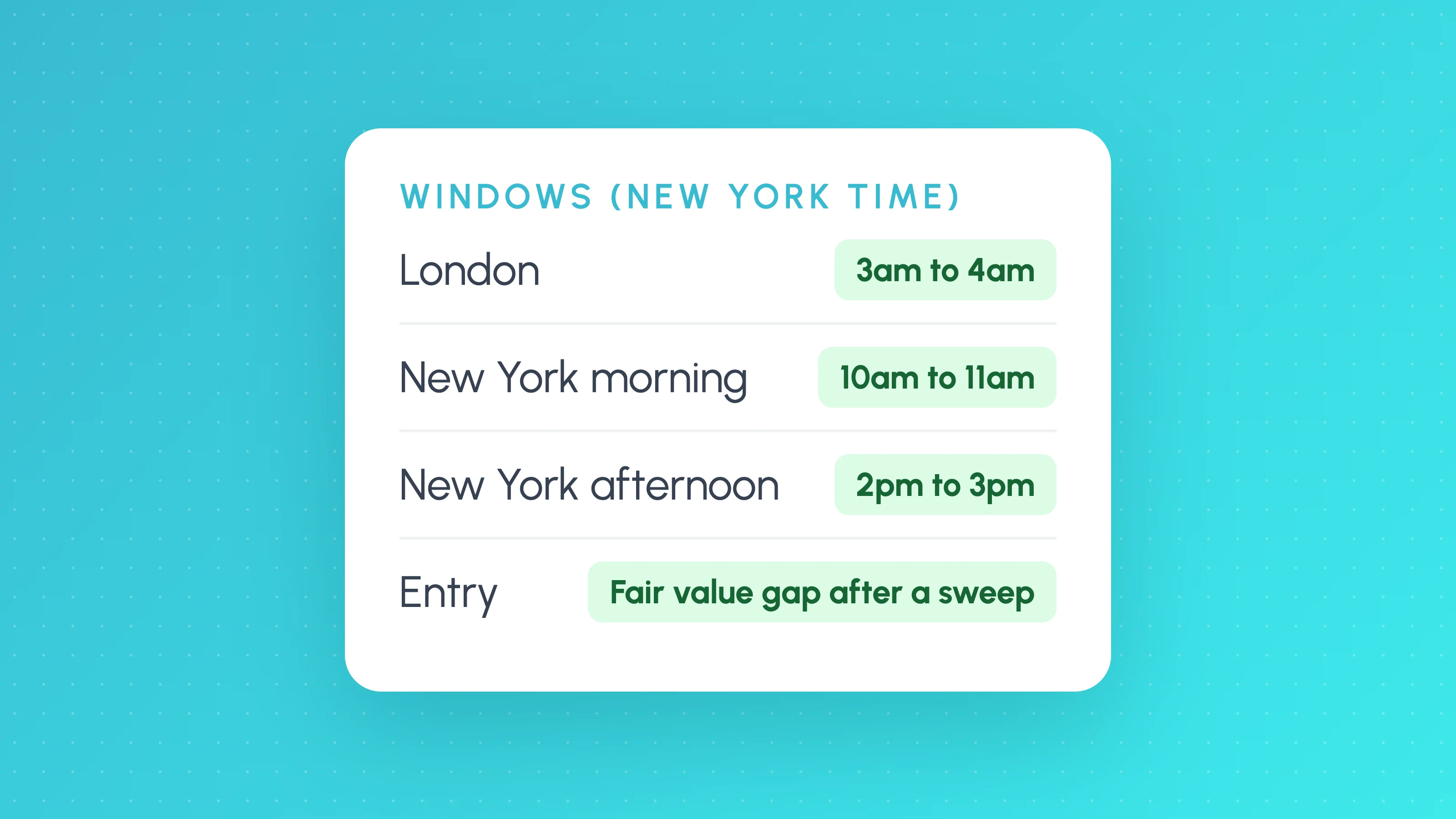
The ICT Silver Bullet is a time-based setup taught by Michael J. Huddleston, known as the Inner Circle Trader (ICT). It looks for a trade inside one of three one-hour windows in New York time (3am to 4am, 10am to 11am and 2pm to 3pm), entering on a fair value gap that forms after price runs liquidity, with a target at the next obvious high or low. It is popular on index futures such as the Nasdaq 100 and S&P 500, and on major currency pairs.
Like other ICT concepts, it is usually taught with chart examples rather than exact rules, which makes it easy to believe and hard to test. This guide sets out the rules precisely enough to backtest.
This is an educational description, not a recommendation. Backtests are not future results, and leveraged trading carries a high risk of loss.
The three windows
| Window (New York time) | Session | Common markets |
|---|---|---|
| 3am to 4am | London | Currency pairs, DAX |
| 10am to 11am | New York morning | Index futures, currency pairs |
| 2pm to 3pm | New York afternoon | Index futures |
Daylight saving time matters: write every rule in New York time and make sure your backtester converts it correctly.
The setup, as testable rules
- Window: only look for setups inside the chosen one-hour window.
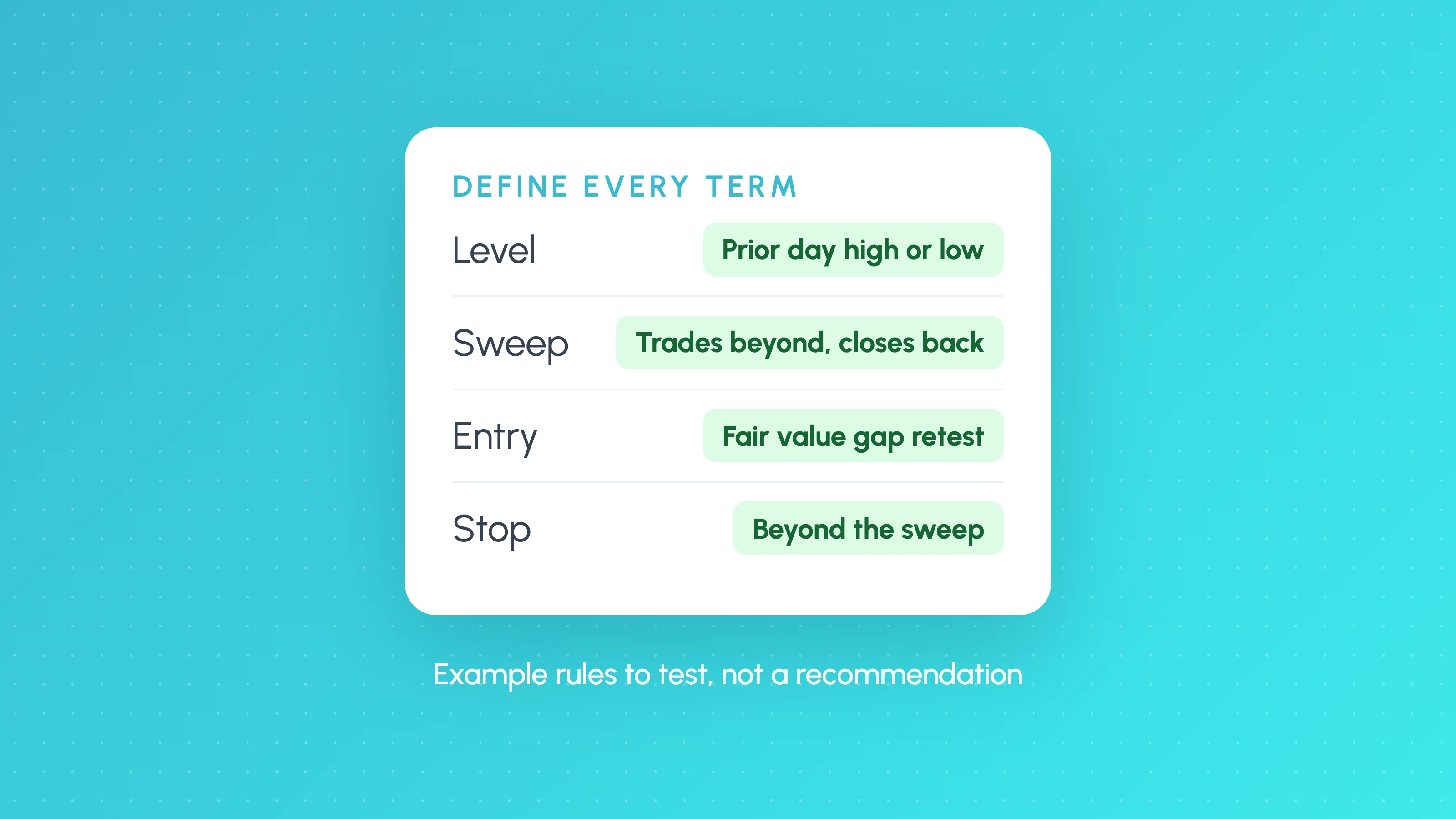
- Liquidity: identify a level price is likely to run, such as the session high or low so far, or a recent swing high or low.
- Sweep or displacement: price trades through that level, then moves sharply the other way.
- Fair value gap: the sharp move leaves a three-candle gap (candle 1's high below candle 3's low, or the reverse).
- Entry: a limit order at the gap (its edge or midpoint) when price retraces into it, still inside the window.
- Stop: beyond the swing that created the gap.
- Target: the next liquidity level in the trade's direction, or a fixed R such as 2R.
Definitions you must pin down
| Term | Decide |
|---|---|
| Liquidity level | Which highs and lows count, and over how many bars |
| Sweep | How far beyond the level price must trade, and whether it must close back inside |
| Displacement | How large the move must be, for example in ATR terms |
| Fair value gap | Minimum size, and which timeframe it's measured on (often 1-minute to 5-minute) |
| Entry | Gap edge or midpoint, and how long the order stays open |
| Trades per window | One, or more |
Each choice changes the result. Decide them before you look at results, and keep a note of every variation you try, so you know how much testing went into the final version. See how to tell if a backtest is overfit.
Where it usually fails
- No setup most days. Strict rules may produce only a few trades a month, so the sample builds slowly. See how many trades a backtest needs.
- Missed fills. Limit entries at the gap assume you get filled; in fast moves you may not, and backtests that assume every fill flatter the result.
- The sweep is a real move. Sometimes price runs the level because a trend is starting.
- Hindsight. It's easy to see a "perfect" Silver Bullet on a chart after the fact. A backtest with fixed definitions removes that bias.
How to backtest the Silver Bullet
- Fix every definition in the table above.
- Test one window at a time on several years of intraday data, with costs.
- Hold back an unseen period. See out-of-sample testing.
- Compare it with a simpler version, such as the same window and target without the fair value gap. If the gap rule doesn't help on unseen data, it may not be doing anything.
- Run Monte Carlo on the trades.
In Strategy Lab, fair value gaps, inverse fair value gaps, liquidity sweeps and killzones are built-in building blocks, and sweep-then-FVG retests are one of the starter packs. You can set the time window as a session filter or describe your full Silver Bullet rules to TES, the AI strategy coach, then check the rules Strategy Lab reads back before the backtest runs. For the related setup without a fixed window, see the liquidity sweep strategy.
Free tools for this: use the profit factor calculator to work out profit factor from your own trades and the Monte Carlo simulator to see the range of drawdowns your trade results could produce. They run in your browser, with no account needed.
Frequently asked questions
- What is the ICT Silver Bullet strategy?
- A time-based setup from the Inner Circle Trader that looks for a fair value gap entry after a liquidity sweep inside one of three one-hour windows in New York time (3am to 4am, 10am to 11am and 2pm to 3pm), targeting the next liquidity level.
- What are the ICT Silver Bullet times?
- 3am to 4am, 10am to 11am and 2pm to 3pm, New York time. Convert them carefully around daylight saving time changes.
- Does the ICT Silver Bullet strategy work?
- It hasn't been tested with standard, published rules, because it's usually taught by example. Whether your version works depends on how you define each part. Backtest it with fixed definitions, costs and an unseen period.
- Can you automate the ICT Silver Bullet?
- Yes, once every part is defined precisely: the window, liquidity levels, what counts as a sweep, the gap size, entry, stop and target. Then it can be backtested and run as a bot like any other rule-based strategy.
Keep reading
 Strategies
Liquidity Sweep Strategy: Rules for Sweeps and Fair Value Gap Entries
The liquidity sweep strategy explained: what a sweep is, sweep then fair value gap entries, killzone filters, the definitions you must pin down, and how to backtest it.
 Strategies
Algorithmic Trading Strategies: 6 Types Explained, With Rules You Can Test
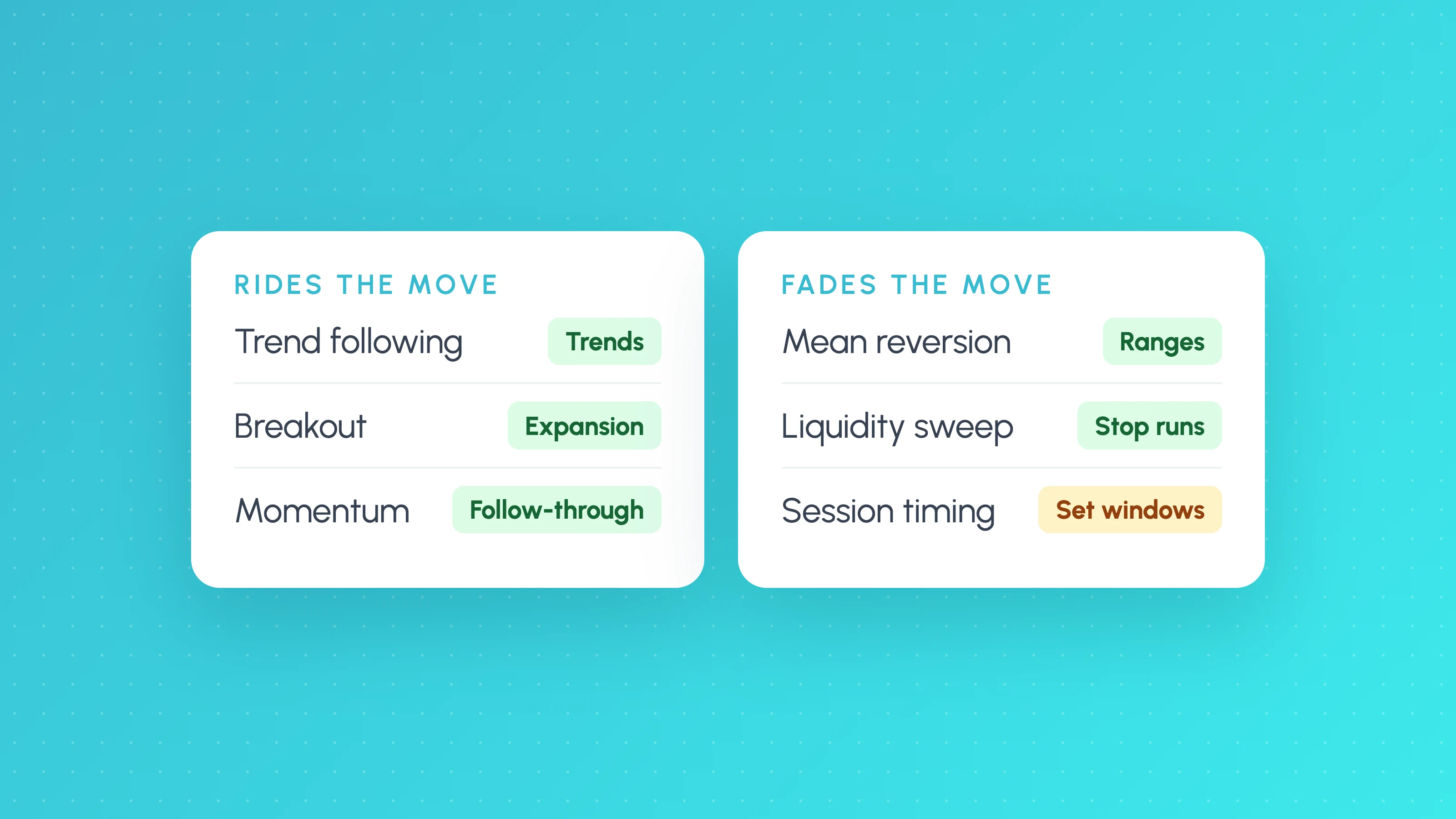
The main algorithmic trading strategies retail traders use: trend following, mean reversion, breakouts, momentum, session and liquidity sweep strategies, with example rules.
 TradingView backtests
Is My Backtest Overfit? A Practical Checklist for Traders
How to tell if a backtest is overfit: too-good metrics, thin samples, fragile inputs, useless filters, out-of-sample and walk-forward tests, plus a checklist.