

Algo Trading for Beginners: A Step-by-Step Roadmap (2026)
Algo trading for beginners: what it is, what you need, a step-by-step roadmap from first strategy to live bot, whether you need to code, and the mistakes to avoid.
By Hristo Skulev · Updated · 5 min read
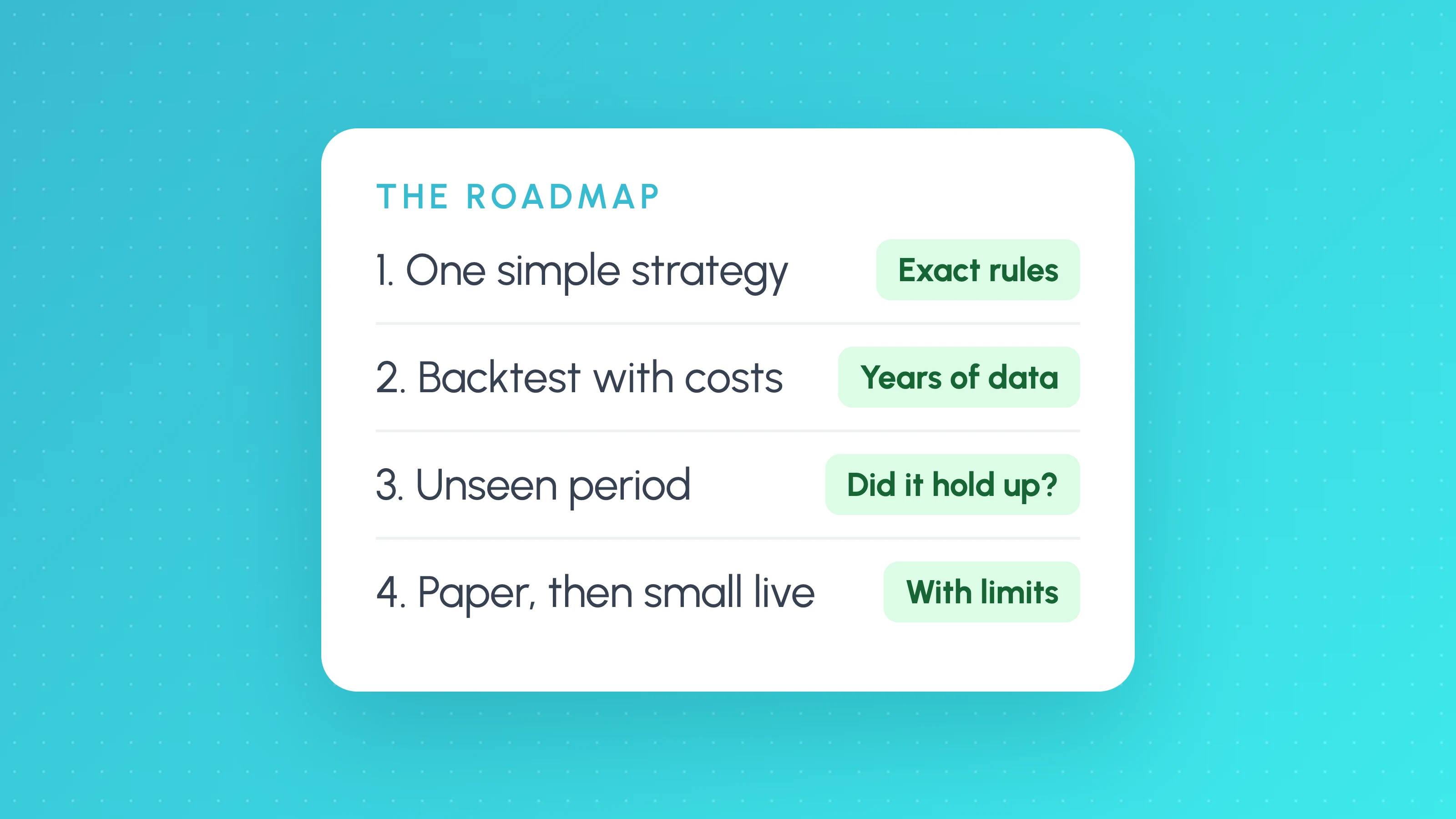
Algo trading means writing your trading strategy as exact rules (when to enter, where the stop goes, when to exit and how much to risk) so a computer can test it on past data and then follow it in a live market. For a beginner, the path is: pick one simple strategy, write its rules down precisely, backtest it with realistic costs, check it on data it wasn't tuned on, paper trade it, and only then run it with small size. You don't need to be a programmer any more: no-code builders and AI tools can turn plain-English rules into a backtest.
The hard part isn't the software. It's resisting the urge to keep tweaking a backtest until it looks good, which is the most common way beginners fool themselves.
Most retail traders lose money in short-term leveraged markets, and automation doesn't change that on its own. Backtests are not future results.
What you need to start
| You need | Why | Free or cheap options |
|---|---|---|
| A strategy idea | Something you can describe as rules | Start with one of the common strategy types |
| A backtester | Tests the rules on past data | No-code builders, TradingView with Pine Script, Python |
| Clean historical data | Results are only as good as the data | Usually included with the backtester |
| A demo or paper account | Tests the strategy on live prices without risk | Most brokers and bot runners offer one |
| A risk limit | Stops a bad day becoming a disaster | A maximum daily loss and position size |
Do you need to code?
No. You have three routes:
- No-code builders, where you assemble rules from setups, filters and exits, or describe the strategy in plain English. Fastest to start. See the best no-code backtesting software.
- Pine Script on TradingView, a simple language for chart-based strategies. AI assistants can write it, but check the result. See testing a strategy ChatGPT or Claude wrote.
- Python, the most flexible route, with the steepest learning curve and the most ways to make mistakes.
Coding is useful later, but it's not the first skill to learn. Learning to define rules precisely and to test honestly matters more.
The roadmap, step by step
1. Pick one simple strategy
Choose something you can explain in two sentences, on one liquid market and one timeframe: a moving-average trend strategy on daily candles, an opening range breakout on an index, or an RSI mean reversion strategy. Simple strategies are easier to test properly and harder to overfit.
2. Write the rules with no room for judgement
Market, timeframe, session, entry, stop, target, position size and costs. If a rule contains "usually" or "it depends", it isn't finished.
3. Backtest with realistic costs
Run it over several years, so it covers calm and volatile markets. Include commission, spread and slippage. See how much slippage to assume.
4. Check whether the result is real
- Enough trades: at least about 100. See how many trades a backtest needs.
- An unseen period the strategy wasn't tuned on. See out-of-sample testing.
- Monte Carlo, to see the drawdowns you could face. See Monte Carlo backtesting.
- The same rules on a few related markets.
5. Paper trade it
Run it on live prices without real money and compare the results with the backtest. See how long to paper trade.
6. Go live small, with limits
Start with the smallest size you can, a maximum daily loss and a maximum number of trades. Review every week: are live results inside the range the backtest suggested?
7. Review and improve one change at a time
Change one rule, re-test it on the unseen period, and keep the change only if it holds up there.
Beginner mistakes to avoid
- Optimising until the backtest looks perfect. The best-looking backtest is often the most overfit. See how to tell if a backtest is overfit.
- Ignoring costs. Many short-term strategies are profitable before costs and unprofitable after.
- Too few trades. Twenty great trades prove nothing.
- Buying a bot that promises returns. If it worked as advertised, it wouldn't be for sale cheaply.
- Going live too big. The first live weeks are a test of the setup, not a payday.
Where to start in practice
Strategy Lab is built for this roadmap. You describe a strategy to TES, the AI strategy coach, or build it from setups and filters, and Strategy Lab reads the rules back in plain English, backtests them with costs on 1-minute to daily candles, holds back the last 30% of the data as an unseen period and runs Monte Carlo. The Free plan includes 15 backtests a week on 5-minute candles and up, with no card. When a strategy holds up, Launchpad can run it on paper, then on a cTrader or Liquid Brokers account (paid plans).
Free tools for this: use the expectancy calculator to see what an average trade makes after costs and the Monte Carlo simulator to see the range of drawdowns your trade results could produce. They run in your browser, with no account needed.
Frequently asked questions
- How do I start algo trading as a beginner?
- Pick one simple strategy, write its rules precisely, backtest it with realistic costs over several years, check it on an unseen period, paper trade it, then go live with small size and strict limits.
- Can a beginner do algo trading without coding?
- Yes. No-code builders let you assemble or describe a strategy in plain English and backtest it. Coding helps later, but defining rules precisely and testing honestly matter more at the start.
- How much money do I need to start algo trading?
- You can learn and backtest for free and paper trade without money. For live trading, start with an amount you can afford to lose and the smallest position size your broker allows, so early mistakes are cheap.
- Is algo trading good for beginners?
- It can be, because it forces you to define rules and test them before risking money. It's not a shortcut to profit: most retail traders lose money, and automation only helps a strategy that already has an edge.
Keep reading
 Algo trading
How to Build an Algo Trading Strategy: From Idea to Rules to Running Bot
How to build an algo trading strategy: turn an idea into exact rules, backtest with costs, validate, paper trade, deploy with limits, then review and improve.
 Strategies
Algorithmic Trading Strategies: 6 Types Explained, With Rules You Can Test
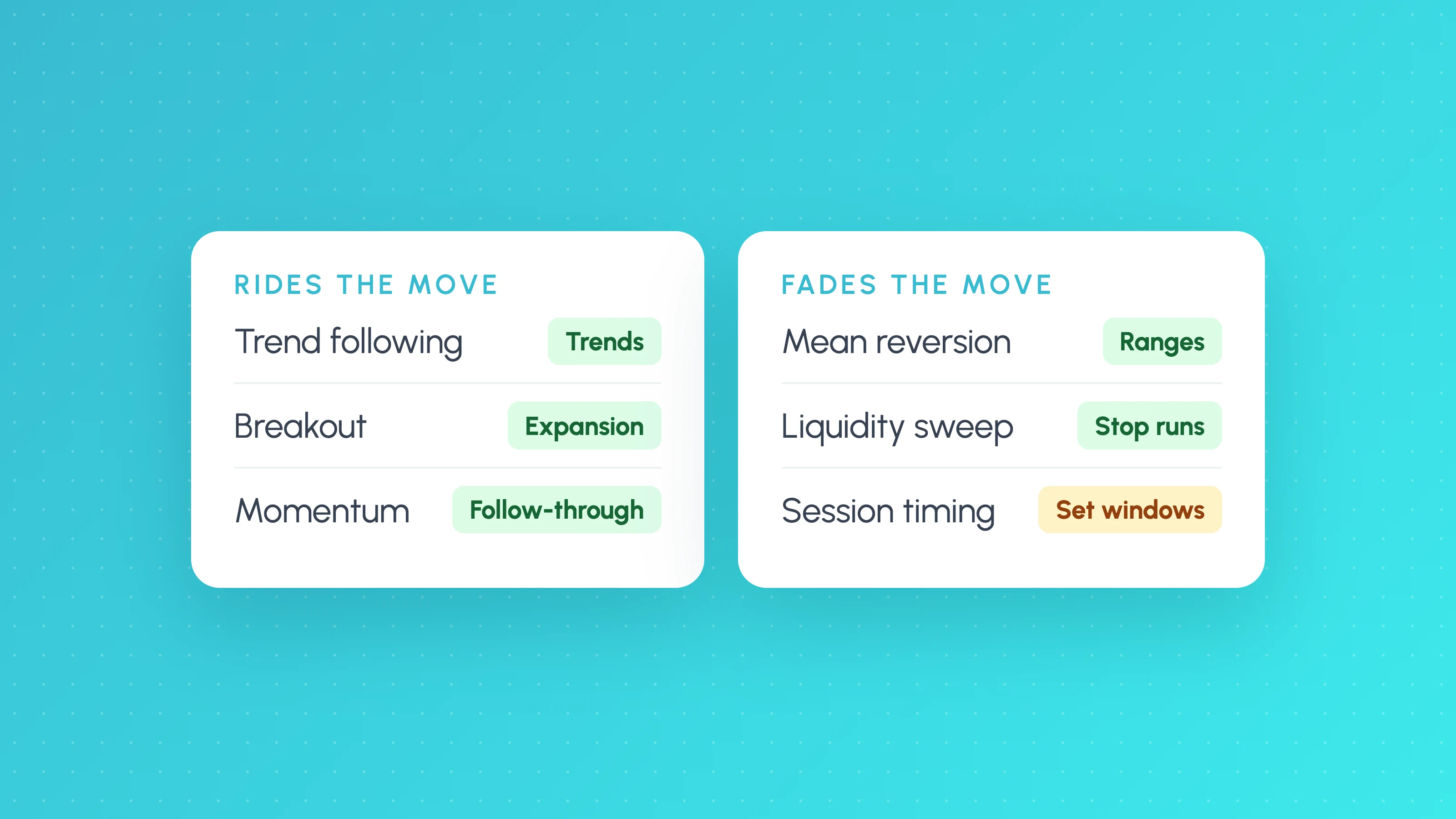
The main algorithmic trading strategies retail traders use: trend following, mean reversion, breakouts, momentum, session and liquidity sweep strategies, with example rules.
 Algo trading
Is Algo Trading Profitable? What the Evidence Actually Says (2026)
SEBI found 87.7% of individual F&O traders lost money in FY26. When algo trading is profitable, whether it's worth it, and how to test your own strategy first.