

VWAP Trading Strategy: Day Trading Rules, Bands and How to Test Them
VWAP trading strategies explained: the pullback, the reclaim and the band fade, with entry, stop and exit rules, why win rates vary, and how to test a VWAP strategy properly.
By Hristo Skulev · Updated · 7 min read
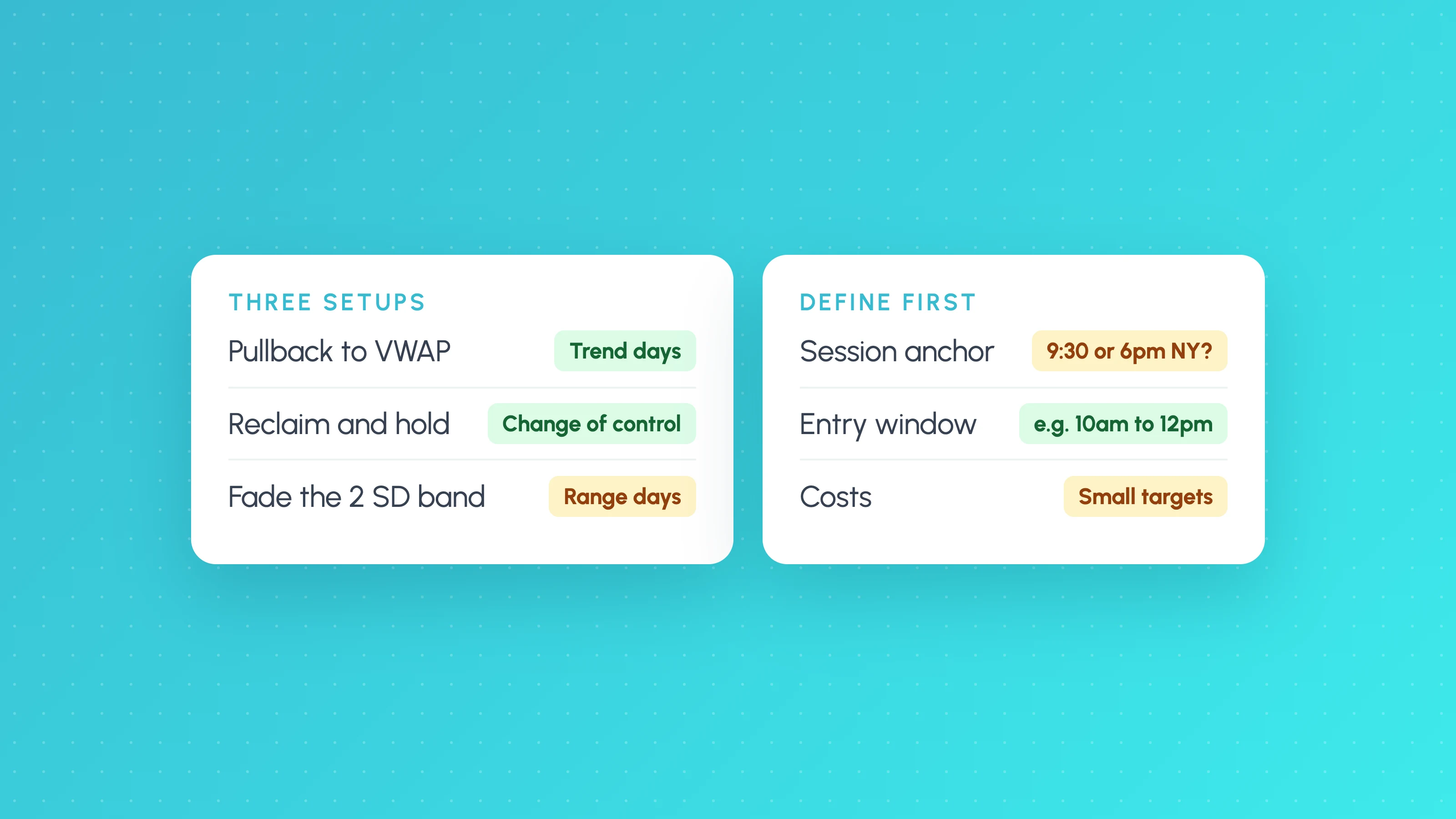
VWAP, the volume-weighted average price, is the average price of the session weighted by how much traded at each price. Day traders use it as the line that tells them who is in control. Above VWAP, buyers have paid more on average than the session's fair price; below it, sellers have. The three common VWAP strategies are the pullback (trade with the trend when price returns to VWAP), the reclaim (enter when price crosses back over VWAP and holds) and the band fade (trade a stretch to an outer band back towards VWAP).
None of them has a fixed win rate. The result depends on the market, the session, the filters and the costs, so the only useful number is the one from your own test.
This is an educational description, not a recommendation. Backtests are not future results, and leveraged trading carries a high risk of loss.
How VWAP is calculated
For each candle, take the typical price (high + low + close, divided by 3) and multiply it by that candle's volume. VWAP is the running total of those values divided by the running total of volume since the session started.
- It resets. Standard VWAP starts again every session. Anchored VWAP starts from a point you choose instead, such as a swing low, an earnings gap or the start of the week.
- It lags more as the day goes on. Early in the session a few candles move it a lot; by the afternoon it barely moves.
- Bands. Most platforms can draw bands at 1, 2 and 3 standard deviations around VWAP. Strategies that fade extremes use these bands.
- Forex has no central volume. On spot forex and CFDs, VWAP uses the broker's tick volume, so it can differ from one broker to the next. On futures and stocks it uses exchange volume.
Three VWAP strategies
| Pullback | Reclaim | Band fade | |
|---|---|---|---|
| Idea | Trend days respect VWAP | A cross back over VWAP shows a change of control | Stretches far from VWAP tend to snap back |
| Long setup | Price above VWAP and rising, pulls back to touch it | Price below VWAP, then closes above it and holds | Price closes below the lower 2 SD band |
| Entry | A rejection candle at VWAP | A retest of VWAP from above | A close back inside the band |
| Stop | Below the pullback low, or a set distance below VWAP | Below the retest low | Beyond the 3 SD band or a fixed ATR |
| Target | The session high, or 2R | The upper 1 SD band, or 2R | VWAP itself |
| Works best | Trending days | After an early sell-off or rally fades | Range days |
| Fails on | Range days that cross VWAP all session | Choppy days with repeated crosses | Strong trend days that keep stretching |
The pullback and the band fade want opposite kinds of day. Testing both on the same market shows quickly which one that market usually gives you. This is the same split as trend following against mean reversion.
Choices that change the results most
- Session start. For US stocks and index futures, VWAP is normally anchored to the 9:30 New York cash open. Futures trade nearly all day, though, and some platforms anchor to the 6pm New York futures session instead. Two traders following "VWAP" on the NQ can be looking at different lines. Write down which one you use.
- Time of day. The first 30 minutes and the last hour behave differently from the middle of the session. Many VWAP traders only take entries in a set window, such as 10am to 12pm New York.
- Trend filter. For pullbacks, require VWAP itself to be sloping, or price above a higher-timeframe average. Without a filter, the pullback rule trades every range day as well.
- Touch or close. Waiting for a candle close beyond VWAP cuts out wick-only signals and takes later entries.
- Costs. VWAP trades are intraday, often with small targets, so spread and slippage take a larger share. See how much slippage to assume.
Why VWAP win rates vary so much
Searches for "VWAP strategy win rate" turn up figures from 40% to 80%. They aren't comparable:
- A band fade with the target at VWAP and a wide stop can win often and still lose money, because the losses are bigger than the wins. See win rate vs risk-reward.
- A pullback strategy with a 2R target might win less than half the time and still be profitable.
- Most published figures leave out costs, use a few weeks of data, or come from one market in one trend.
Judge a VWAP strategy on expectancy, profit factor and drawdown over hundreds of trades, not on win rate.
How to test a VWAP-style strategy in Strategy Lab
Strategy Lab doesn't plot a VWAP line yet, but each VWAP setup has a close equivalent built from its setups, filters and sessions. You can test the same idea, without code, on years of intraday data:
| VWAP setup | Build it in Strategy Lab as |
|---|---|
| Pullback to VWAP | An EMA pullback in the direction of a higher-timeframe trend filter, inside a session window such as 10am to 12pm New York |
| Reclaim and hold | A swing break back above a level, such as the prior day's high or low or the opening range, with a retest entry |
| Band fade | Mean reversion: a close outside the lower Bollinger band with RSI oversold, targeting the middle band |
Then test it the same way you'd test any intraday strategy:
- Describe it to TES, the AI strategy coach, with times and timezones, for example: "Nasdaq 100 5-minute, long only above the 1-hour 50 EMA, buy a pullback to the 20 EMA between 10am and 12pm New York, stop below the pullback low, 2R target, flat by 3:30pm". Strategy Lab reads the rules back in plain English before it runs, so check the session and filters are what you meant. If you ask for VWAP itself, TES will say it isn't in the library yet and offer the closest option.
- Backtest on intraday candles over several years, with commission and slippage. The Free plan supports 5-minute candles and up; 1-minute entries need a paid plan. Make sure there are enough trades; see how many trades a backtest needs.
- Check the unseen period. Strategy Lab holds back data the strategy wasn't built on and shows whether the result held up. See out-of-sample testing.
- Stress it with Monte Carlo, price noise and higher costs to see the range of drawdowns the same edge could produce.
- Run it on other markets. An intraday edge that only works on one index deserves suspicion.
- Break the results down by time of day. VWAP-style edges often sit in one window, such as the first two hours. If yours does, narrow the session filter and retest.
VWAP strategies and prop firm challenges
VWAP strategies are mostly intraday, which suits firms that close or limit overnight positions. Before you run one on a challenge:
- Check the worst day against the daily loss limit. A band fade on a trend day can stack several losses in one session.
- Check the profit spread against any consistency rule with the prop firm consistency calculator.
- Check the firm's news rules, because US data releases at 8:30am and 10am New York time fall right in the VWAP trading window. See prop firm news trading rules.
Free tools for this: use the profit factor calculator to work out profit factor from your own trades and the Monte Carlo simulator to see the range of drawdowns your trade results could produce. They run in your browser, with no account needed.
Frequently asked questions
- What is the VWAP trading strategy?
- A set of intraday strategies that use the volume-weighted average price as a reference line. The most common are buying pullbacks to VWAP in an uptrend, entering when price reclaims VWAP, and fading stretches to the outer VWAP bands back towards VWAP.
- Is VWAP good for day trading?
- It's widely used, because it resets each session and reflects where most of the day's volume traded. Whether a VWAP strategy works for you depends on the market, the time window and the filters, which only a test with costs can show.
- What is the win rate of a VWAP strategy?
- There isn't one. Published figures range widely because they use different rules, targets, markets and costs. A strategy with a high win rate can still lose money if its losses are larger than its wins, so judge it on expectancy and drawdown.
- Does VWAP work in forex?
- It can be used, but spot forex has no central volume, so VWAP is built from the broker's tick volume and can differ between brokers. On futures and stocks it uses exchange volume.
- What is the difference between VWAP and anchored VWAP?
- Standard VWAP resets at each session start. Anchored VWAP starts from a point you choose, such as a swing high or low, a gap or the start of the week, and keeps running from there.
- Can I backtest a VWAP strategy without code?
- Yes, in its closest form. Strategy Lab doesn't plot VWAP yet, but you can build the same setups without code: an EMA pullback inside a session window for the VWAP pullback, a level reclaim for the VWAP reclaim, and a Bollinger-band fade for the band fade. Then backtest them on years of intraday data with an unseen period and Monte Carlo.
Keep reading
 Strategies
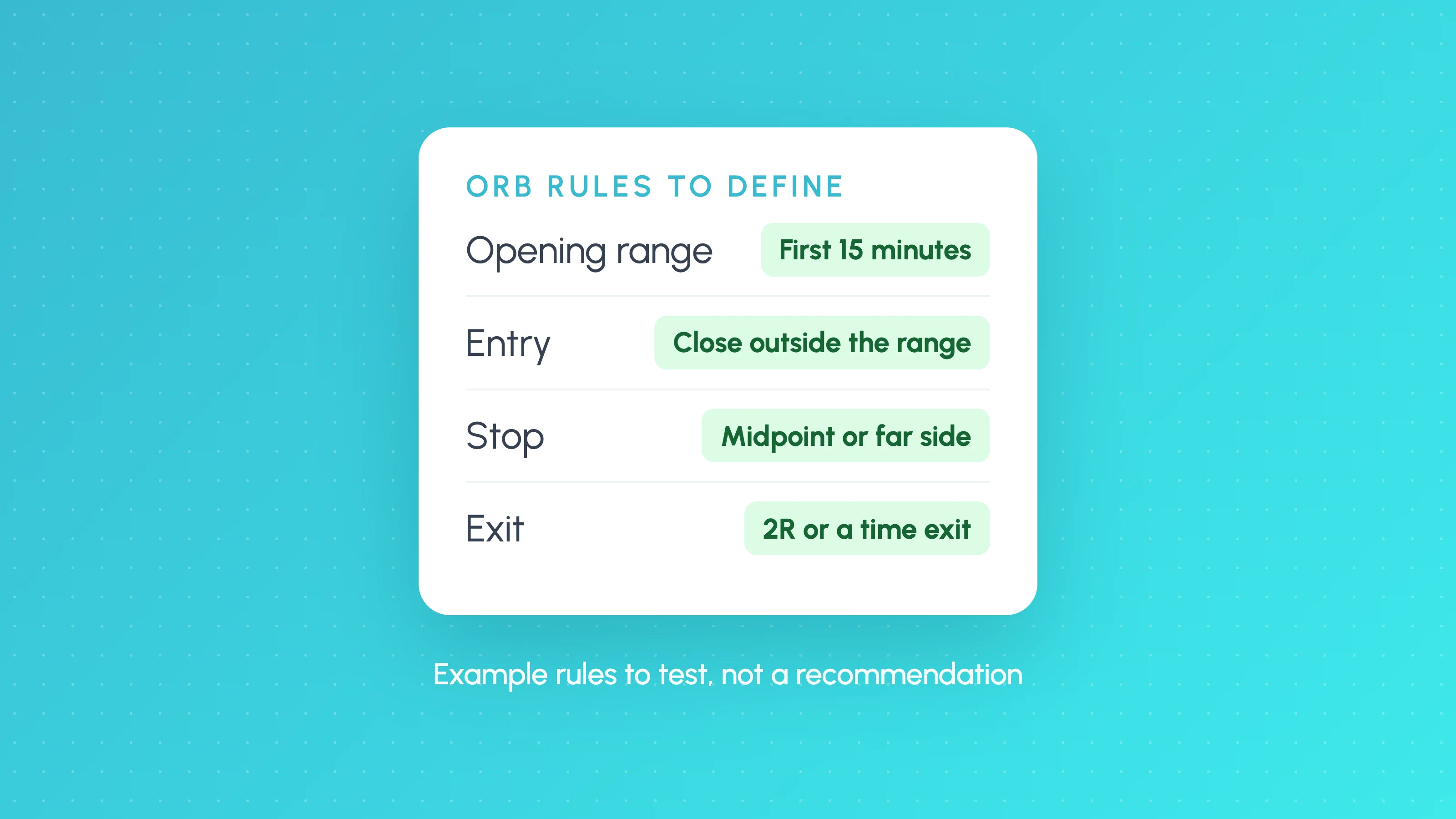
Opening Range Breakout Strategy: Rules, Variations and How to Test It
The opening range breakout (ORB) strategy explained: the 5, 15 and 30-minute range, entry, stop and target rules, the filters that cut false breakouts, and how to test it.
 Strategies
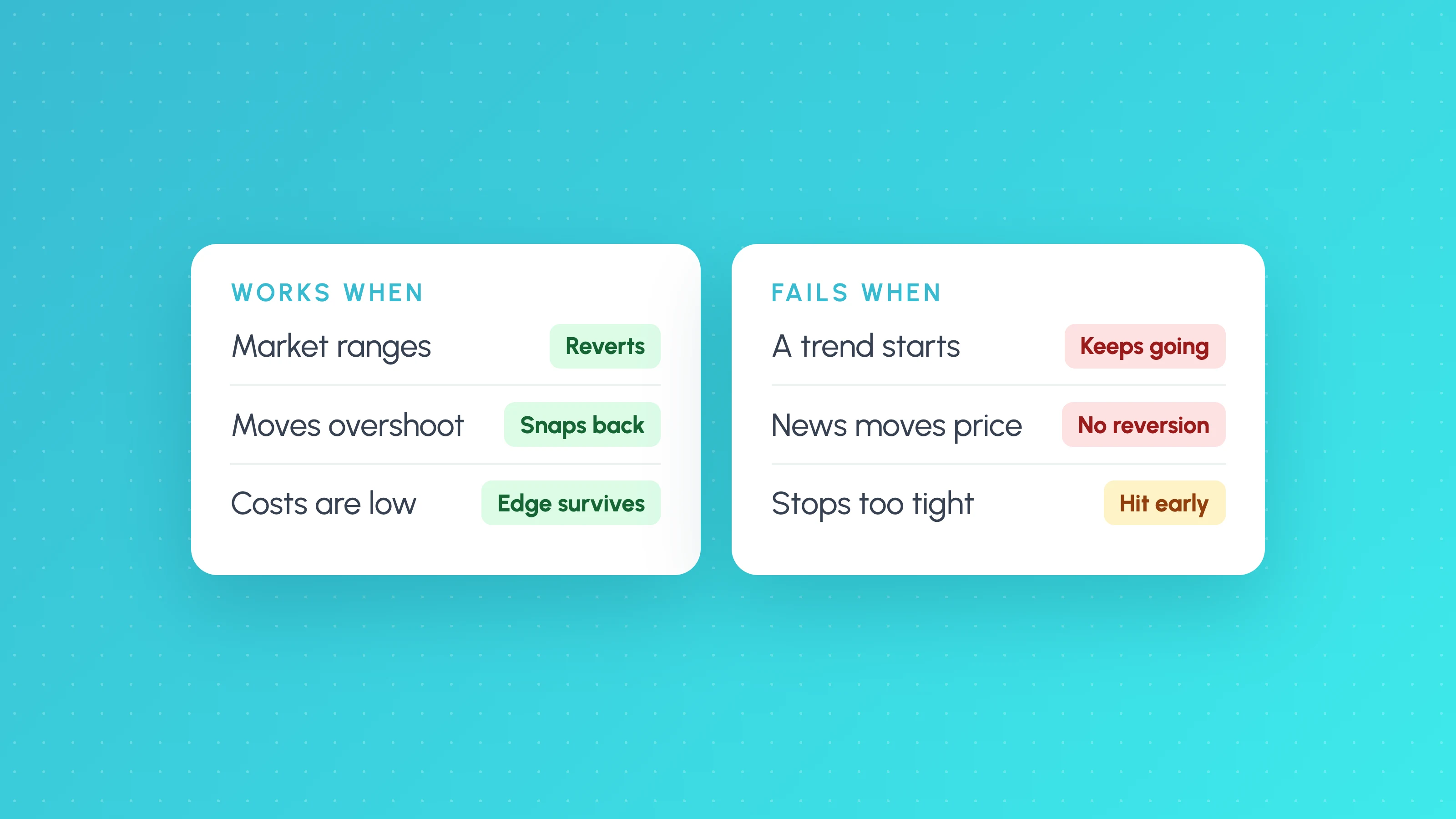
Mean Reversion Trading Strategy: How It Works, Example Rules and Risks
Mean reversion trading explained: the RSI, Bollinger Band and moving-average versions, example rules you can test, why trends break them, and how to test one properly.
 Strategies
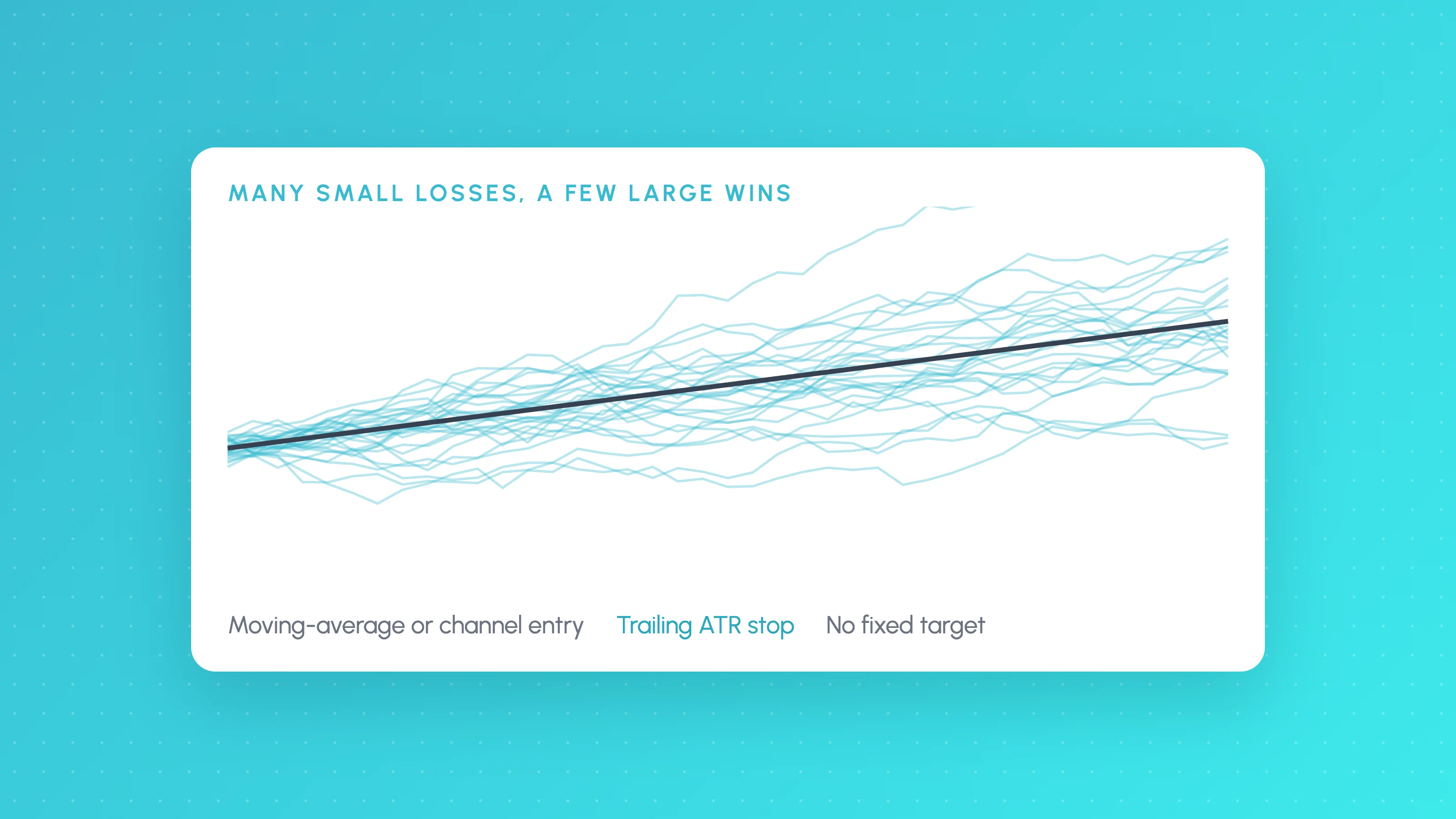
Trend Following Strategy: Rules, Examples and Why It's Hard to Stick With
Trend following trading explained: moving-average and channel breakout rules, ATR stops and trailing exits, why win rates are low, and how to test a trend strategy properly.