

Do AI Trading Bots Actually Work? What the Live Results Show (2026)
Do AI trading bots work? In public live tests most lost money, and regulators warn about AI bot scams. See the evidence and how to judge any bot's record.
By Tessera Trades · Updated · 12 min read
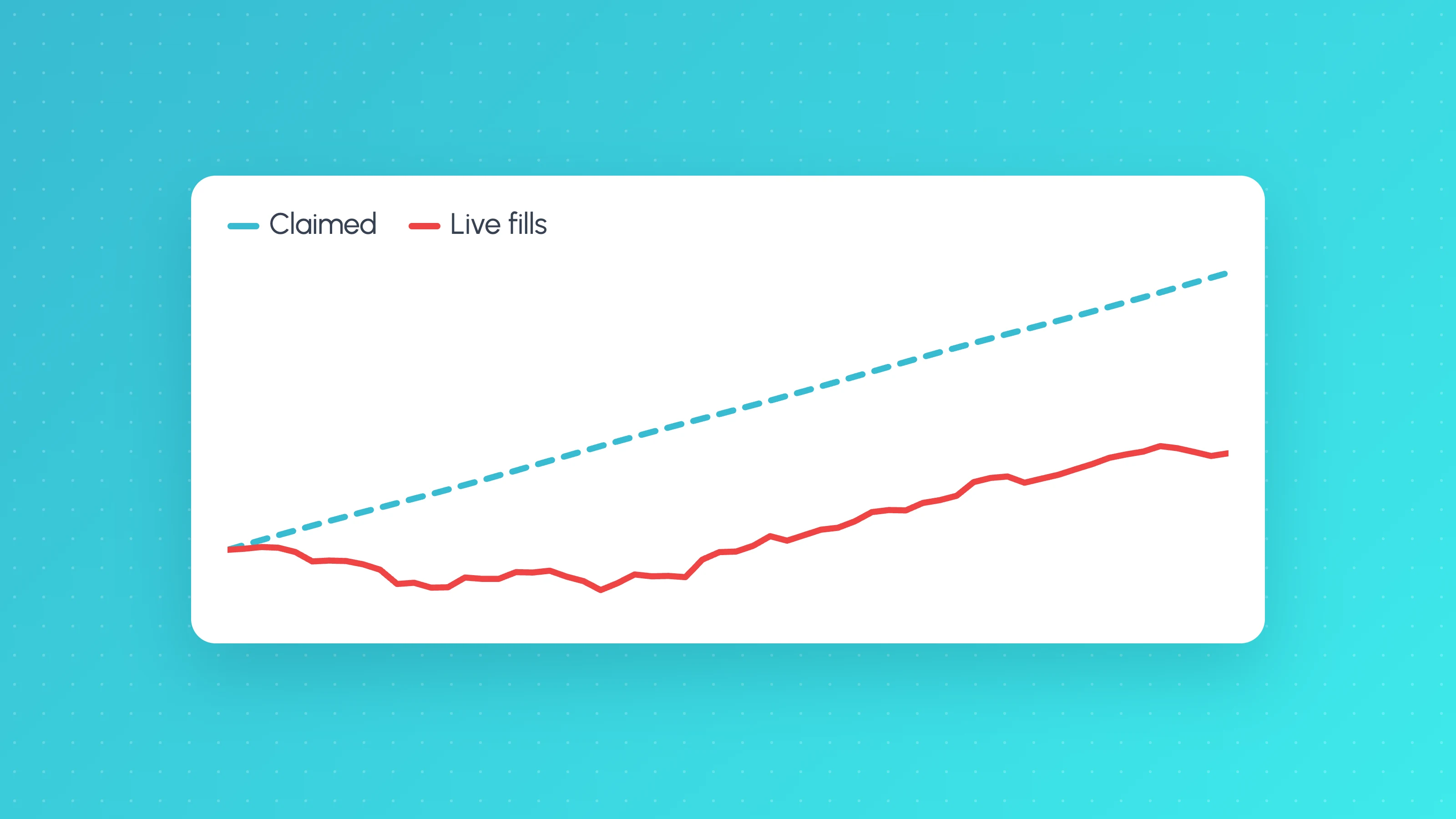
AI trading bots can place trades automatically, but the public evidence so far does not show that they make money reliably: in the best-documented live experiments, most large language models (LLMs) trading real money finished with losses, and research tests find that their apparent edge tends to fade over longer periods. A bot "works" only if its own live, after-cost record over a meaningful number of trades says so, and almost no bot sold to retail traders publishes one.
That does not make automation useless: a bot is only as good as the rules it follows and how they are executed. This guide sets out what live experiments, studies and regulators have found as of October 2026, why most bots fail, and how to judge any bot's record, including your own.
Risk note: trading with or without a bot can lose money, including all of the capital you put in. Nothing here suggests any bot or strategy will be profitable.
The short answer
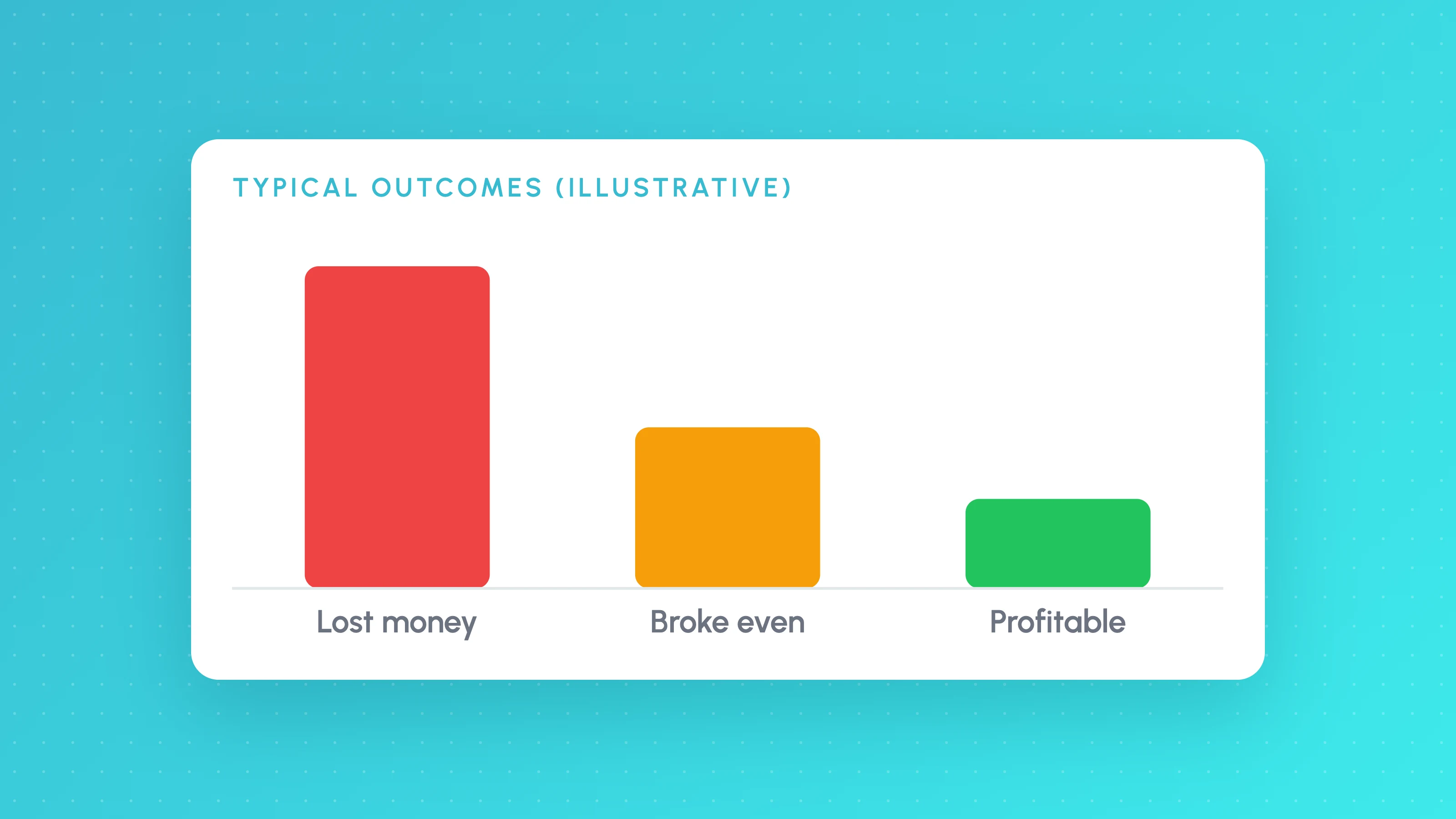
- LLMs trading live with real money have mostly lost. In the three public real-money experiments we could verify, most models finished below their starting balance. Details are below.
- Academic backtests are mixed to negative. Benchmarks that test LLM agents over longer periods and wider sets of stocks find that most fail to beat simple buy-and-hold, and that earlier reported advantages shrink.
- Many "AI trading bots" sold online are not trading at all. US regulators have brought several fraud cases in which the AI bot either did not exist or did not work as claimed.
- A specific bot can still work. Only its own live fills, after costs, over enough trades can show it.
The live evidence so far
These are the public, real-money tests of AI models trading that we could verify. Models change quickly, so a result from one season says little about the next.
| Experiment | When | Setup | Result |
|---|---|---|---|
| Alpha Arena Season 1 (Nof1) | October to early November 2025 | 6 LLMs, $10,000 each, crypto perpetuals on Hyperliquid | 2 finished up, 4 finished down between about 42% and 59% |
| Alpha Arena Season 1.5 (Nof1) | Late November to early December 2025 | US stocks, four competition modes | One model reported in profit in all four modes and overall; it was the only model in overall profit as of 8 December 2025 |
| Prediction Arena (arXiv paper) | 12 January to 9 March 2026 | 6 models, $10,000 each, Kalshi and Polymarket | All 6 lost on Kalshi (-16.0% to -30.8%); none gained on Polymarket |
Alpha Arena Season 1: crypto perpetuals
Nof1, an AI research lab, gave six models $10,000 each to trade Bitcoin, Ethereum, Solana, XRP, Dogecoin and BNB perpetual contracts on Hyperliquid with no human intervention, using 10x to 20x leverage and publishing every trade (Blockhead, 21 October 2025). The final balances, shared by Nof1's founder and reported by ForkLog on 4 November 2025, were:
| Model | Final balance from $10,000 | Return |
|---|---|---|
| Qwen3 Max | $12,231 | +22.3% |
| DeepSeek | $10,489 | +4.9% |
| Claude Sonnet 4.5 | $5,799 | -42.0% |
| Gemini 2.5 Pro | $5,445 | -45.6% |
| Grok 4 | $4,208 | -57.9% |
| GPT-5 | $4,126 | -58.7% |
Returns are calculated from the reported balances. The season lasted about two and a half weeks, far too short to separate skill from luck, and high leverage magnified both. It shows these models, prompted this way, in that period, mostly lost; it does not rank them as traders in general.
Alpha Arena Season 1.5: US stocks
In the follow-up season on US stocks, ForkLog reported on 8 December 2025 that an anonymous "Mystery Model", later named as Grok 4.20, won with an average return of about 12% over roughly two weeks, and that it made money in all four competition modes and was the only model in overall profit as of 8 December 2025, which included a capital-protection mode and a maximum-leverage mode. Again, two weeks is a tiny sample, and the line-up and winner were different from Season 1.
Prediction Arena: prediction markets
A March 2026 paper, Prediction Arena (arXiv 2604.07355), ran six frontier models with real capital on Kalshi and Polymarket for 57 days. On Kalshi every model lost money, with returns between -16.0% and -30.8%. On Polymarket, over a shorter window, results ranged from -2.68% to 0.00%, with the 0.00% belonging to a model that made no trades. The authors found no clear correlation between how much research a model did and its results, and that platform design strongly affected which models did better.
What the academic studies say
Live experiments are short. Backtest studies cover longer periods but carry the usual backtest risks. The more careful ones point the same way.
- FINSABER. Li, Kim, Cucuringu and Ma tested LLM-based timing strategies over two decades and more than 100 symbols, and found that "previously reported LLM advantages deteriorate significantly" under a broader and longer evaluation. Their strategies were too cautious in bull markets, trailing passive benchmarks, and too aggressive in bear markets, taking heavy losses (arXiv 2505.07078, accepted for KDD 2026 according to the listing).
- StockBench. A benchmark of LLM agents making daily buy, sell or hold decisions over several months found that "most models struggle to outperform the simple buy-and-hold baseline", though some showed potential for better returns and risk control (arXiv 2510.02209).
Results that look good on a narrow test (a few stocks, a short window, a rising market) tend not to survive a wider one, the same overfitting problem that affects any strategy. Our guide on whether algo trading is profitable covers the broader evidence.
What regulators warn about
A large share of what is marketed as an "AI trading bot" is not a trading tool at all. Regulators in the US have been specific about this.
- CFTC. In a customer advisory announced on 25 January 2024, the CFTC warned that scammers use AI hype to sell trading bots and signal services promising unrealistic returns. The advisory itself says plainly that AI cannot predict the future, lists red flags such as claimed returns of tens of thousands of percent or 100% win rates, and describes the Mirror Trading International case, in which a supposed forex bot was a Ponzi scheme that took nearly 30,000 bitcoin from at least 23,000 people.
- SEC, NASAA and FINRA. A joint investor alert from 25 January 2024 warns about unregistered platforms promoting "AI trading systems" and says to be sceptical even of registered firms that claim AI can guarantee strong returns.
- SEC cases in 2026. In May 2026 the SEC charged a Texas man who allegedly raised about $12.3 million from roughly 150 investors by claiming AI-based crypto arbitrage bots that did not work as represented (Litigation Release 26558). On 29 September 2026 it charged two further groups, alleging in one case that there were no AI trading bots at all and in the other that AI-generated "signals" led investors to a fake platform (press release 2026-95). These are allegations, not findings.
The red flags repeat across these warnings: guaranteed or very high returns, "no experience needed", rewards for recruiting others, account balances that may be faked (the CFTC notes scammers have used demo accounts to show invented gains), and unclear fees. Wherever you are, check a firm is authorised with your national regulator before sending money.
Why most trading bots fail
Setting fraud aside, honest bots lose money for a fairly short list of reasons. Most apply to any automated strategy, not only AI ones.
- The rules have no edge. An LLM can write code and explain a chart, but nothing in the live tests above suggests it can find a durable edge on demand. A bot running rules without an edge loses slowly to costs.
- Costs were left out. Small-edge strategies that trade often are decided by commission, spread and slippage. For a sense of how hard leveraged retail trading is even before bots, ESMA reported in March 2018 that 74-89% of retail CFD accounts typically lost money. Trading expectancy shows how costs cut into profit per trade.
- The backtest was overfit. Tuning until the equity curve looks good describes the past, not the market. Is my backtest overfit? has the checks.
- The backtest assumed fills that didn't happen. Intrabar guesses, limit orders filled on a touch, and orders filled on the same close that created the signal all flatter results. Backtest vs live goes through each one.
- The bot's log is not the account. A bot records what it thinks it did. If an order was rejected, partly filled or filled at a different price, the log and the broker disagree.
- Leverage and position sizing. At 10x to 20x leverage, a run of ordinary losses becomes a large drawdown. Several Season 1 models lost over 40% in a few weeks.
- The market changed, or the sample is small. A few weeks of good results can be luck, and a strategy built for one volatility regime can stop working in another.
The logged-versus-real gap: one documented case
The fifth point is easy to underestimate. In a GitHub issue opened on 30 March 2026, a user reported that a Polymarket bot managed with Claude Code showed +$665 in its own CSV log while the on-chain result was about -$266, because roughly 55% of logged trades were orders that never filled. It is one person's unverified report, not a study, but the failure mode is common: strategy changes were made on the bot's log rather than on reconciled fills. If you run a bot, the broker or exchange record is the only result that counts. Our guide to Claude Code trading bots covers how to check one.
How to judge any bot's record
Whether the record comes from a vendor, a forum post or your own bot, ask the same questions.
| Question | What a credible answer looks like | Red flag |
|---|---|---|
| Is it live or a backtest? | Live fills from a named broker or exchange account | Backtest, demo or "simulated" results presented as performance |
| How many trades? | Enough to judge: as a rough guide, 100+ overall and 30+ in any slice you act on | 20 trades, or "92% win rate" with no count |
| Over what period? | Several months, ideally across different market conditions | A few weeks in one trending market |
| After costs? | Net of commission, spread, funding and slippage | Gross returns, or costs not mentioned |
| What was the worst drawdown? | Stated, with the leverage used | Only the equity curve's high points |
| Is the record complete? | Every trade, including the losers and closed accounts | Selected screenshots, or results from the best of several accounts |
| Can you verify it? | Exported statement or read-only broker access | Only the seller's own dashboard |
Win rate on its own says very little. A bot can win most of its trades and still lose money if the losers are larger, which is why trading expectancy (average profit per trade after costs) and profit factor are better summaries. And sample size decides how much any of these numbers can be trusted.
How to measure your own AI bot
If you already run a bot, whether an LLM writes the rules or makes the decisions, judge it on its fills, not its log.
- Export or sync the real fills from the broker or exchange, not the bot's own record.
- Reconcile them against the bot's log. Count orders the bot logged that never filled, and fills the bot didn't log.
- Calculate results after all costs, including funding on perpetuals and spreads on prediction markets.
- Break the results down by condition: session, weekday, time of day, volatility and symbol. A bot that loses in one condition and makes money in others needs a filter, not a rewrite.
- Compare with the backtest over the same period, trade by trade, to see whether the gap is costs, missed fills or a strategy problem.
- Change one thing at a time, and test it on trades it wasn't designed from before running it live.
Tessera covers steps 1, 4 and 5. It imports trade history from TradingView Strategy Tester exports, MetaTrader 4 and 5, NinjaTrader, Tradovate, Hyperliquid or a CSV, and syncs live from Liquid Brokers, Interactive Brokers, OANDA, cTrader and Binance, then breaks results down by session, weekday, time, volatility and symbol. Tessera does not give signals or run bots bought or built elsewhere; it analyses trades a strategy has already taken, and its simulator replays stop, target and filter changes on real candles. See supported brokers and platforms for the full list. Tessera's own bot, Launchpad (paid plans), only runs strategies built in its Strategy Lab, on paper or on cTrader and Liquid Brokers accounts. The strategy, the settings and the risk are yours, and a backtest is not a guide to future results.
If you want AI to help build a rules-based strategy rather than make live decisions, there is a no-code alternative. In Strategy Lab, TES, the AI strategy coach, builds and tests a strategy from a plain-English description, proposing each change for you to confirm, and Launchpad then runs the same rules. How to create a trading bot without coding shows how the pieces fit.
The verdict
AI trading bots work in the sense that they can place trades for you. On whether they make money, the public evidence as of October 2026 is weak: short live experiments where most models lost, longer studies where reported advantages faded, and a steady stream of fraud cases using "AI bot" as the pitch. Treat an AI bot as an automated strategy with no presumed edge, and judge it only on its own reconciled, after-cost, live results.
If you have a strategy or bot already running, upload its trades to the free Entry Analysis report to see which conditions its results come from. No card needed.
Frequently asked questions
- Do AI trading bots actually make money?
- Some individual bots may, but the public evidence does not show that AI trading bots make money reliably. In Alpha Arena Season 1, four of six LLMs lost between about 42% and 59% of their capital, and in the Prediction Arena study all six models lost money on Kalshi. Any claim that a specific bot is profitable should come with verifiable live fills after costs.
- Why do most trading bots fail?
- Most fail because the rules have no real edge, costs and slippage were left out of the backtest, the strategy was overfit to past data, or the backtest assumed fills that didn't happen live. Leverage turns those problems into large losses quickly. Bots also fail when their own logs disagree with what actually filled at the broker.
- Can ChatGPT or Claude trade for me?
- They can write strategy code, and with the right tools an LLM can be connected to an exchange to place orders. The live experiments so far show that doing so does not produce reliable profits, and the model has no way to see the future. If you use one, keep position sizes small and judge it on real fills.
- How can I tell if an AI trading bot is a scam?
- Be wary of guaranteed or very high returns, 100% win rates, "no experience needed", rewards for recruiting others, account balances that may be faked, and firms that are not registered with a financial regulator. The CFTC, SEC and FINRA have all published warnings with these red flags. Ask for a verifiable live statement, not screenshots.
- How long should I test an AI bot before trusting it?
- Long enough to get a meaningful number of trades, not a fixed number of weeks: as a rough guide, at least 100 live trades after costs, ideally across different market conditions. A bot that trades a few times a week needs months. Even then, past results do not guarantee future ones.
Keep reading
 Algo trading
Is Algo Trading Profitable? What the Evidence Actually Says (2026)
Is algo trading profitable? It can be, but most retail traders lose money. What regulator and academic data show, why algos fail and how to test yours.
 AI and Pine Script
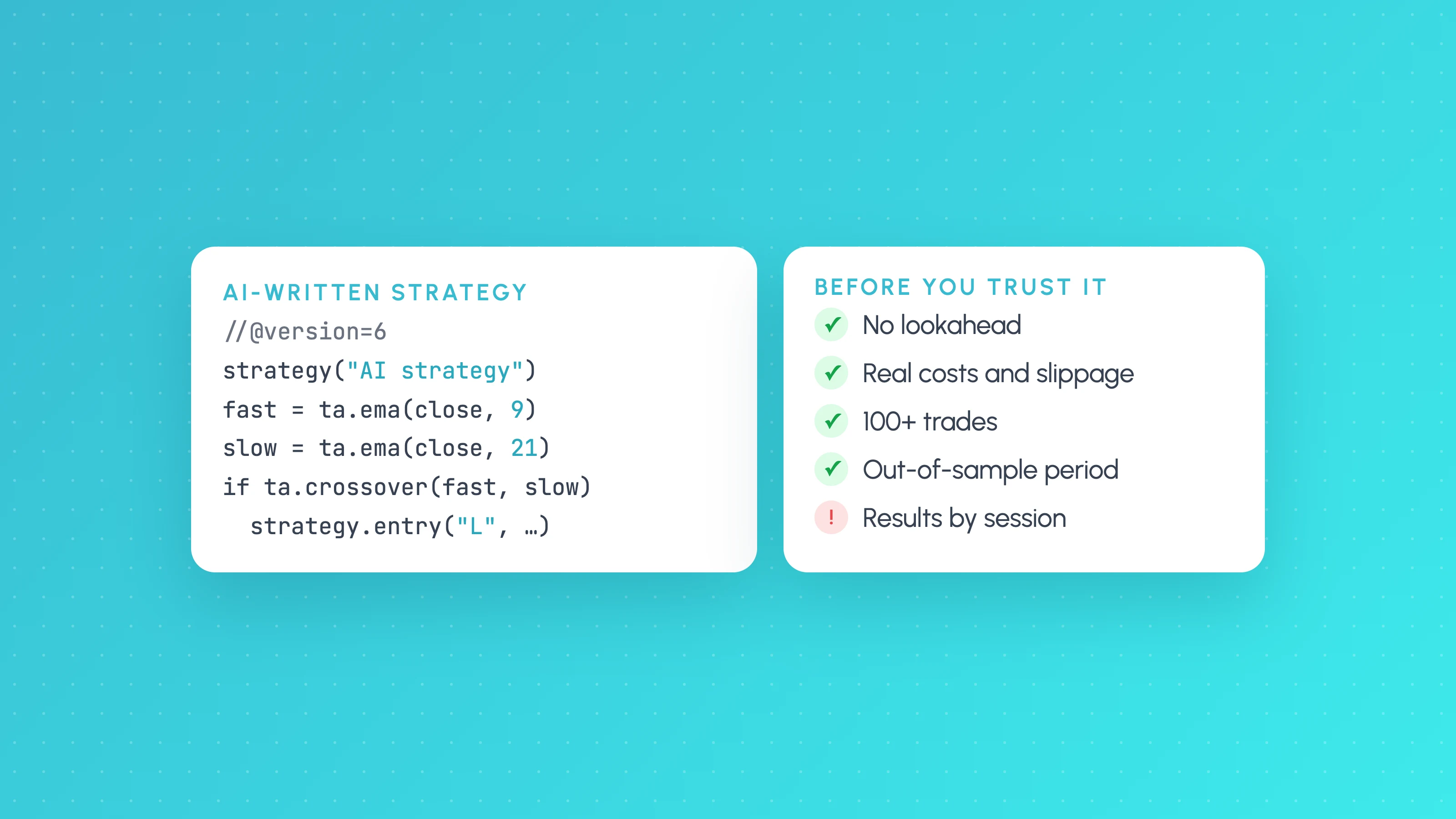
How to Test a Trading Strategy ChatGPT or Claude Wrote
A step-by-step way to check an AI-written Pine Script strategy: catch lookahead and repainting, set realistic costs, test out of sample and by market condition.
 AI and Pine Script
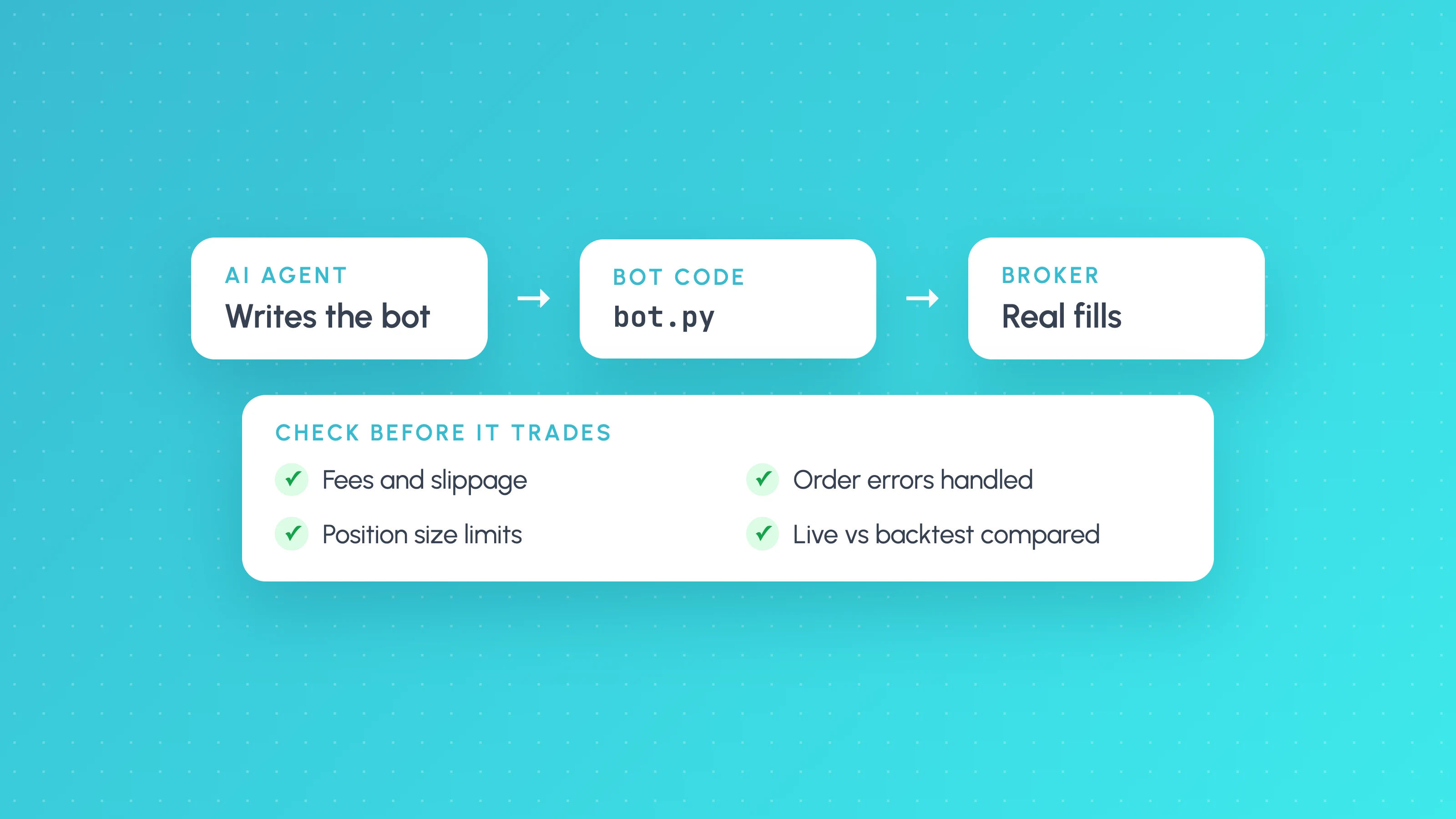
Claude Code and OpenClaw Trading Bots: What the Tutorials Leave Out (and How to Check Yours)
Claude Code can often build a trading bot in an afternoon, but it can't tell you if it has an edge. What tutorials skip, and how to check yours.