

Prop Firm Trading Bots (2026): Which Firms Allow Them and How to Build One That Survives the Rules
Can you use a trading bot on a prop firm? Which firms allow bots in 2026, the rules that fail them, and how to build and test one against challenge limits first.
By Hristo Skulev · Updated · 7 min read
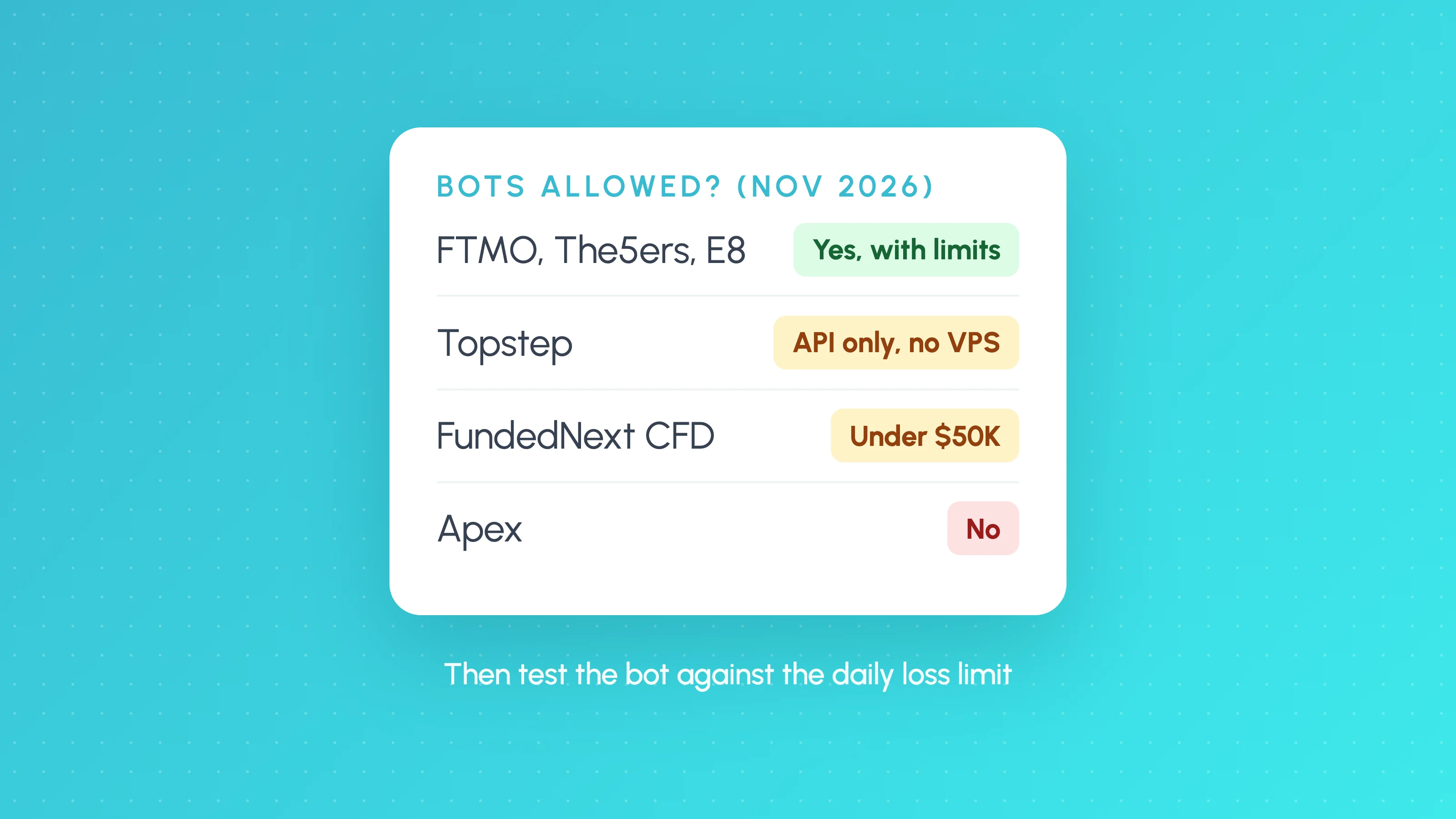
You can run a trading bot on many prop firm accounts in 2026. On the forex and CFD side, FTMO, The5ers and E8 Markets allow EAs (Expert Advisors, trading bots for MetaTrader). On the futures side, Topstep (through its API), Lucid, Tradeify and FundedNext Futures allow them. Apex bans automation outright. Every firm that allows bots still applies the same daily loss, drawdown and consistency limits as manual traders, and most add bot-specific bans on HFT, copied strategies and exploiting the simulator. A bot that is allowed can still fail a challenge in one bad day.
This guide covers which firms allow bots, the rules that fail them most often, and a build-and-test process that checks a bot against the rules before you pay for a challenge.
Rules below come from each firm's own help pages, as summarised in our dated rules tracker and forex EA guide, checked in October and November 2026. Firms change rules often, so confirm on the firm's site before you buy. Nothing here recommends a firm, and leveraged trading carries a high risk of loss.
Which prop firms allow trading bots?
| Firm | Bots allowed? | The catch |
|---|---|---|
| FTMO | Yes, on all phases | No more than 2,000 server requests a day; a bought EA that many traders run can breach FTMO's capital allocation limit |
| The5ers (forex) | Yes, if you own the source code | No HFT, tick scalping, latency arbitrage or copying other traders; stops must be visible |
| E8 Markets | Yes | No more than 50% of trades held under a minute; no straddling news |
| FundedNext (CFD) | Only on accounts under $50,000, on MT4 or MT5, with a paid add-on | No EAs on cTrader or Match-Trader; named "challenge passing" EAs banned |
| Topstep | Yes, through the TopstepX API | No VPS for order routing; no API on Live Funded accounts; no HFT |
| Lucid Trading | Yes | You carry the risk of software errors |
| Tradeify | Yes, with conditions | Your own strategy only; more than 50% of trades and profit held over 10 seconds before a payout |
| FundedNext Futures | Yes | No latency abuse or order flooding |
| Apex Trader Funding | No | "No Automation or Algorithm Usage allowed" |
| Alpha Futures | Semi-automated only | You must place and manage each trade yourself |
Full sources, dates and more firms are in the rules tracker. Firm-by-firm detail: FTMO, Topstep, The5ers and Apex.
The rules that fail prop firm bots
Being allowed is the easy part. These are the rules that end bot-run challenges, roughly in order of how often they bite:
- Daily loss limit. Often 2% to 5% of the starting balance (FTMO's 1-Step uses 3%, its 2-Step 5%), and some firms count open losses. A bot that risks 1% a trade and hits four stops in a row on a volatile day can breach it before you notice.
- Maximum or trailing drawdown. A trailing drawdown that follows intraday equity punishes bots that give back open profit. The same trades can pass an end-of-day trailing rule and fail an intraday one.
- Consistency rules. Many firms cap the best day's share of total profit, often at 40% or 50%. Trend-following bots that make most of a month on one day fail this even when they hit the target. See prop firm consistency rules.
- Holding time and order counts. Minimum holding times (Tradeify, E8, Blue Guardian) and server request caps (FTMO) catch fast bots automatically.
- Own strategy only. Several firms ban bought or shared bots, and FTMO counts identical strategies across traders together. A commercial "passing EA" is the riskiest bot you can run; see prop firm passing EAs.
- News and weekends. Some funded accounts ban trading around high-impact news or holding over the weekend. A bot doesn't know about either unless you build it in. See prop firm news trading rules.
How to build a prop firm bot that respects the rules
1. Start from rules you can write down
A bot needs exact rules: the setup, the entry, the stop, the target, the session and the maximum trades a day. If you can't write them as a checklist, you can't automate or test them. Our guide to building an algo trading strategy walks through turning an idea into rules.
In Tessera's Strategy Lab you describe the rules in plain English to TES, the AI strategy coach, and it builds the strategy and backtests it. No code is needed.
2. Size for the firm, not for a personal account
Work backwards from the daily loss limit. If the limit is 5% and your strategy's worst losing streak in the backtest is six trades, risking 1% a trade leaves almost no margin on a bad day. At 0.5% a trade, ten losses in a row reach a 5% limit; at 0.25% they use half of it. The risk of ruin calculator shows how sizing changes the odds of hitting a limit.
3. Test the bot against the challenge rules, not just for profit
A backtest that makes money says nothing about whether it passes. Replay the trades through the firm's actual limits instead:
- the worst day against the daily loss limit;
- the deepest drawdown under the firm's drawdown type;
- the best day's share of profit against the consistency rule;
- how long it takes to hit the target, against any time limit.
Strategy Lab's account test does this. It starts a new simulated challenge every week of your backtest, checks the limits inside every candle on open equity, and reports the pass rate, days to pass, challenges bought per pass and the deepest dip. Presets cover FTMO 1-Step and 2-Step, The5ers 1-Step and Topstep 50K, based on the firms' published rules as of October 2026. It's on the Free plan. You can also use the prop firm challenge simulator page to see how it works.
Then check that the edge is real: an unseen period the strategy wasn't built on, Monte Carlo on the order of trades, and costs. How to stress test a trading strategy covers each check.
4. Paper trade it with the same limits
Run the bot on paper with live prices before it touches a challenge. Tessera's Launchpad, on paid plans from $39 a month, runs a Strategy Lab strategy on paper using the backtest's own costs, so paper results are comparable with the backtest. It then runs it on a cTrader or Liquid Brokers account, either as Copilot (you approve each trade on Telegram) or Autopilot (it trades inside your limits).
Set Launchpad's own limits to sit inside the firm's: a daily loss limit below the firm's, a maximum number of trades a day, and trading hours that skip news windows if your firm restricts them. Launchpad doesn't load a firm's rule set automatically, so these limits are yours to set. If you want to run a bot on a prop firm's cTrader account, check with the firm that automated and third-party API trading is allowed on that account type first.
See how long to paper trade a strategy for when the paper results are enough to trust.
Bought bots vs your own bot
| Bought or "passing" EA | Your own tested bot | |
|---|---|---|
| Allowed? | Often banned or limited (The5ers, Tradeify, FundedNext name or restrict them) | Allowed at most firms that allow automation |
| Capital allocation risk | High: identical strategies run by many traders are counted together at FTMO | None from other traders |
| Do you know why it trades? | Rarely; many are grid or martingale systems | Yes, you wrote the rules |
| Can you test it honestly? | Only with a vendor's report | Yes, with an unseen period, costs and challenge rules |
Frequently asked questions
- Can you use a trading bot on a prop firm?
- Yes, at many firms. As of November 2026, FTMO, The5ers, E8 Markets, Topstep (through its API), Lucid, Tradeify and FundedNext Futures allow bots with conditions, while Apex Trader Funding bans automation. Check the firm's own rules page before you buy a challenge.
- Which prop firm is best for trading bots?
- It depends on the bot. A bot with long holds and a steady equity curve suits most firms that allow automation. A fast bot needs a firm without minimum holding times or request caps. A trend bot with big single days needs a firm without a strict consistency rule. Test your bot's trades against each firm's limits rather than relying on a ranking.
- Do prop firm passing bots work?
- Most bots sold as "challenge passers" rely on high risk, grid or martingale logic, and several firms ban them by name. Even if one passes, the funded account usually has the same rules, and the bot's risk doesn't change. See prop firm passing EAs.
- Can I run a prop firm bot on a VPS?
- It depends on the firm. Topstep bans routing orders from a VPS, Elite Trader Funding bans VPS use that hides your device, and some forex firms sell a VPS add-on. Check the firm's terms.
- How do I know if my bot will pass a prop firm challenge?
- No test can promise a pass. You can estimate the odds by replaying the bot's backtest through the firm's daily loss, drawdown, consistency and time rules, starting from many different dates. Strategy Lab's account test does this on the Free plan.
Keep reading
 Prop firms
Futures and Forex Prop Firms That Allow Algo Trading in 2026: Rules for Bots, EAs and Automation
Prop firms that allow algo trading and bots as of November 2026: Topstep (API only), Lucid, Tradeify, FundedNext and FTMO allow them with limits; Apex bans them.
 Prop firms
Prop Firm Passing Bots and EAs: How to Test One Before You Buy or Run It
Looking for the best EA for prop firm challenges? What 'passing' EAs usually do, which firm rules they break, and how to test any EA against the rules first.
 Prop firms
Best Strategy to Pass a Prop Firm Challenge: How to Test Yours Against the Rules
The best strategy to pass a prop firm challenge is one that survives the rules. Which strategy types suit daily loss, trailing drawdown and consistency rules, and how to test yours.