

Prop Firm Passing EAs and Bots: How to Test One Before You Buy or Run It
Prop firm passing EAs and 'challenge passer' bots promise easy funded accounts. What they usually do, which firm rules they break, and how to test one properly first.
By Hristo Skulev · Updated · 5 min read
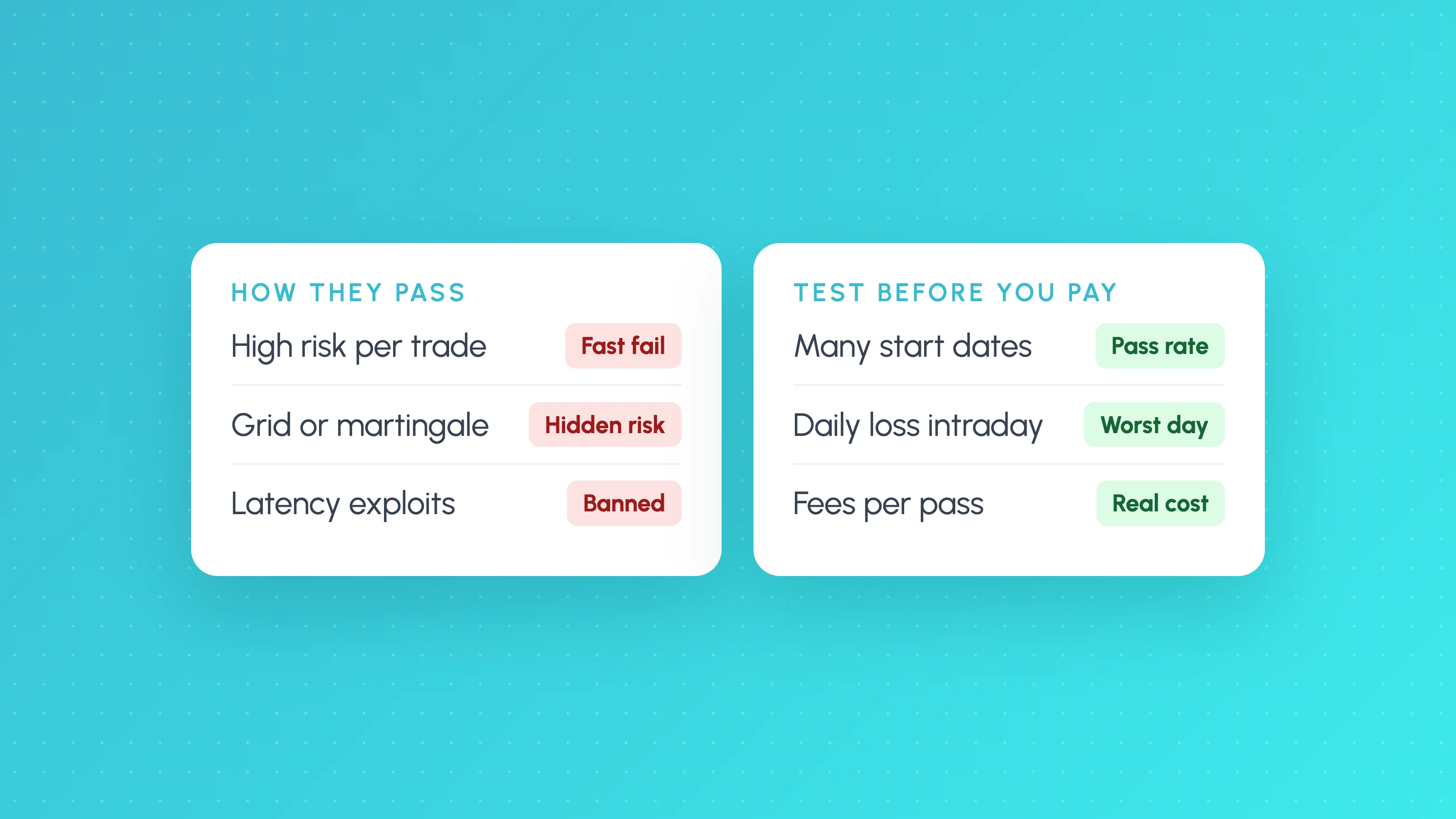
A "prop firm passing EA" is an Expert Advisor or trading bot sold on the promise that it will pass a prop firm challenge for you. Most of them rely on one of three things: high risk that passes quickly or blows up quickly, grid or martingale position sizing that hides losses until it can't, or exploits such as latency arbitrage, tick scalping or hedging across accounts that firms ban outright. Before you pay for one, or for a challenge to run one on, check what it actually does, whether the firm allows it, and how it would have done from many different start dates, not just the one in the seller's screenshot.
This guide explains how passing EAs usually work, the rules they most often break, and a testing routine you can run before risking a challenge fee.
Nothing here endorses any EA or firm. A simulated pass rate is not a promise of a pass, and leveraged trading carries a high risk of loss.
How "challenge passer" bots usually work
| Approach | How it "passes" | Why it fails |
|---|---|---|
| High risk per trade | Hits the profit target in a few trades | Hits the daily or maximum loss just as fast |
| Grid or martingale | Adds to losing positions so most cycles end in profit | One trend wipes out weeks of gains, often breaching the daily loss limit |
| Latency or tick exploits | Profits from slow price feeds or tiny moves | Banned by most firms; profits are removed and accounts closed |
| Hedging across accounts | Opposite positions on two accounts so one passes | Banned by most firms as account manipulation |
| A genuine strategy | Trades a real edge inside the rules | Can work, but passes slowly and not every time |
Only the last one is a strategy. The others are bets on luck or on the firm not noticing.
Check the firm's rules first
Before testing performance, check the rules for the firm and account you will use:
- Are EAs and bots allowed on evaluation and funded accounts? Some firms allow your own EAs but not third-party or off-the-shelf ones that many traders run.
- Banned practices: high-frequency trading, tick scalping, latency arbitrage, copy trading across accounts, hedging between accounts, and in some cases grid or martingale.
- News trading: some accounts restrict trading around high-impact releases.
- Consistency rules: a bot that makes most of its profit on one day can fail a consistency rule even when it hits the target.
Our guides to prop firms that allow algo trading, FTMO's algo rules and Topstep's algo rules cover the details. Rules change often, so always confirm on the firm's own help centre.
Red flags in a passing EA's sales page
- A single equity curve or one "passed" certificate, with no start date or account size.
- No maximum drawdown or worst-day figure.
- Promises of a pass in a set number of days.
- No explanation of the strategy, or "proprietary AI" with nothing behind it.
- A recommendation to run it on several accounts at once.
- Results only from a demo account with unrealistic fills.
How to test a passing EA or bot properly
- Get its trade history, ideally a full backtest or live list of trades over at least a year, not a summary.
- Replay those trades through the challenge rules from many start dates. A challenge started in a quiet month and one started before a volatile week can end very differently. One historical run tells you almost nothing.
- Check daily loss inside the day, not at the close. Most firms measure it on open equity, so a dip that recovered by the close still counts as a breach.
- Look at the worst day and the longest losing streak, not just the pass rate.
- Count how many challenge fees you'd expect to pay per pass. A 40% pass rate means you'd typically buy two to three challenges per funded account.
- Check the consistency rule on the days it made its money.
The prop firm challenge simulator in Strategy Lab does steps 2 to 6 for a strategy you build or describe: it starts a fresh challenge on every week or month of the data, checks the limits inside every candle and shows the pass rate, median days to pass, challenges per pass and the deepest dip against the daily loss limit, with presets for FTMO, The5ers and Topstep and custom rules for other firms. If you only have an EA's trade statistics, free Monte Carlo pass-odds calculators are a quick first check; see the best prop firm challenge simulators.
A better route: test your own strategy
If you want an algo on a prop account, a strategy you understand and have tested is safer than a black box. Build it, backtest it, check it on an unseen period, then run the challenge test before buying the challenge. Our guide to passing a prop firm challenge with an algo walks through sizing for losing streaks and the rules that fail most algos.
Free tools for this: use the Monte Carlo simulator to see the range of drawdowns your trade results could produce, the risk of ruin calculator to find a risk per trade that survives a realistic losing streak and the prop firm consistency calculator to check your best day against the firm's rule. They run in your browser, with no account needed.
Frequently asked questions
- Do prop firm passing EAs work?
- Some pass some challenges, usually by taking large risks or using sizing methods such as grid or martingale that fail badly in trends. Many rely on practices firms ban. Test any EA's trades against the firm's rules from many start dates before paying for it or for a challenge.
- Are prop firm passing EAs allowed?
- It depends on the firm and the EA. Some firms allow EAs, but ban high-frequency trading, latency arbitrage, copy trading or hedging across accounts, and some restrict third-party EAs. Check the firm's current rules before running one.
- How can I test if an EA will pass a prop firm challenge?
- Replay its full trade history through the challenge rules from many different start dates, checking daily loss inside each day, and look at the pass rate, worst day and how many challenge fees you'd expect to pay per pass.
- What is the best EA to pass a prop firm challenge?
- There's no reliable "best" one. A strategy that trades a real edge inside the rules, sized so a normal losing streak can't breach the daily loss limit, is more dependable than any EA sold as a challenge passer.
Keep reading
 Prop firms
Best Strategy to Pass a Prop Firm Challenge: How to Test Yours Against the Rules
The best strategy to pass a prop firm challenge is one that survives the rules. Which strategy types suit daily loss, trailing drawdown and consistency rules, and how to test yours.
 Prop firms
Futures and Forex Prop Firms That Allow Algo Trading in 2026: Rules for Bots, EAs and Automation
Prop firms that allow algo trading and bots as of November 2026: Topstep (API only), Lucid, Tradeify, FundedNext and FTMO allow them with limits; Apex bans them.
 Prop firms
Best Prop Firm Challenge Simulators (2026): Test Whether Your Strategy Would Pass Before You Pay
Which tools let you build or backtest a strategy and see if it would pass an FTMO, The5ers or Topstep challenge? 8 prop firm simulators compared on method, firms and price.