

How to Pass a Prop Firm Challenge With an Algo Strategy
Map prop firm rules (daily loss, trailing drawdown, consistency, news) onto your algo's backtest, size for losing streaks, and check automation is allowed.
By Tessera Trades · Updated · 11 min read
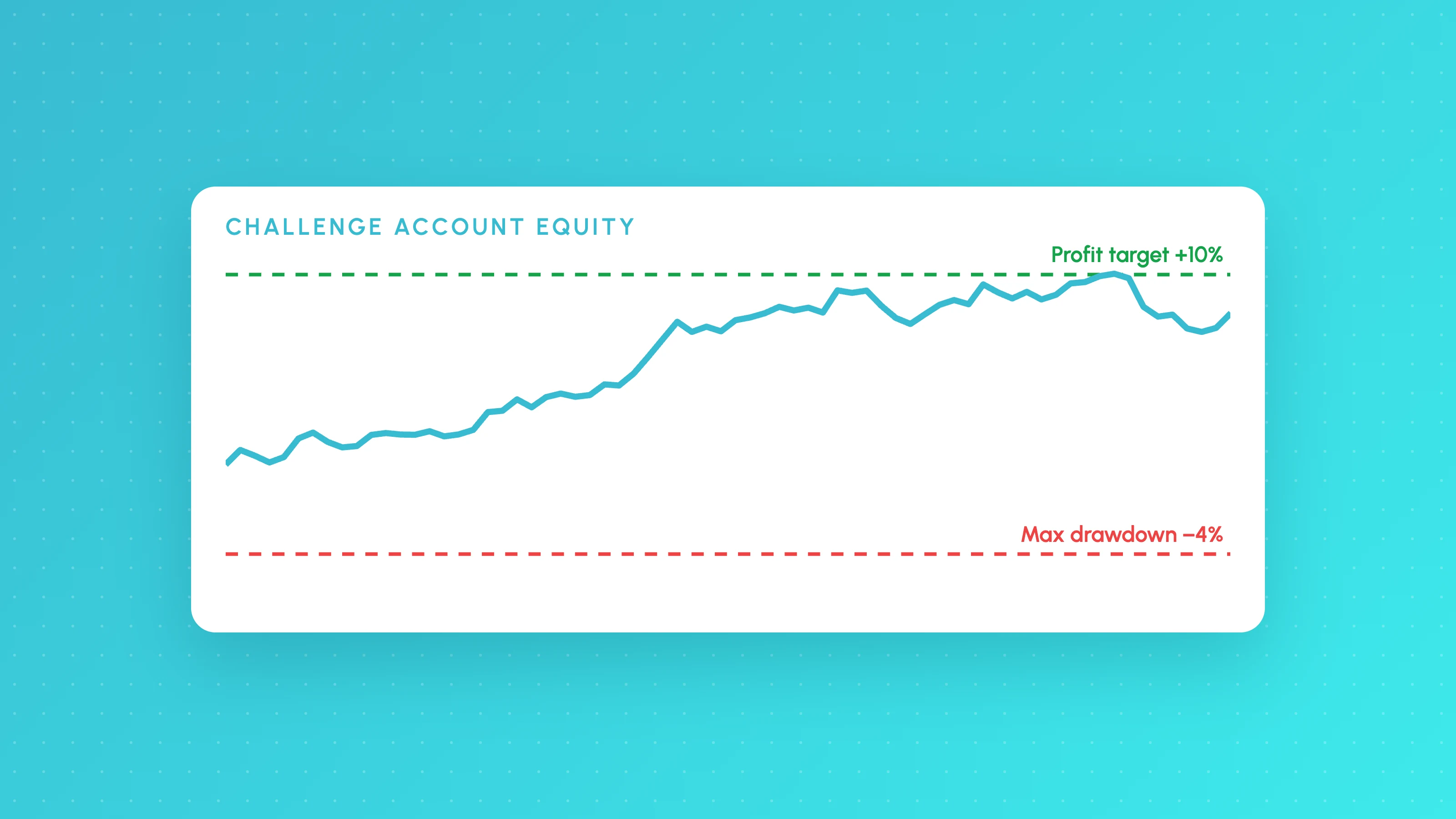
To pass a prop firm challenge with an algo, test the strategy against the firm's rules, not just for profit: check its worst day against the daily loss limit, its worst peak-to-trough against the maximum or trailing drawdown, its best day's share of profit against any consistency rule, and its longest losing streak against both. Then size each trade so a realistic losing streak cannot breach a limit, and confirm in writing that the firm allows automated trading at all.
Most algos that fail challenges are not losing strategies. They are profitable strategies sized for a personal account, where a bad week is survivable, run under rules where one bad day ends the account. This guide shows how to turn a challenge's rules into numbers you can check in your backtest.
Prop firm rules vary between firms and between account types, and they change often. This guide uses an example rule set, not any firm's actual rules. Always read your firm's current rule page and terms before you start, and re-read them before each new challenge.
Step 1: Check that the firm allows your automation
Do this first, because a passed challenge is worthless if the payout is refused for a rule you never read. In the firm's terms and FAQ, look for:
- Whether expert advisors, bots or API trading are allowed at all, and whether that differs between the evaluation and the funded account.
- Whether third-party or purchased EAs are treated differently from your own code.
- Banned strategy types, often described as high-frequency trading, latency or tick arbitrage, exploiting simulated fills, or hedging across accounts.
- Whether a VPS or a specific platform connection is required or forbidden.
- Whether the same strategy may run on several accounts at once, at the same firm or across firms.
If anything is unclear, ask support and keep the written answer. Wording like "we reserve the right to refuse strategies that do not reflect real market conditions" is common, so a strategy that relies on fills it would never get live is a risk even where bots are allowed. For two common firms, see our dated summaries of FTMO's algo trading rules and Topstep's algo trading rules.
Step 2: Write down the rules as numbers
Turn every rule into a number and a measurement method. Here is an example rule set on a $100,000 account. It is illustrative, not taken from any firm.
| Rule | Example value | What you need to find out from your firm |
|---|---|---|
| Profit target | 10% ($10,000) | Balance or equity? Must trades be closed? |
| Daily loss limit | 5% ($5,000) | Measured from start-of-day balance or equity? Includes floating losses and commission? Which time zone does the day reset in? |
| Maximum loss | 10% ($10,000), static | Static from the starting balance, or trailing? |
| Trailing drawdown (if used) | $5,000 | Trails intraday equity or end-of-day balance? Does it stop trailing at some level? |
| Consistency rule | Best day no more than 40% of total profit | How is "day" and "profit" defined? Does it apply in evaluation, funded or both? |
| Minimum trading days | 4 days | What counts as a trading day? |
| News restriction | No trades opened or closed 2 minutes either side of high-impact news | Which calendar? Does an EA's stop or target filling in the window count? |
The details in the right-hand column decide whether your strategy passes. A daily limit that includes floating losses is much stricter for an EA that holds through drawdowns than one measured on closed trades.
Step 3: Map each rule to a backtest metric
Export your backtest's trade list and calculate these. Your platform's summary will give you some of them; the rest take a spreadsheet.
| Rule | Backtest metric | How to calculate it |
|---|---|---|
| Daily loss limit | Worst day | Group closed trades by the firm's trading day, sum net P&L, take the minimum. If the limit includes floating losses, also add each trade's maximum adverse excursion on that day |
| Maximum loss (static) | Lowest point below the start | Running cumulative P&L from the start of each challenge window, take the minimum |
| Trailing drawdown | Worst peak-to-trough | Running peak of equity (or end-of-day balance) minus current value, take the maximum |
| Consistency rule | Largest day's share of profit | Best day's P&L divided by total P&L over the challenge window |
| Survival | Longest losing streak | Count consecutive losing trades, take the maximum |
| Minimum days and time | Trades per day and per week | Count days with at least one trade |
| News restriction | Trades in news windows | Flag trades opened or closed inside each window using an economic calendar |
Two cautions. First, use net P&L after commission, swap and slippage, because the firm's account will charge them. Second, if your backtest's worst day only just passes the limit, it will fail live, since live fills are rarely better than the backtest's.
The trailing drawdown deserves a worked example, because it catches algos that let winners run and give some back. Say your equity rises intraday from $100,000 to $103,000, then the trade reverses and the day closes at $100,500. With a $5,000 drawdown that trails intraday equity, your floor has moved to $98,000 ($103,000 minus $5,000). If it trails end-of-day balance instead, the floor is $95,500 ($100,500 minus $5,000). The same day leaves you with $2,500 of room in the first case and $5,000 in the second. If your firm trails intraday, how far each trade runs in your favour before it closes matters as much as where it closes.
Step 4: Size for the losing streak, not the average
The single biggest decision is risk per trade. Work it out from the streak your strategy will plausibly hit, not from its average.
Say your strategy wins 45% of the time and you expect about 200 trades over the period you will be trading the account. If trades are independent, a quick simulation of that win rate over 200 trades gives a median longest losing streak of 8, and about 1 run in 10 has a streak of 11 or more. A streak of 8 is not bad luck; it is what to expect.
Now apply the example rules ($10,000 maximum loss, $5,000 daily limit):
| Risk per trade | Loss after 8 straight losers | Loss after 11 straight losers | Verdict |
|---|---|---|---|
| 1% ($1,000) | $8,000 | $11,000 | An ordinary streak uses 80% of the maximum loss; a 1 in 10 streak breaches it |
| 0.5% ($500) | $4,000 | $5,500 | Survives both, with room for slippage |
| 0.25% ($250) | $2,000 | $2,750 | Very safe, but slow to reach the target |
These are fixed dollar amounts based on the starting balance. Losses can exceed the planned risk when stops slip or price gaps, so leave a margin.
Check the daily limit the same way. If the EA can open up to 4 trades a day, the worst plausible day is 4 losses. At 1% risk that is $4,000, which leaves only $1,000 for slippage, commission and floating losses against a $5,000 limit. At 0.5% it is $2,000. If the EA has no cap on trades per day, add one, or add a daily stop that halts trading well before the limit.
Then check the other side: can you still reach the target? Say your strategy's expectancy is 0.2R per trade after costs. At 0.5% risk, 1R is $500, so the average trade makes $100, and the $10,000 target takes about 100 trades on average. If the EA trades 5 times a week, that is around 20 weeks. If your challenge has a time limit, check that this fits, and do not respond to a slow start by raising risk mid-challenge, which is how most sizing plans fail.
The simulated streak figures assume independent trades with a constant win rate. Real strategies can cluster losses in particular conditions, so also check the actual longest streak and worst week in your own backtest, and use whichever is worse.
Step 5: Check the consistency rule and minimum days
Consistency rules punish exactly what a good algo sometimes does: one big trending day that makes half the target.
Using the example rule (best day no more than 40% of total profit): if your best day makes $4,500 and you reach the $10,000 target, that day is 45% of profit and you fail the rule even though you hit the target. To bring it to 40%, total profit has to reach $4,500 divided by 0.40, which is $11,250. Some firms make you keep trading until the ratio is met; others define the rule differently, so check yours.
In your backtest, take the largest day's share of profit in each challenge-length window. If it often exceeds the limit, the usual fixes are a daily profit cap in the EA, or lower size on days after a large win, rather than changing the entry logic.
For minimum trading days, look at how often the strategy trades. An EA that only trades a few times a month can satisfy every other rule and still not reach the minimum days in time.
Step 6: Handle news restrictions in code
If the firm restricts trading around high-impact news, the EA needs a news filter, and the rule has to hold for exits too: a stop or target that fills inside the window may count as trading in it. To estimate the cost of complying, take your backtest, remove every trade that would have been opened or closed inside a news window, and compare the results. If the strategy's edge comes mostly from news spikes, it is the wrong strategy for that firm.
Tessera's simulator does this kind of check on trades you have already taken: remove trades matching a condition, such as a time window, or change the stop, target, breakeven or trailing rules and replay them on real candles, then compare the runs side by side.
Step 7: Replay the backtest as many challenges
One backtest is one path. A challenge is a short window that starts on whatever day you begin. To see how often you would pass:
- Split your backtest into overlapping windows the length of a challenge, for example starting a new window every week.
- For each window, apply every rule in order: did it breach the daily limit, the maximum or trailing drawdown, or the consistency rule before hitting the target?
- Count the share of windows that passed, failed, or neither passed nor failed by the end.
Then shuffle the trade order a few thousand times and repeat, to see how sensitive the result is to the sequence of wins and losses. If the pass rate depends heavily on a few windows in one market regime, check that the backtest is not overfit, and that it has enough trades to judge at all (see backtest sample size).
Simulate the challenge first
Step 7 by hand takes an afternoon in a spreadsheet. If you build the strategy in Tessera's Strategy Lab, the prop firm challenge simulator does it as part of the account test. It replays the strategy's trades through the account rules, starting a fresh run every week or month of the data, at up to six account sizes. Limits are checked inside every candle on open equity, so a trade that dips through a limit and recovers before it closes still counts as a breach.
It reports the pass rate, the days to pass, the challenges per pass, the deepest dip, the payout and how often the account ended below its start. Presets cover Personal, FTMO 1-Step, FTMO 2-Step, The5ers 1-Step and Topstep 50K, based on published rules as of October 2026. Firms change their rules, so check each preset against the firm's current page. An optional "never breach" guard sizes trades down to stay inside the limits.
If you are choosing between FTMO's two challenges, FTMO 1-Step vs 2-Step for algo traders works through which rule set suits which kind of bot. A pass rate from past trades is a measure, not a promise: live fills and future markets will differ.
Find out where your strategy loses first
Most breaches come from a few bad conditions: one session, one weekday, high-volatility days. Upload your strategy tester export or trade history to the free Entry Analysis report to see results by session, weekday, time of day and volatility, with the trade count behind each, before you pay for a challenge.
To compare the tools that test a strategy against challenge rules, from free odds calculators to full backtest replays, see our guide to the best prop firm challenge simulators.
Frequently asked questions
- Can you use an algo or EA to pass a prop firm challenge?
- Many prop firms allow automated trading, but not all, and some allow it only in the evaluation or ban specific strategy types such as high-frequency or latency arbitrage. Read your firm's current terms and get written confirmation from support before you start.
- What risk per trade should I use for a prop firm challenge?
- Work back from the rules. Estimate a plausible losing streak for your win rate (around 8 in a row is common over 200 trades at a 45% win rate) and size so that streak uses well under half the maximum loss, and the worst day's losses stay well inside the daily limit.
- What is a consistency rule in a prop firm challenge?
- It limits how much of your total profit can come from one day, for example no single day above 40% of profit. Definitions vary by firm. If your algo has occasional very large days, a daily profit cap can keep you within the rule.
- How does a trailing drawdown affect an algo strategy?
- A trailing drawdown moves your loss floor up as your equity or balance makes new highs. If it trails intraday equity, open profit that you later give back still raises the floor, which hurts strategies that let trades run and retrace before exiting.
- How do I test my strategy against prop firm rules?
- Export your backtest trades, group them by the firm's trading day, and check the worst day, worst peak-to-trough, best day's share of profit and longest losing streak against each rule. Then replay the backtest as many challenge-length windows to see how often it would pass.
Keep reading
 TradingView backtests
How Many Trades Do You Need for a Valid Backtest?
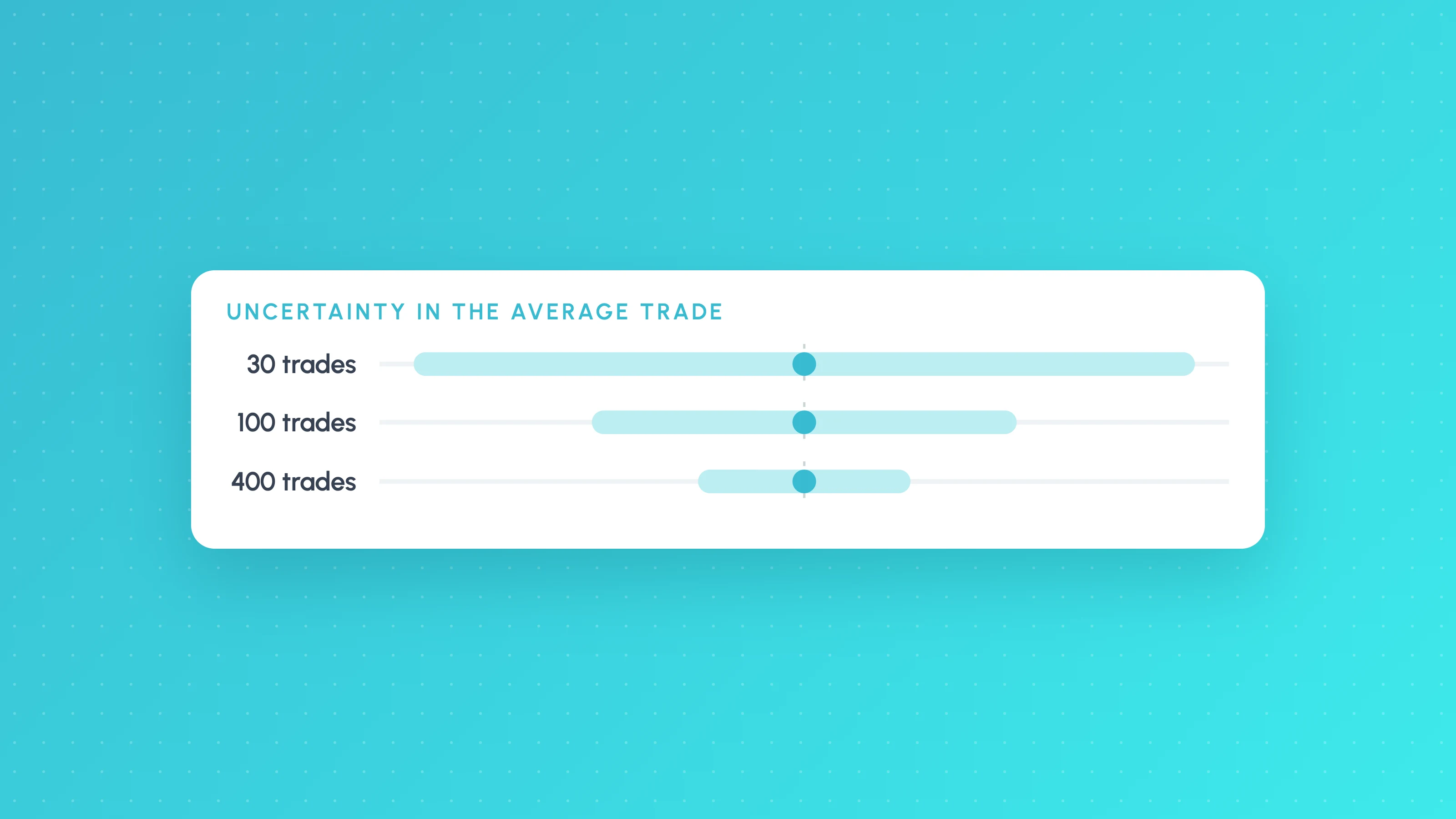
How many trades a backtest needs: rules of thumb, the t-statistic formula with a worked example, a table by edge size, per-bucket minimums and multiple testing.
 TradingView backtests
Is My Backtest Overfit? A Practical Checklist for Traders
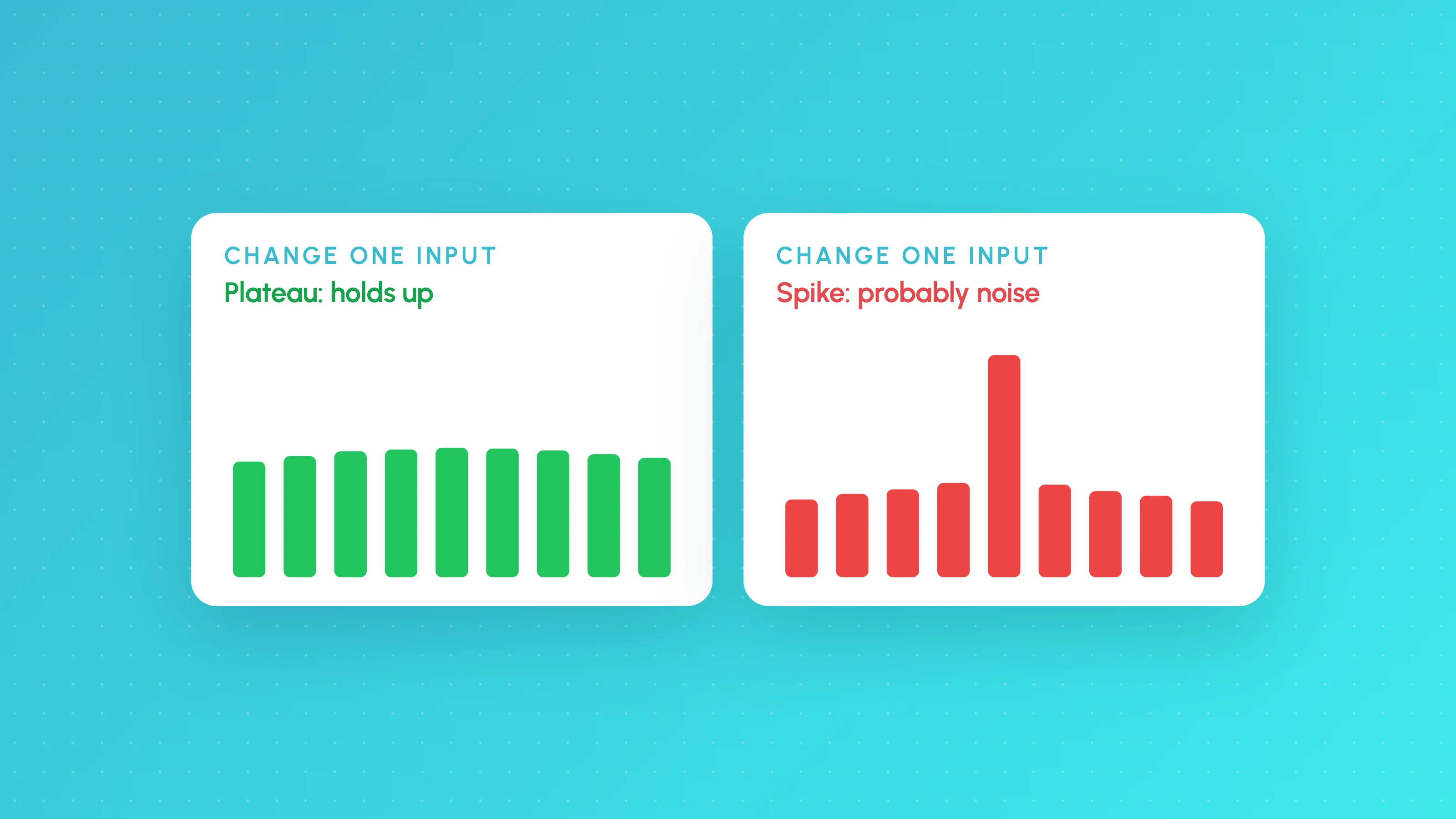
How to tell if a backtest is overfit: too-good metrics, thin samples, fragile inputs, useless filters, out-of-sample and walk-forward tests, plus a checklist.
 Trading metrics
Trading Expectancy Formula: In Currency and R, With Examples
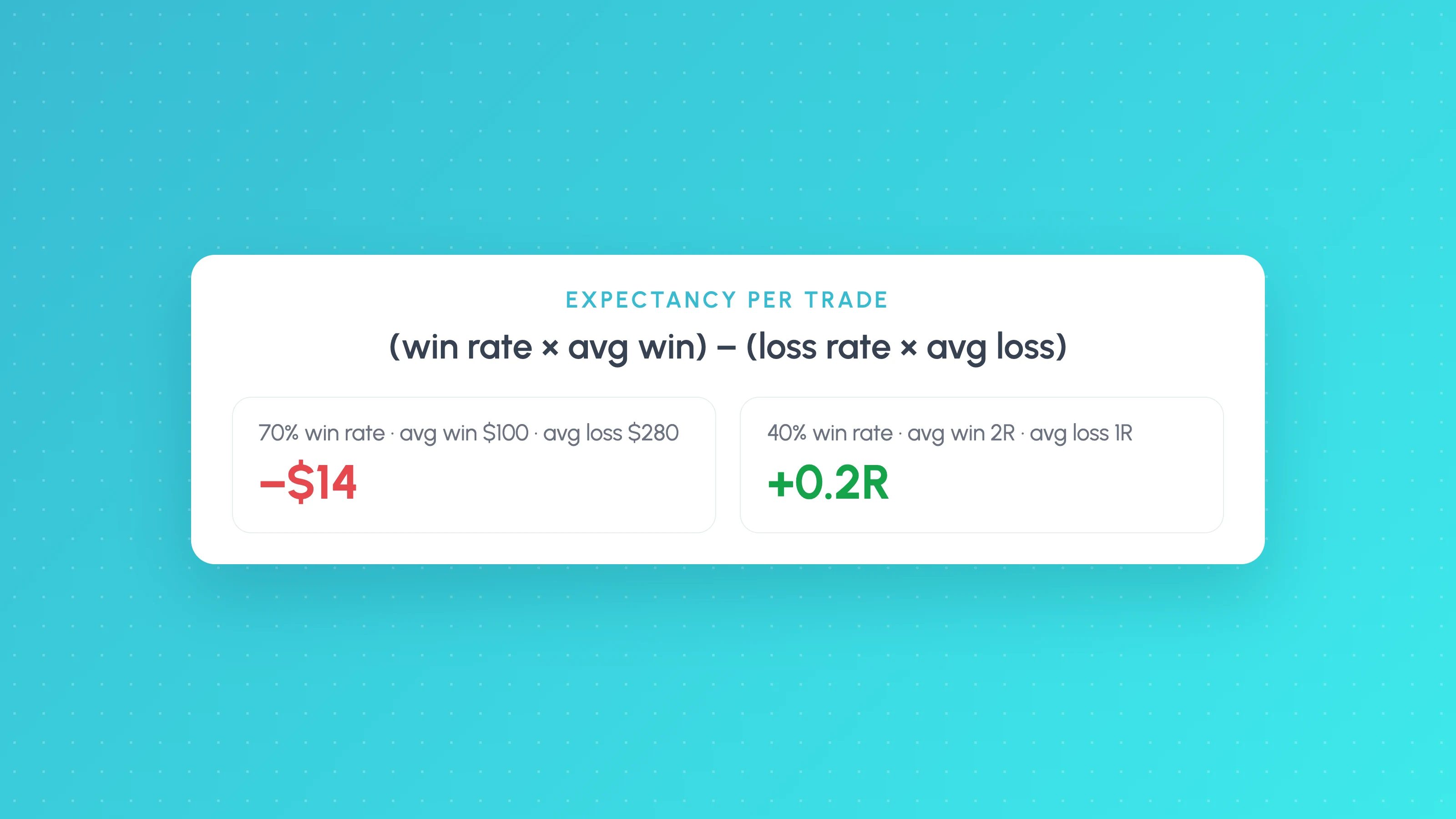
Expectancy = win rate x average win minus loss rate x average loss. Worked examples in currency and R, why 70% win rates lose, and spreadsheet formulas.