

FTMO Algo Trading Rules (2026): What Bots and EAs Can and Can't Do
FTMO algo trading rules as of November 2026: EAs are allowed, but HFT, latency exploits, copied trades and over 2,000 server requests a day are not.
By Tessera Trades · Updated · 10 min read
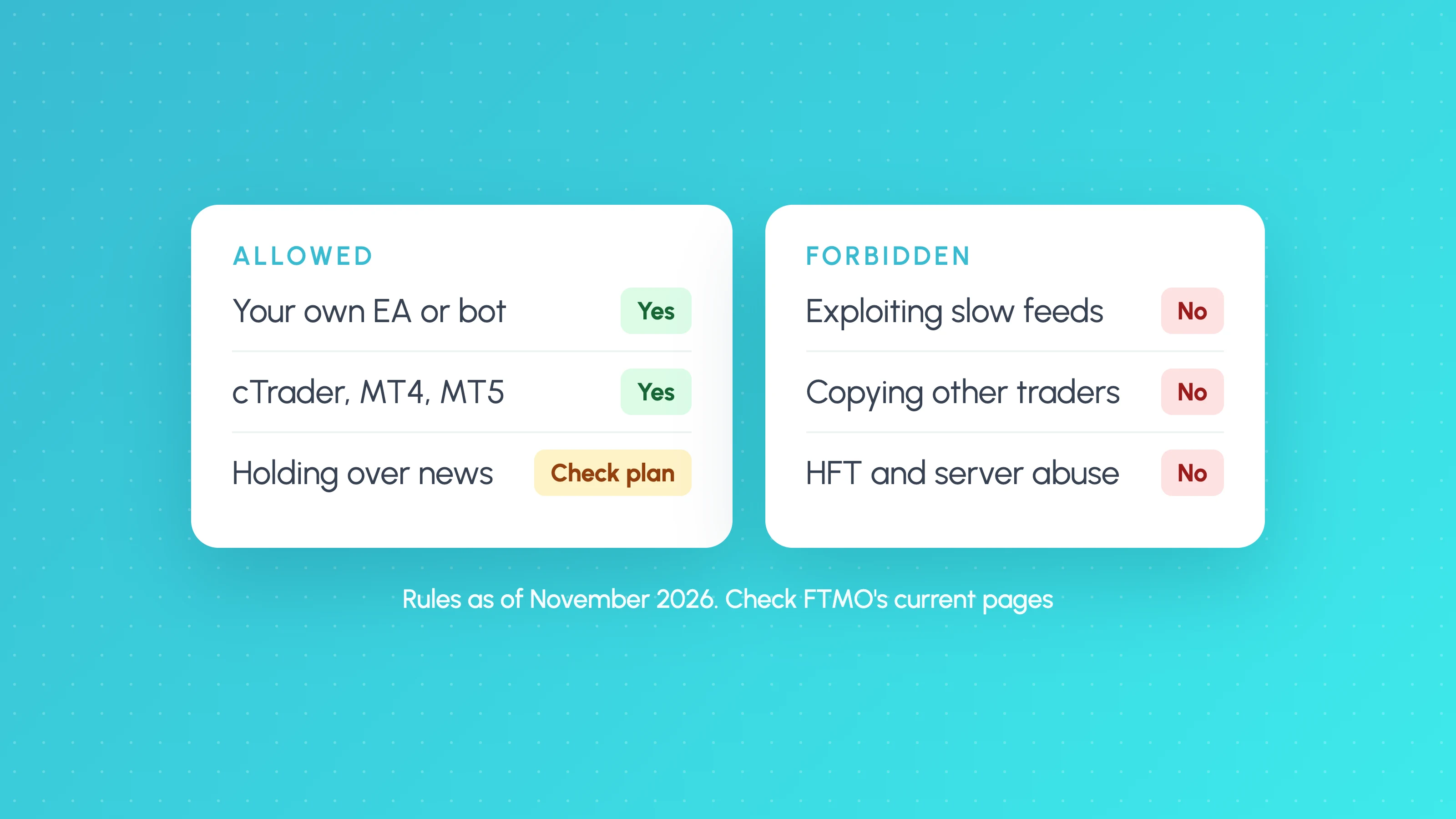
Yes, you can use a bot or expert advisor (EA) on FTMO. As of November 2026, FTMO says it does not restrict algorithmic trading as long as the trading is legitimate, uses proper risk management and reflects real market conditions. What it bans is specific behaviour: EAs that make more than 2,000 server requests a day, strategies that exploit price feed delays or the simulated environment, trading on someone else's decisions, and hedging across accounts.
The rest of this guide goes through each rule, what it means for an automated strategy, and the account limits your bot has to survive on the 1-Step and 2-Step challenges.
FTMO changes its rules, and its regional pages are not always identical. Everything here is taken from FTMO's own pages as of November 2026. Read the current Trading Objectives, Forbidden Trading Practices and your account agreement before you start, and ask support in writing about anything unclear.
Can you use a bot on FTMO?
FTMO's FAQ on which instruments and strategies are allowed says it has no reason to restrict a strategy, including algorithmic trading and EAs, provided the trading is legitimate, follows proper risk management and avoids the forbidden practices. It also expects a strategy to be one that could be repeated on a live account.
That last point is the one bot traders should take seriously. FTMO accounts are simulated. A strategy that only makes money because the simulated fills are better than anything a real market would give you is the kind of trading FTMO refuses to pay on, even if every individual rule looks satisfied.
You are also responsible for every trade your code places. A breach caused by a bug counts the same as a breach you made by hand.
What FTMO bans for EAs and bots
These come from FTMO's Forbidden Trading Practices page and related FAQs, as of November 2026.
| Rule | What FTMO says | What it means for a bot |
|---|---|---|
| Server request limit | Accounts run by EAs may not become "hyperactive" with more than 2,000 server requests a day | Every order sent, modified or cancelled counts. A trailing stop that updates every tick can hit this without placing many trades |
| Exploiting errors and delays | Strategies that exploit pricing errors, update delays or a slow data feed are banned | Latency arbitrage and similar strategies are out. FTMO's futures rules name high-frequency strategies and latency arbitrage directly |
| Unfair technology | FTMO's futures rules ban software, AI or automated systems that manipulate, abuse or gain an unfair advantage over the programme | Very fast, high-volume scalping is risky even below the request limit |
| Third parties | No third party may access or use your account, and nobody may trade it for you | Signal services and account managers are not allowed to run your account |
| Copying other people | Replicating someone else's trading decisions, through signals, master accounts or trade copiers, is banned | Copy trading from another trader is not allowed |
| Hedging across accounts | Opposite positions across accounts, alone or with other people, including at other firms, are banned | Opposite positions on a single account are allowed |
| Gap trading | Listed as a forbidden practice when carried out through simulated trades | A bot built to catch price gaps, for example opening positions before a market closure to profit from the reopening, is a problem |
The 2,000 server requests rule in practice
This rule catches bots that are not high-frequency in the usual sense. Say your EA opens 20 trades a day and moves each trade's stop every time price moves 2 pips. If a trade lasts a few hours, that can easily mean 100 stop modifications per trade. Twenty trades times 100 modifications is 2,000 requests before you count the opening and closing orders.
The fix is usually simple: trail the stop on candle closes, or in larger steps, rather than on every tick.
Copy trading and bought EAs
FTMO's futures rules allow you to copy trades between accounts registered to you, as long as each account meets the rules on its own. Copying someone else's trades is banned. Check the rules for your own product, because the CFD and futures pages are worded differently.
Bought EAs carry a separate risk. FTMO's strategies FAQ warns that other traders may run the same EA, and identical strategies count together towards its maximum capital allocation. FTMO's accounts FAQ puts that cap at $400,000 per trader or strategy before any scaling, and says it may suspend accounts where identical or near-identical trading appears across several accounts. A popular commercial EA can therefore get a funded account refused even if you followed every other rule.
A strategy you built yourself, with your own settings, avoids this problem.
News and weekend rules for bots
Two rules apply to funded FTMO Accounts but not to the evaluation, which catches bots that passed the challenge without any filters.
- News. FTMO's news FAQ says Standard FTMO Accounts may not execute orders on affected instruments from 2 minutes before to 2 minutes after a restricted high-impact release. That includes a stop loss or take profit that fills inside the window. Swing accounts and the evaluation are not restricted.
- Market breaks. FTMO's holding FAQ says Standard FTMO Accounts must close positions before market breaks longer than 2 hours, such as the weekend. Swing accounts and the evaluation phases are exempt, and Swing accounts have lower leverage (1:30 rather than 1:100).
If your bot holds trades for days, or has stops and targets resting through news, decide before you buy whether you need a Swing account or a news filter. FTMO's pages say Swing is not offered on the 1-Step challenge, so check this at checkout.
FTMO cTrader, MT4, MT5 and other platforms
As of November 2026, FTMO's platforms FAQ lists MetaTrader 4, MetaTrader 5, cTrader and TradingView. DXtrade appears in some older FTMO material but not on the current platforms page, so do not plan around it without confirming with FTMO.
For automation this matters because each platform uses its own bot format:
| Platform | How bots usually run | Notes |
|---|---|---|
| MetaTrader 4 | EAs written in MQL4 | Most commercial EAs target MT4 or MT5 |
| MetaTrader 5 | EAs written in MQL5 | Built-in strategy tester |
| cTrader | cBots written in C# or Python | See our guide to building a cTrader bot without coding |
| TradingView | Strategies and alerts in Pine Script | Placing orders automatically depends on how the platform is connected |
The forbidden practices apply on every platform. An EA on MT5 and a cBot on cTrader are judged by the same rules.
The account limits your bot has to survive
FTMO's rules on automation decide whether your bot is allowed. The trading objectives decide whether it passes. As of November 2026, from FTMO's Trading Objectives and 1-Step and 2-Step pages:
| Objective | 2-Step | 1-Step |
|---|---|---|
| Profit target | 10% in the FTMO Challenge, 5% in the Verification | 10% |
| Maximum daily loss | 5% of the initial balance | 3% of the initial balance, from the balance at midnight CE(S)T |
| Maximum loss | 10%, static | 10%, trailing the end-of-day balance |
| Minimum trading days | 4 in each phase | None |
| Time limit | None | None |
| Best day rule | None | Best day no more than 50% of profit |
Both daily limits count floating losses on open trades, not just closed trades. For 1-Step orders placed after FTMO's October 2026 change, the best day is measured against total profit including losing days, rather than profit on winning days only. Our prop firm consistency rule guide explains how these rules work across firms. FTMO's trading update of 8 October 2026 gives the effective date for new orders as 12 October 2026, while some other FTMO pages say 5 October, so check which rule your account is on.
We compare the two in detail, with worked examples, in FTMO 1-Step vs 2-Step for algo traders.
Worked example: is a bot's worst day safe?
This is a hypothetical example with round numbers, not a backtest result.
Your EA risks 1% per trade on a $100,000 account and can open up to 4 trades a day. Its worst plausible day is 4 losing trades, a loss of $4,000.
- On the 2-Step, the daily limit is 5%, or $5,000. A $4,000 day leaves $1,000 for slippage, spread and floating losses on any other open trade. That is tight.
- On the 1-Step, the daily limit is 3%, or $3,000. The same day breaches it after the third loss.
At 0.5% risk per trade, the same 4-loss day costs $2,000, which fits inside both limits with room to spare. Size first, then check the target is still reachable. Our guide to passing a prop firm challenge with an algo strategy walks through the arithmetic.
A checklist before you run a bot on FTMO
- Confirm the rules for your exact product. 1-Step, 2-Step, Standard and Swing accounts, and futures, have different rules.
- Count server requests. Estimate orders, modifications and cancellations per day at your busiest. Keep well under 2,000.
- Remove anything that depends on simulated fills. If the edge disappears when you add realistic slippage and spread, FTMO is unlikely to accept it, and live markets would not pay it either.
- Add a news filter and a weekend close if you plan to trade a Standard FTMO Account after passing.
- Cap daily risk in code. Add a maximum number of trades a day and a daily stop well inside the daily loss limit.
- Use your own strategy. A bought EA shared by many traders can breach the capital allocation cap.
- Test against the account rules, not just for profit, before you pay the fee. Our guide to prop firms that allow algo trading covers other firms if FTMO's rules do not fit your strategy.
Test your strategy against FTMO's rules in Strategy Lab
Tessera's prop firm challenge simulator is the account test inside Strategy Lab. It is included on every plan, including Free.
It takes a strategy you have built and backtested in Strategy Lab and replays its trades through account rules, starting a fresh challenge every week or month of the data, at up to 6 account sizes. Limits are checked inside every candle on open equity, which matters for FTMO because both daily limits count floating losses.
There are presets for FTMO 1-Step and FTMO 2-Step, based on FTMO's published rules as of October 2026, alongside The5ers 1-Step, Topstep 50K and a personal account. You can adjust the rules to match your account. The test models challenge, verification and funded phases, the profit target, daily loss, static or trailing maximum loss, minimum days, time limits, best-day consistency, and payouts.
You get the pass rate, days to pass, challenges bought per pass, the deepest dip against the limits, the payout once funded, and how often the account ended below its start. An optional "never breach" guard sizes trades down to stay inside the limits and shows what that costs in pass rate.
A high pass rate in the account test describes how past trades would have fared under the rules. It is not a promise that the strategy passes a real challenge, and live fills and FTMO's current rules can differ. Strategy Lab does not check FTMO's forbidden practices, such as server request counts, so the checklist above still applies.
To check how often a strategy would pass before you pay the fee, compare the best prop firm challenge simulators.
Frequently asked questions
- Does FTMO allow EAs?
- Yes. As of November 2026, FTMO allows EAs and algorithmic trading as long as the trading is legitimate, uses proper risk management, reflects real market conditions and avoids its forbidden practices. The main limits for EAs are no more than 2,000 server requests a day, no exploiting price delays or simulated fills, and no copying other people's trades.
- Can you use a bot on FTMO cTrader?
- Yes. FTMO lists cTrader among its platforms, and cTrader bots (cBots) fall under the same rules as MetaTrader EAs. The forbidden practices, the server request limit and the account objectives apply in the same way on every platform.
- Is copy trading allowed on FTMO?
- Copying another trader's decisions, through a signal service, a master account or a trade copier, is not allowed. FTMO's futures rules allow copying between accounts registered to you if each account meets the rules on its own. Identical trading across several accounts also counts towards FTMO's maximum capital allocation of $400,000 before scaling.
- Is latency arbitrage allowed on FTMO?
- No. FTMO's forbidden practices ban strategies that exploit pricing errors, update delays or slow data feeds, and its futures rules name latency arbitrage and high-frequency strategies directly. Any strategy whose profit depends on the simulated environment rather than real market conditions is at risk.
- Is a 1-Step or 2-Step FTMO challenge better for a bot?
- It depends on the strategy. The 2-Step has a wider daily loss limit and a static maximum loss, which suits bots with deeper swings, while the 1-Step has one phase but a 3% daily limit, a trailing maximum loss and a best day rule. Our 1-Step vs 2-Step comparison works through examples.
Keep reading
 Prop firms
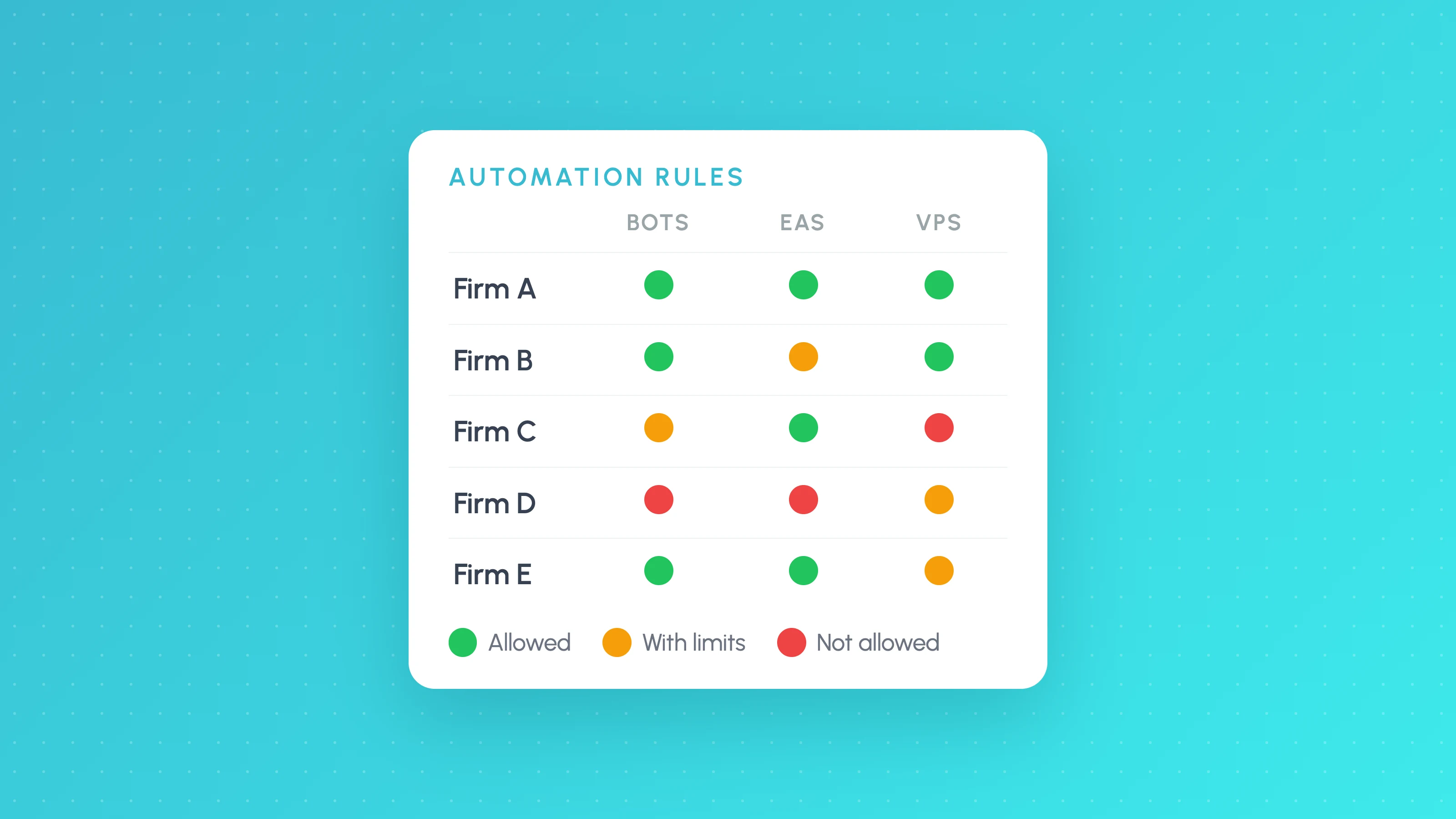
Futures and Forex Prop Firms That Allow Algo Trading in 2026: Rules for Bots, EAs and Automation
Prop firms that allow algo trading as of October 2026: Topstep, Lucid, Tradeify, FundedNext and FTMO allow bots with limits; Apex bans them. Rules table.
 Prop firms
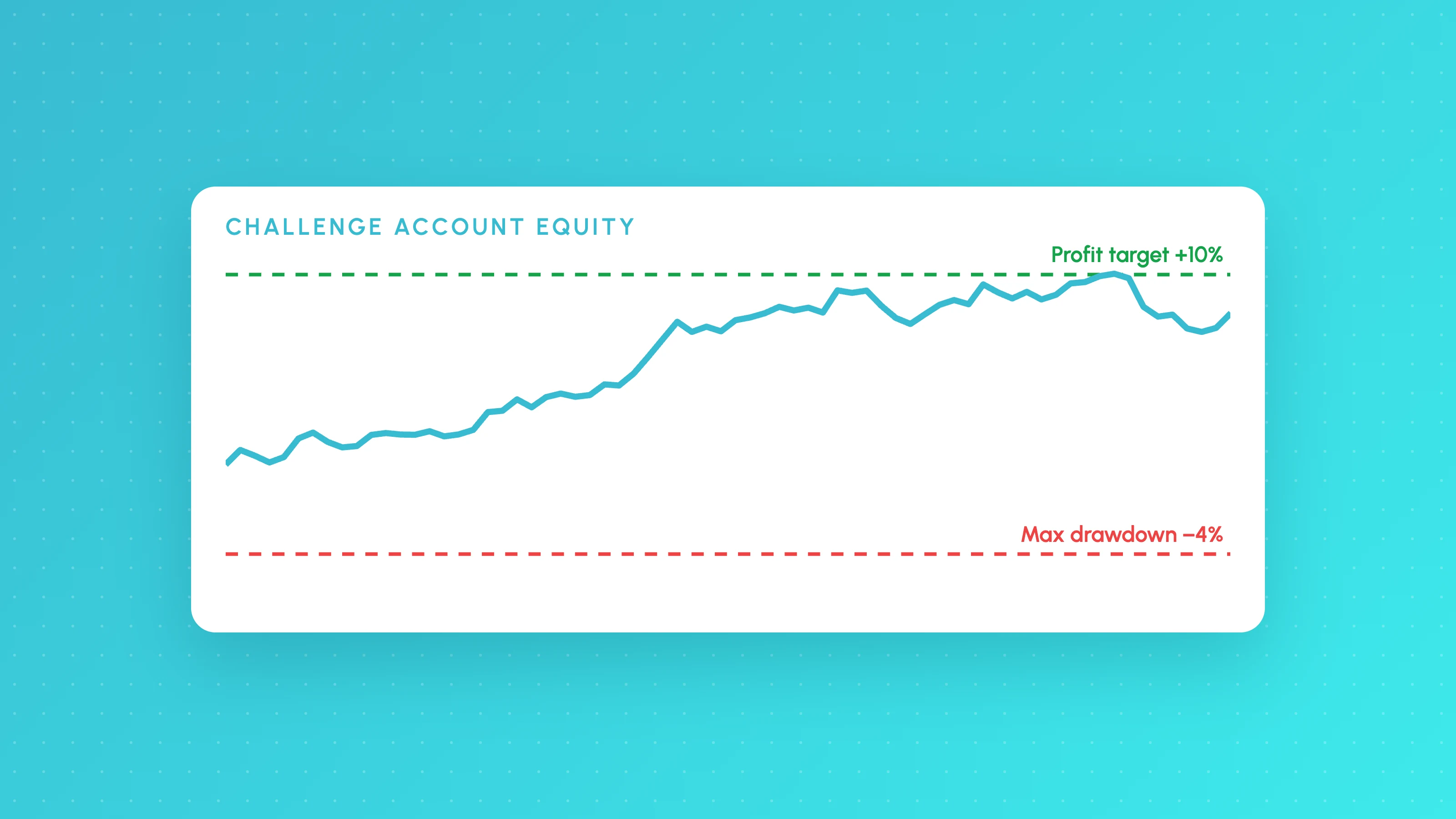
How to Pass a Prop Firm Challenge With an Algo Strategy
Map prop firm rules (daily loss, trailing drawdown, consistency, news) onto your algo's backtest, size for losing streaks, and check automation is allowed.
 Prop firms
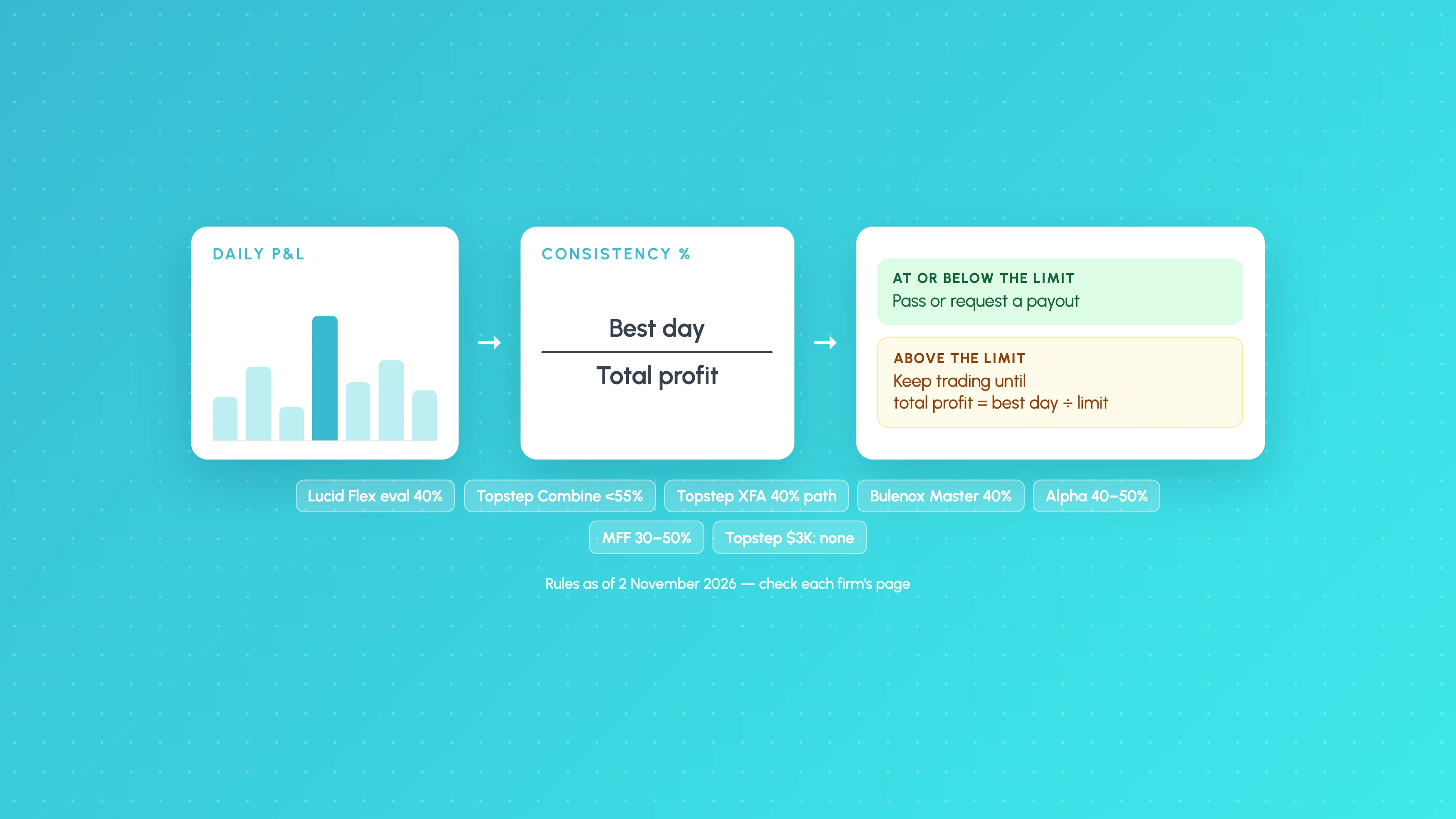
Prop Firm Consistency Rules in 2026: How the 40% Best-Day Rule Works
A prop firm consistency rule caps your best day's share of total profit, often at 40% or 50%. Formula, worked examples and a dated per-firm rules table.