

FTMO 1-Step vs 2-Step for Algo Traders: Which Suits a Bot?
FTMO 1-Step vs 2-Step for algo traders: daily loss, trailing vs static max loss, targets and the best day rule, with worked examples for different bots.
By Tessera Trades · Updated · 9 min read
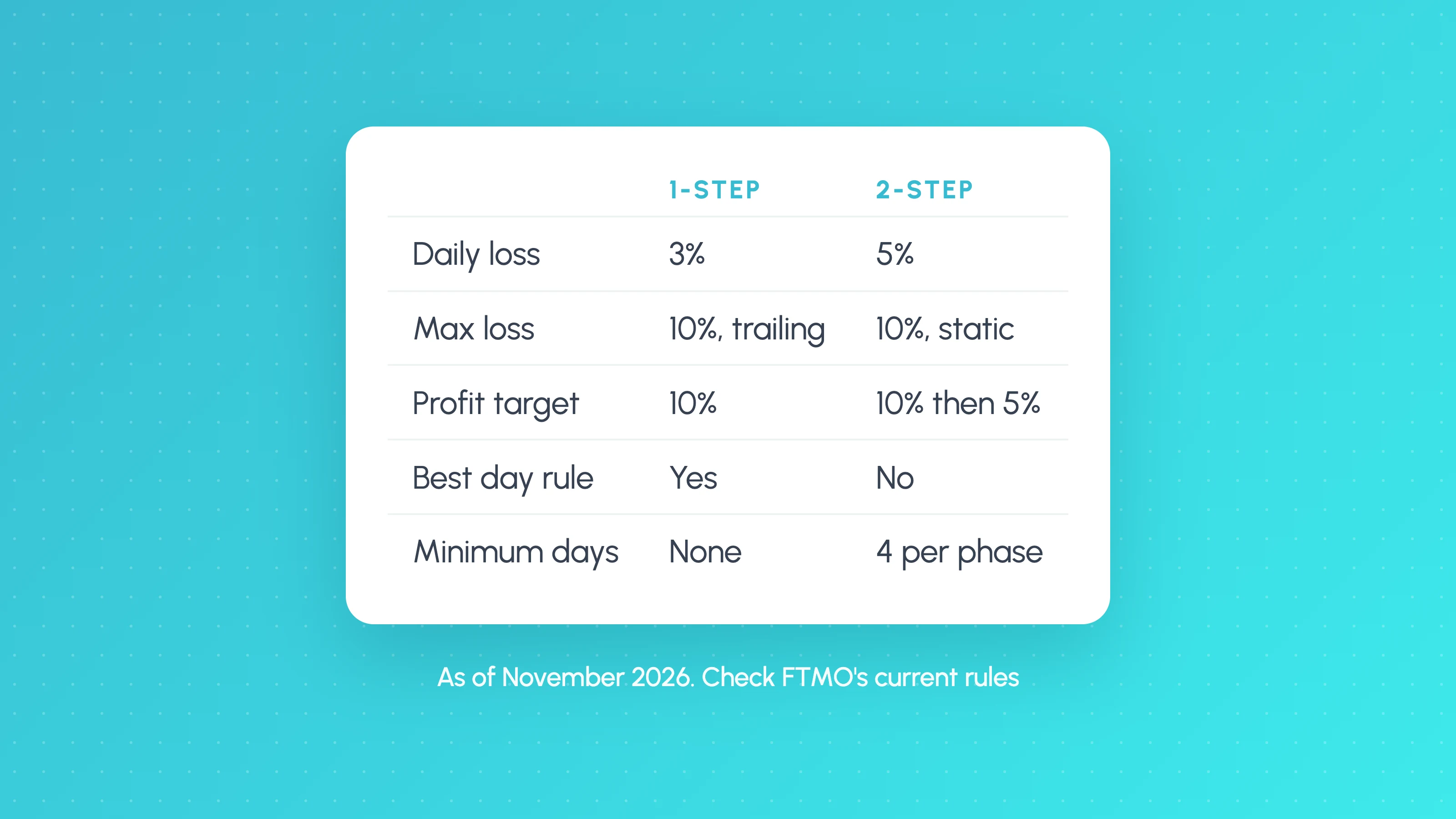
The FTMO 2-Step has two phases (a 10% then a 5% target) but a wider 5% daily loss limit and a static 10% maximum loss. The 1-Step has a single 10% target but a 3% daily loss limit, a 10% maximum loss that trails the end-of-day balance, and a best day rule. As a rule of thumb, bots with deep intraday swings or occasional very large days fit the 2-Step better, while steady, low-variance bots that can reach 10% without one dominant day may suit the 1-Step.
Neither is easier in general. Which one suits your bot depends on its worst day, its drawdown shape and how its profits are spread across days. This guide sets out the rules from FTMO's own pages and works through hypothetical examples so you can judge your own strategy.
All rules here are from FTMO's pages as of November 2026. FTMO changes its rules, and changed the 1-Step best day rule in October 2026. Check the current Trading Objectives before you buy.
FTMO 1-Step vs 2-Step: the rules side by side
From FTMO's Trading Objectives, 1-Step and 2-Step pages, as of November 2026:
| Rule | 2-Step | 1-Step |
|---|---|---|
| Phases | FTMO Challenge, then Verification | One phase |
| Profit target | 10%, then 5% | 10% |
| Maximum daily loss | 5% of the initial balance | 3% of the initial balance, from the balance at midnight CE(S)T |
| Maximum loss | 10%, static from the initial balance | 10%, trailing the end-of-day balance |
| Minimum trading days | 4 in each phase | None |
| Time limit | None | None |
| Best day rule | None | Best day no more than 50% of profit |
| Swing account option | Yes | Not offered, per FTMO's pages |
Both daily limits include floating losses on open trades, plus commission and swap. A trading day runs from midnight to midnight CE(S)T.
FTMO 2-Step rules in plain English
On a $100,000 account, you need to reach $110,000 with all positions closed, trading on at least 4 days. Then you do it again in the Verification, this time to $105,000, on at least 4 more days. Your equity can never drop below $90,000, and you can never lose more than $5,000 in one day.
FTMO 1-Step rules in plain English
On a $100,000 account, you need to reach $110,000 with all positions closed. There is no minimum number of days. You can never lose more than $3,000 in one day, measured from the balance at midnight. Your floor starts at $90,000 but rises with your highest end-of-day balance, and never falls back.
And no single day may account for more than 50% of your profit. If it does, it is not a breach: you keep trading until your best day falls to 50% or less.
The October 2026 change to the 1-Step best day rule
FTMO's trading update of 8 October 2026 replaced the Best Day Rule with a Consistency rule for new 1-Step orders. The old rule measured your best day against profit on winning days only. The new one measures it against total profit, including losing days, which FTMO itself describes as stricter. The update gives the effective date as 12 October 2026 for new orders, while some other FTMO pages say 5 October, so check which applies to your account. Older accounts keep the old rule.
Which FTMO challenge is easier for a bot?
The honest answer is that it depends on four features of your strategy. Check each in your backtest.
| Strategy feature | Favours | Why |
|---|---|---|
| Worst day above 3% of the account | 2-Step | The 1-Step daily limit is 3%; the 2-Step's is 5% |
| Deep drawdowns after strong runs | 2-Step | The 1-Step maximum loss trails, so profits you give back reduce your room |
| One very large day makes much of the profit | 2-Step | The 1-Step best day rule makes you keep trading |
| Small, frequent, evenly spread wins | Either; the 1-Step needs only one phase | Low daily variance fits inside 3% and spreads profit across many days |
| Very few trades | 1-Step | No minimum trading days, though the best day rule can bite |
| Slow to reach a target | Neither has a time limit | Speed affects cost and patience, not a deadline |
This guide does not quote pass rates for either challenge. The only pass rate that matters is your own strategy's, under each rule set.
Worked example 1: a trend-following bot
All examples are hypothetical, with round numbers, on a $100,000 account.
A trend bot trades a few times a week. It risks 0.75% per trade, wins 35% of the time, and its winners are often 3R or more. Its profits come in bursts: over a typical 10% run, one day might make $5,000.
Daily loss. Its worst day in the backtest is three stopped trades: 3 × $750 = $2,250, plus slippage. That fits inside the 1-Step's $3,000, but with only $750 to spare for slippage and floating losses on any other open trade. On the 2-Step, $5,000 leaves plenty of room.
Trailing maximum loss. Say the bot runs from $100,000 to an end-of-day balance of $107,000, then gives back $5,000 over the next two weeks.
- On the 2-Step, the floor stays at $90,000. At $102,000, you have $12,000 of room.
- On the 1-Step, the floor has risen to $97,000 ($107,000 minus $10,000). At $102,000, you have $5,000 of room.
A normal pullback for a trend bot has used half of the 1-Step's room.
Best day. If the bot reaches $10,000 and one day made $5,000, that day is exactly 50% of profit. One more good day, $6,000 rather than $5,000, and the bot has to keep trading until total profit reaches $12,000 ($6,000 ÷ 0.50). Under the new Consistency rule, losing days count against total profit, which makes this worse.
Verdict for this profile: the 2-Step's static floor and wider daily limit suit it better, at the cost of a second phase.
Worked example 2: a mean-reversion bot
The second bot trades 3 to 4 times a day, risks 0.25% per trade, wins 60% of the time and takes about 1R per winner. Its profit is spread across many small days, and its longest losing streak in the backtest is 7 trades.
Daily loss. Its worst day is 4 losses: 4 × $250 = $1,000. That is a third of the 1-Step's daily limit.
Trailing maximum loss. A 7-trade losing streak costs $1,750. Even with the 1-Step's floor trailing at its highest point, $10,000 of room below the last high is ample.
Best day. With profit spread across many days, the best day is unlikely to come near 50% of a $10,000 total.
Time to target. Say the bot's expectancy is 0.15R after costs. At $250 risk, that is $37.50 a trade on average. Reaching $10,000 takes about 267 trades, or around 18 weeks at 15 trades a week. The 2-Step needs $15,000 in total across both phases, about 400 trades, or around 27 weeks.
Verdict for this profile: the 1-Step's single phase saves time, and the tighter rules rarely bite. The 2-Step works too, but takes longer.
Worked example 3: the same bot, sized up
Now take the mean-reversion bot and raise risk to 1% per trade to reach the target faster.
- Worst day: 4 × $1,000 = $4,000. That breaches the 1-Step's $3,000 daily limit and uses 80% of the 2-Step's $5,000.
- Losing streak: 7 × $1,000 = $7,000. On the 2-Step that is 70% of the maximum loss. On the 1-Step, if the streak starts after a new high, it is 70% of the trailing room as well.
Sizing changes the answer more than the challenge type does. Before comparing challenges, size the bot so its worst plausible day and longest plausible streak fit well inside the tighter rules. Our guide to passing a prop firm challenge with an algo strategy shows how to estimate a plausible streak.
How to choose between the FTMO challenges
- Export your backtest's trades and group them by FTMO's trading day (midnight to midnight CE(S)T).
- Find the worst day, including the largest floating loss on open trades. If it is near 3% of the account, the 1-Step is risky.
- Find the worst drawdown from an end-of-day high. If it is near 10%, the 1-Step's trailing floor is risky.
- Find the best day's share of profit over windows the length of a typical pass. If it is often above 50%, expect the 1-Step to take longer than the target suggests.
- Estimate time to target for 10%, and for 10% plus 5%.
- Replay both rule sets from many different start dates, not just one. A single backtest is one start date.
- Check the strategy has enough trades to trust any of this. See backtest sample size.
Before either challenge, read FTMO's algo trading rules, which apply to both: no more than 2,000 server requests a day, no exploiting price delays and no copying other traders.
Compare both in Strategy Lab's account test
Tessera's prop firm challenge simulator is the account test inside Strategy Lab, on every plan including Free. It has presets for both FTMO 1-Step and FTMO 2-Step, based on FTMO's published rules as of October 2026, so you can run your own strategy through each and compare.
The account test replays your backtested trades through the rules, starting a fresh challenge every week or month of the data, at up to 6 account sizes. Limits are checked inside every candle on open equity, which is how FTMO measures daily loss. It models the verification phase, static and trailing end-of-day maximum loss, minimum days, best-day consistency and payouts. You can edit any preset if your account differs.
For each, you see the pass rate, days to pass, challenges bought per pass, the deepest dip against the limits, the payout once funded, and how often the account ended below its start. The optional "never breach" guard sizes trades down to stay inside the limits and shows what that does to the pass rate, which is a quick way to see whether the 1-Step needs smaller sizing than the 2-Step.
These results describe how past trades would have fared under the rules. They are not a promise of a pass, and FTMO's current rules always take priority. Strategy Lab's Monte Carlo and robustness checks help you judge whether the edge itself will hold up.
Frequently asked questions
- What is the difference between FTMO 1-Step and 2-Step?
- As of November 2026, the 2-Step has two phases with 10% and 5% targets, a 5% daily loss limit, a static 10% maximum loss and 4 minimum trading days per phase. The 1-Step has one phase with a 10% target, a 3% daily loss limit, a 10% maximum loss that trails the end-of-day balance, no minimum days, and a best day rule of 50%.
- Which FTMO challenge is easier?
- Neither is easier for every trader. The 2-Step gives more room per day and a fixed floor, which suits strategies with deep swings or occasional big days. The 1-Step needs only one phase, which suits steady strategies whose worst day is well under 3% and whose profit is spread across many days.
- What is the FTMO 1-Step best day rule?
- Your best day must be no more than 50% of your profit. For 1-Step orders after FTMO's October 2026 change, it is measured against total profit including losing days. Going over is not a breach; you keep trading until the best day falls to 50% or less.
- Is the FTMO 1-Step maximum loss trailing?
- Yes. As of November 2026, the 1-Step maximum loss is 10% of the initial balance, trailing the highest end-of-day balance, and it never moves down. The 2-Step maximum loss is static at 10% below the initial balance.
- Does the FTMO 2-Step have a time limit?
- No. As of November 2026, neither the 2-Step nor the 1-Step has a maximum time limit, but the 2-Step needs at least 4 trading days in each phase.
Keep reading
 Prop firms
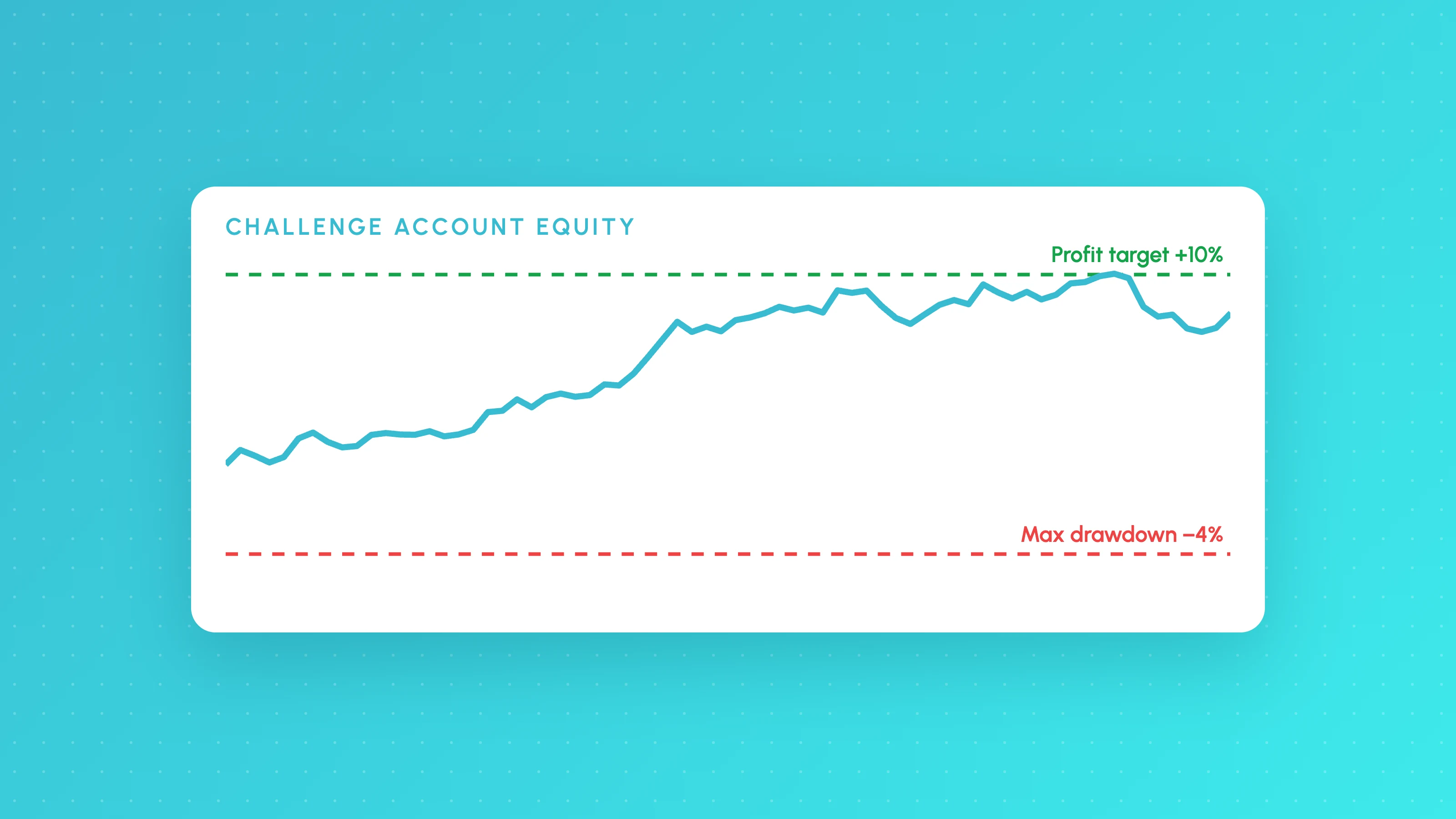
How to Pass a Prop Firm Challenge With an Algo Strategy
Map prop firm rules (daily loss, trailing drawdown, consistency, news) onto your algo's backtest, size for losing streaks, and check automation is allowed.
 Prop firms
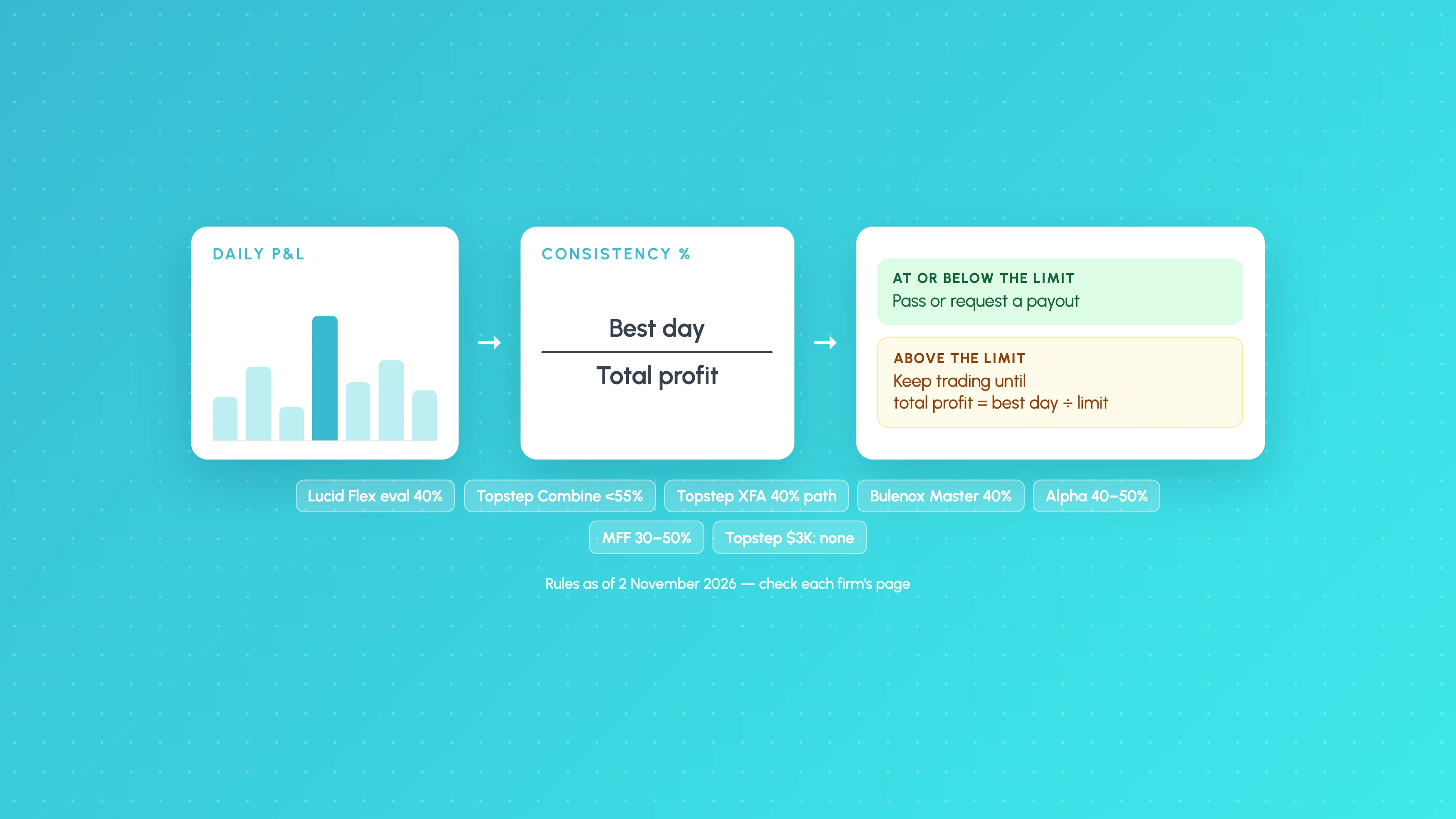
Prop Firm Consistency Rules in 2026: How the 40% Best-Day Rule Works
A prop firm consistency rule caps your best day's share of total profit, often at 40% or 50%. Formula, worked examples and a dated per-firm rules table.
 TradingView backtests
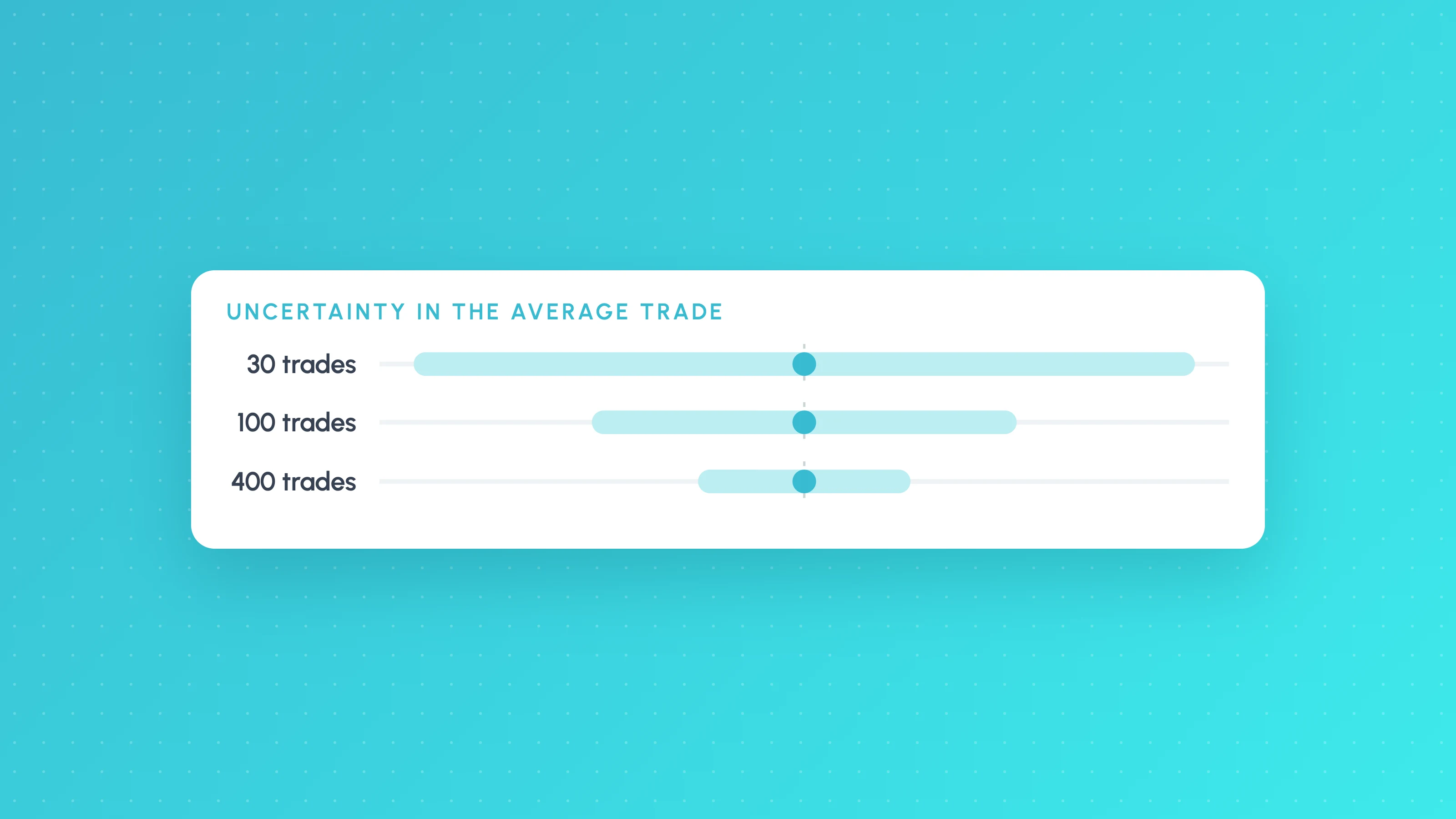
How Many Trades Do You Need for a Valid Backtest?
How many trades a backtest needs: rules of thumb, the t-statistic formula with a worked example, a table by edge size, per-bucket minimums and multiple testing.