
Prop Firm Consistency Rules in 2026: How the 40% Best-Day Rule Works
A prop firm consistency rule caps your best day's share of total profit, often at 40% or 50%. Formula, worked examples and a dated per-firm rules table.
By Tessera Trades · Updated · 10 min read
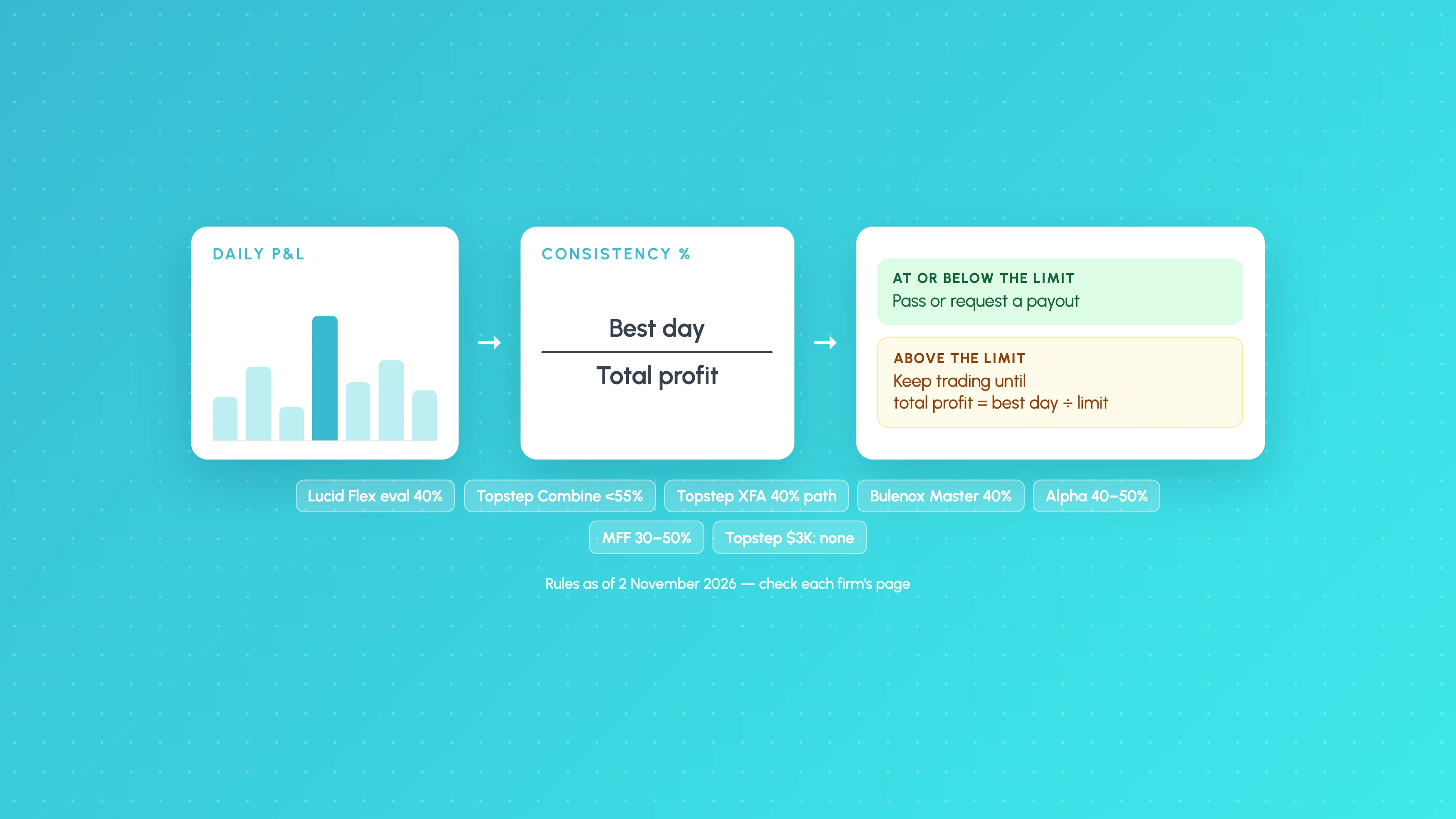
A prop firm consistency rule limits how much of your total profit can come from your single best trading day: under a 40% rule, your best day divided by your total profit must be 40% or less before you can pass an evaluation or request a payout. If one big day pushes you over the limit, most firms do not fail the account; you keep trading until your total profit is large enough to bring the percentage back down.
The rule decides how much profit you really need, not just the headline target, and it catches algo strategies that make much of their money on a few trend or news days. This guide gives the formula, worked examples, a dated table of current rules at six futures firms, and a way to measure your own strategy's best-day concentration from its trade list.
Rules change often. Everything in the table below was checked on each firm's own help pages on 2 November 2026. Re-read the source before you buy an evaluation, and get anything unclear confirmed in writing by support.
The consistency rule formula
Consistency % = Best single day profit / Total profitLucid states it as "Largest Single Day Profit / Account Profit" in its LucidFlex consistency article, and Bulenox gives the same calculation on its Master Account help page. Rearranged, it tells you the total profit you need for a given best day:
Required total profit = Best day / Consistency limit
Extra profit needed   = Required total profit - Current total profit
Three details change the answer in practice:
- Losing days count. A red day lowers total profit and raises your percentage. Tradeify's consistency article says its figure updates in real time.
- The measurement window. Evaluations usually measure the whole evaluation. Payout rules usually measure the current payout cycle and reset after each approved payout, as Bulenox and Alpha Futures both state.
- "At or below" vs "below". Most firms accept a result at the limit. Topstep's Trading Combine wording is that the best day must stay "below 55%".
Worked examples (illustrative numbers)
These examples use made-up round numbers to show the arithmetic. They are not any firm's account or any real trader's results.
Example 1: a big day before the target
Say an evaluation has a $3,000 profit target, and your best day so far is $1,800. When you reach $3,000, your consistency is $1,800 / $3,000 = 60%.
| Consistency limit | Required total profit | Extra profit beyond the $3,000 target |
|---|---|---|
| 50% | $1,800 / 0.50 = $3,600 | $600 |
| 40% | $1,800 / 0.40 = $4,500 | $1,500 |
| 30% | $1,800 / 0.30 = $6,000 | $3,000 |
Those figures assume no later day beats $1,800; if one does, the required total rises again.
Example 2: a losing day makes it worse
A payout cycle with five illustrative trading days:
| Day | P&L | Running total | Best day | Consistency |
|---|---|---|---|---|
| 1 | +$600 | $600 | $600 | 100% |
| 2 | -$300 | $300 | $600 | 200% |
| 3 | +$1,200 | $1,500 | $1,200 | 80% |
| 4 | +$400 | $1,900 | $1,200 | 63% |
| 5 | +$500 | $2,400 | $1,200 | 50% |
At a 40% limit you need $1,200 / 0.40 = $3,000, so another $600. If day 6 loses $200, the total drops to $2,200, consistency rises to 55%, and the gap grows to $800.
Consistency rules by firm (as of 2 November 2026)
Each row was checked on the firm's own help pages on 2 November 2026. Where a page shows a date, it is given.
| Firm and account | Evaluation | Funded / payout stage | Source (page date) |
|---|---|---|---|
| Lucid Trading, LucidFlex | Best day 40% or less of account profit to upgrade, or 50% with an optional add-on bought at checkout | Evaluation stage only; the rule no longer applies once promoted | LucidFlex Consistency Percentage (no date shown) |
| Topstep, Trading Combine and Express Funded Account | Best trading day must stay below 55% of total profits | Consistency payout path: trade at least 3 days at 40% consistency. Standard path: five winning days of $150+ and no consistency target | Topstep Program Overview (updated 10 Sep 2026), XFA rules (updated 26 Jun 2025) |
| Topstep $3K Challenge ("Revenge of the $3K") | No consistency target, no daily loss limit, no minimum days | Fixed $3,000 payout after a Challenge Round and a Payout Round | Topstep Labs announcement (15 Oct 2026) |
| Bulenox | Momentum qualification: no consistency requirement | Master: best day 40% or less of total P&L for the payout period, on every request; resets after each payout. Fast Track: 20%, 25%, then 30% from the third payout. Momentum Master: 35% per payout cycle. Funded Account: no fixed best-day cap | Bulenox Help Center: Master, Fast Track, Momentum, Funded (no dates shown) |
| MyFundedFutures | Rapid EOD 30%; Rapid Intraday and Pro 50%; Pro one-day pass and Builder plans none | Builder: 50% in the simulated funded stage | MFF consistency rule (updated 25 Sep 2026) |
| Tradeify | Select evaluation 40% (Copilink reports a paid add-on that raises this to 50% on 25K to 150K accounts) | Select funded: none. Growth sim funded: 35%. Lightning funded bought after 12 Sep 2025: 20%, 25%, then 30% from the third payout (20% for older accounts) | Tradeify consistency rule (no date shown) |
| Alpha Futures | Standard 50%; Advanced 40% | Zero and Standard Qualified 40% of net profit since the last withdrawal request; Direct Qualified 20%; Advanced Qualified none | Alpha Futures consistency rule (dated 27 Jul 2026) |
Notes on the table:
- Lucid changed its number. The independent Copilink changelog logged on 20 October 2026 that LucidFlex evaluations now need a best day of 40% or less, with 50% as a paid add-on. Older guides quoting a flat 50% rule for LucidFlex predate this.
- Bulenox's Funded Account is not something you buy. Master Accounts may be considered for it after three successful payouts, at Bulenox's discretion. Its page sets no specific best-day limit but keeps withdrawals subject to "performance consistency and risk management requirements".
- Bulenox's first payout includes the reserve. For the first Master payout, the Safety Threshold Reserve is included in the consistency calculation.
- Topstep's Combine figure differs between sources. Its help centre says below 55%; some third-party guides still quote 50%.
- Tradeify's evaluation has a paid add-on. Copilink's Tradeify page, checked on 20 October 2026, reports an add-on raising the Select evaluation limit to 50% on 25K to 150K accounts, which Tradeify's help article does not mention.
- Apex Trader Funding is not in the table because its help centre was not reachable from our location on 2 November 2026. Copilink's Apex page, checked on 20 October 2026, reports that no single profitable day may be 50% or more of profit since the last approved payout on current Performance Accounts. Apex's own rules also ban automated trading, as covered in our guide to prop firms that allow algo trading.
Evaluation vs funded vs payout rules
The same firm can apply different rules at each stage, and the stage changes what a breach costs you.
| Stage | What the rule usually measures | What happens if you exceed it |
|---|---|---|
| Evaluation | Best day against total evaluation profit | You cannot pass yet; keep trading (Lucid, MFF, Alpha) |
| Funded payout | Best day against profit in the current payout cycle | No breach, but no payout request until it comes back in line (Bulenox, Tradeify, Alpha) |
| After a payout | The cycle resets | Your previous big day no longer counts, but nor do your previous small days |
MyFundedFutures, Bulenox, Tradeify and Alpha Futures (for Qualified accounts) state that exceeding the limit does not breach the account, and none of the pages we checked describe it as a failure. The cost is more days in the market, each one a chance to hit a loss limit before you qualify.
Prop firms without a consistency rule
It depends on the account rather than the firm. From the table above, the setups with no consistency rule at the stated stage are: the Topstep $3K Challenge, Topstep's Standard XFA payout path, LucidFlex after promotion, MFF Builder evaluations and the Pro one-day pass, Tradeify Select funded accounts, Alpha Futures Advanced Qualified accounts, and Bulenox's Momentum qualification. These usually substitute winning-day requirements, a tighter loss limit or a fixed payout.
Why algo strategies trip the consistency rule
Consistency rules target one-day gambles, but systematic strategies trip them too:
- Trend days. A breakout or trend-following system often loses small on most days and makes most of its money on a few days when the market runs. That pattern is the strategy working as designed, and it is exactly what a 40% rule penalises.
- News and volatility spikes. CPI, FOMC and payroll days can produce outsized wins for strategies that trade volatility, and an evaluation is short enough that one such day can dominate it.
- Position sizing doesn't fix it. The consistency percentage is a ratio. If you halve the size of every trade, every day halves, and the percentage stays the same. Only changing the distribution of daily results moves it.
- Daily profit caps cost something. Stopping the bot after a set profit each day lowers the best day directly, but it also cuts the winners that pay for the losing days. Test whether the capped version still has a positive expectancy before you rely on it.
How to check your strategy's best-day concentration
You can measure this from any trade list: a backtest export, a broker history or a spreadsheet.
- Build daily P&L. Sum net P&L per trading day. Use the firm's definition of a trading day; CME futures sessions reopen the previous evening (6 PM ET), so at most firms an evening trade belongs to the next day's session.
- Calculate the best-day share. With daily P&L in B2:B200, this works in Excel and Google Sheets:
Best-day share:  =MAX(B2:B200)/SUM(B2:B200)
Top-3 share:     =SUM(LARGE(B2:B200,{1,2,3}))/SUM(B2:B200)
Needed at 40%: =MAX(B2:B200)/0.4- Use challenge-length windows, not the whole backtest. A year of results dilutes any single day. Split the history into evaluation-length windows and calculate the best-day share for each; the share of windows over your firm's limit is the better guide.
- Look at the top-3 share too. If your top three days make up most of a window's profit, small timing changes decide whether you qualify.
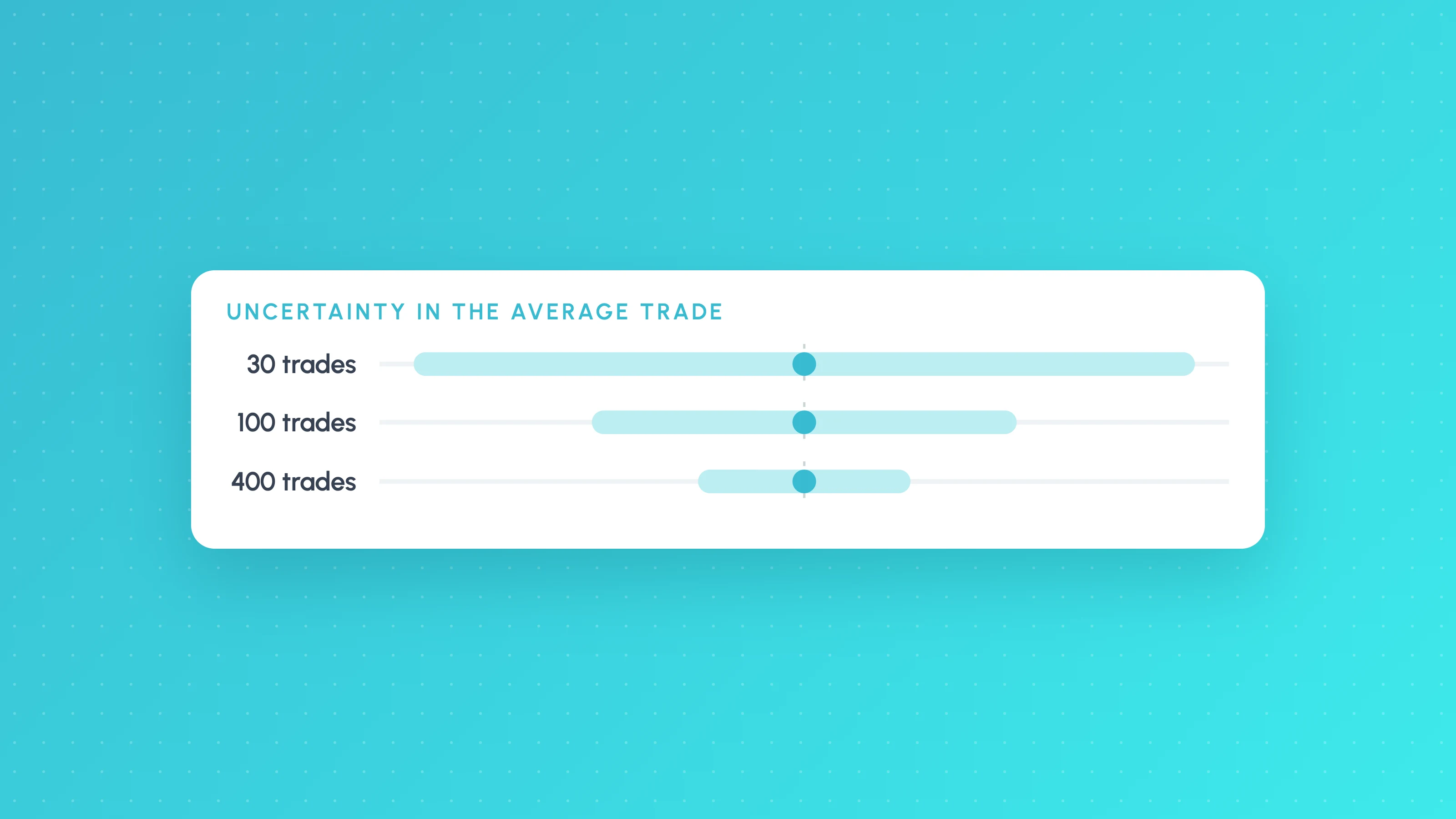
- Check the sample. A handful of windows proves little. Our guide to backtest sample size covers how many trades and periods you need before trusting a split.
Tessera's free Entry Analysis report breaks a backtest export or live account's trades down by session, weekday, time of day, volatility, symbol and direction, with the trade count behind each slice, so you can see which conditions produce the outlier days. It analyses trades your strategy has already taken; it does not track or enforce any prop firm's rules, and you still need to do the consistency calculation against your firm's own definition.
For the rest of the rule set (daily loss, trailing drawdown, news restrictions) see our guide to passing a prop firm challenge with an algo strategy.
Prop firm fees are lost if you fail an evaluation, and meeting a consistency rule says nothing about whether a strategy will be profitable on a funded or live account.
To see which market conditions produce your strategy's biggest days before you buy an evaluation, upload a strategy tester export, broker history or spreadsheet to the free Entry Analysis report. No card is needed.
To check a list of daily results against a rule without the spreadsheet, use the free prop firm consistency calculator. For how to weigh the consistency rule against the other rules when picking a firm, see how to choose a prop firm for algo trading.
Frequently asked questions
- How do I calculate a prop firm consistency rule?
- Divide your best single day's profit by your total profit over the period the firm measures. If the result is above the limit, divide your best day by the limit to get the total profit you need. For example, with illustrative numbers, a $1,500 best day under a 40% rule needs $3,750 of total profit.
- What is the Lucid consistency rule in 2026?
- As of November 2026, LucidFlex evaluations require a consistency percentage of 40% or less to upgrade, or 50% if you bought the consistency add-on at checkout. Lucid's help article says the requirement applies only during the evaluation stage. Lucid calculates it as largest single day profit divided by account profit.
- Does Topstep have a consistency rule?
- Yes, on most accounts. As of November 2026, Topstep's help centre says the Trading Combine's best day must stay below 55% of total profits, and the Express Funded Account's Consistency payout path requires 40% consistency over at least three trading days. The Topstep $3K Challenge, announced on 15 October 2026, has no consistency target.
- What happens if I break the consistency rule?
- MyFundedFutures, Bulenox, Tradeify and Alpha Futures (Qualified) state it is not a breach, and none of the pages we checked describe it as a failure. You cannot pass or request a payout until more profit brings your best day's share back under the limit, and the extra days expose you to loss limits.
- Can I avoid the consistency rule by trading smaller?
- No. Scaling every trade down scales every day down by the same amount, so the percentage doesn't change. Only changing how profit is spread across days moves it, for example a daily profit cap.
- Which prop firms have no consistency rule?
- It depends on the account rather than the firm. As of November 2026, examples include the Topstep $3K Challenge, Topstep's Standard XFA payout path, MyFundedFutures Builder evaluations, Tradeify Select funded accounts and Alpha Futures Advanced Qualified accounts. Check each firm's current page, because these accounts usually have other limits instead.
Keep reading
 Prop firms
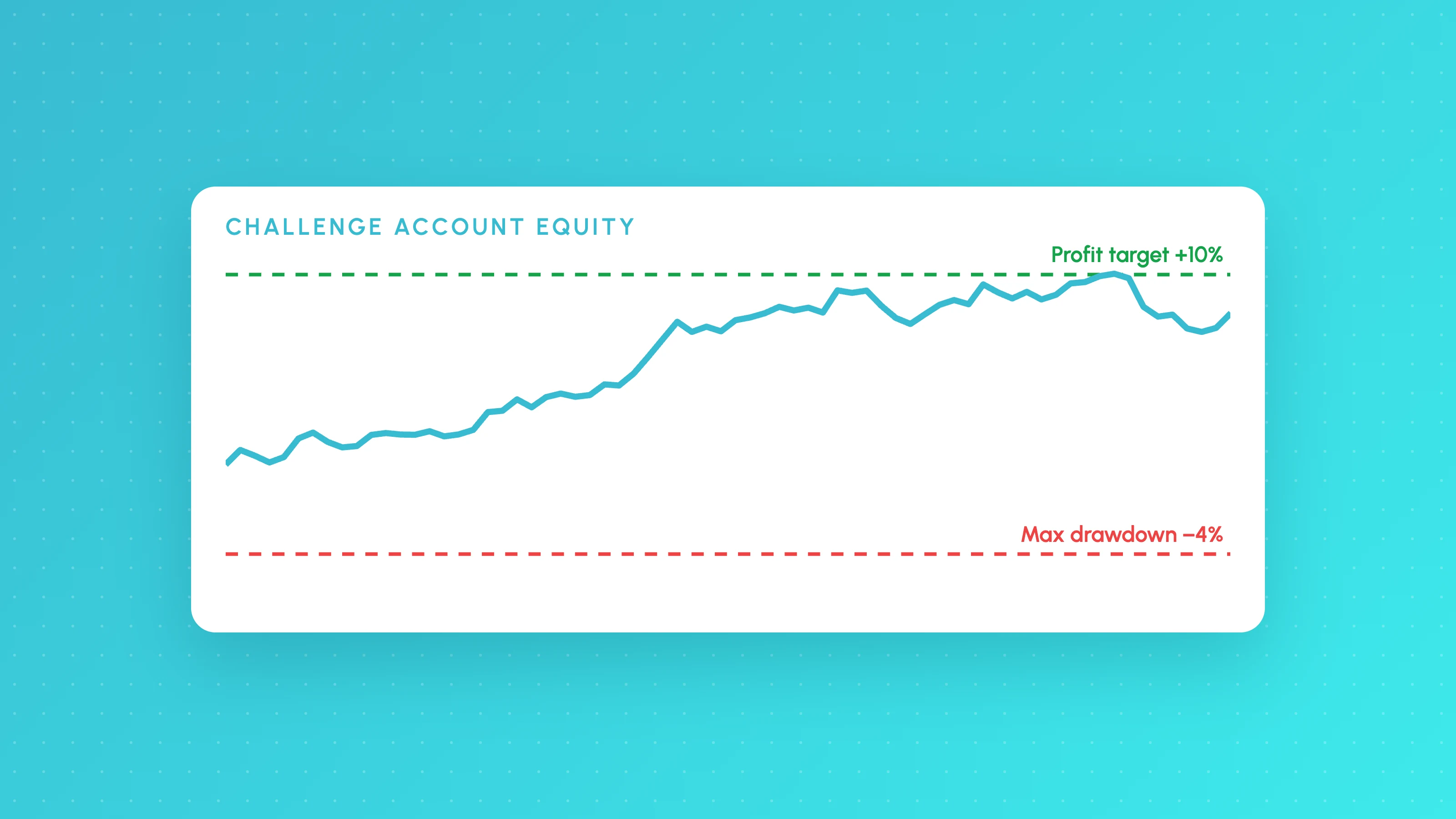
How to Pass a Prop Firm Challenge With an Algo Strategy
Map prop firm rules (daily loss, trailing drawdown, consistency, news) onto your algo's backtest, size for losing streaks, and check automation is allowed.
 Prop firms
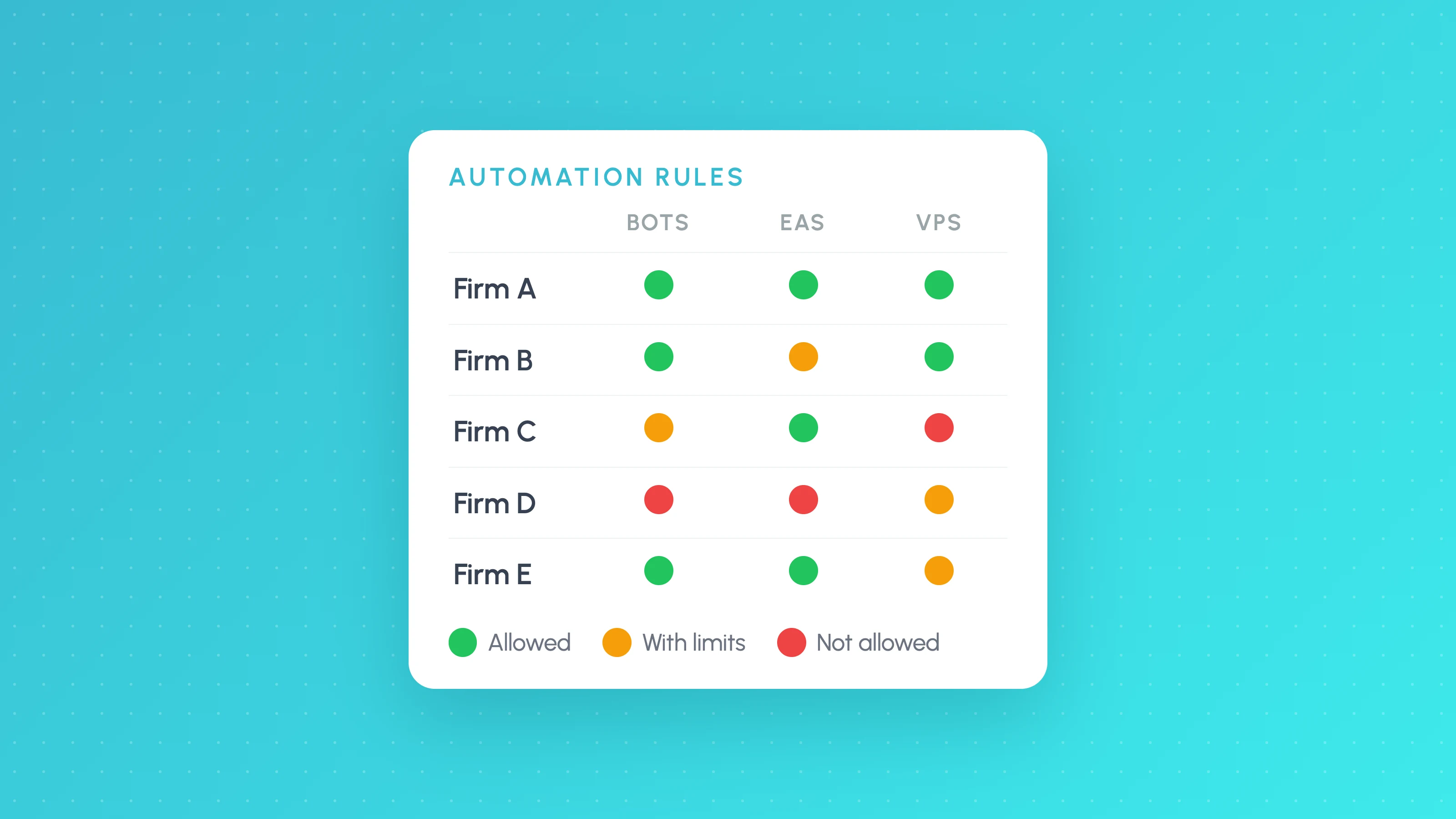
Futures and Forex Prop Firms That Allow Algo Trading in 2026: Rules for Bots, EAs and Automation
Prop firms that allow algo trading as of October 2026: Topstep, Lucid, Tradeify, FundedNext and FTMO allow bots with limits; Apex bans them. Rules table.
 TradingView backtests
How Many Trades Do You Need for a Valid Backtest?
How many trades a backtest needs: rules of thumb, the t-statistic formula with a worked example, a table by edge size, per-bucket minimums and multiple testing.