

How to Choose a Prop Firm for Algo Trading Using Your Own Trade Data
Choose a prop firm for algo trading by testing your own trade list against each firm's rules: drawdown type, daily loss, consistency, news and payouts.
By Tessera Trades · Updated · 10 min read
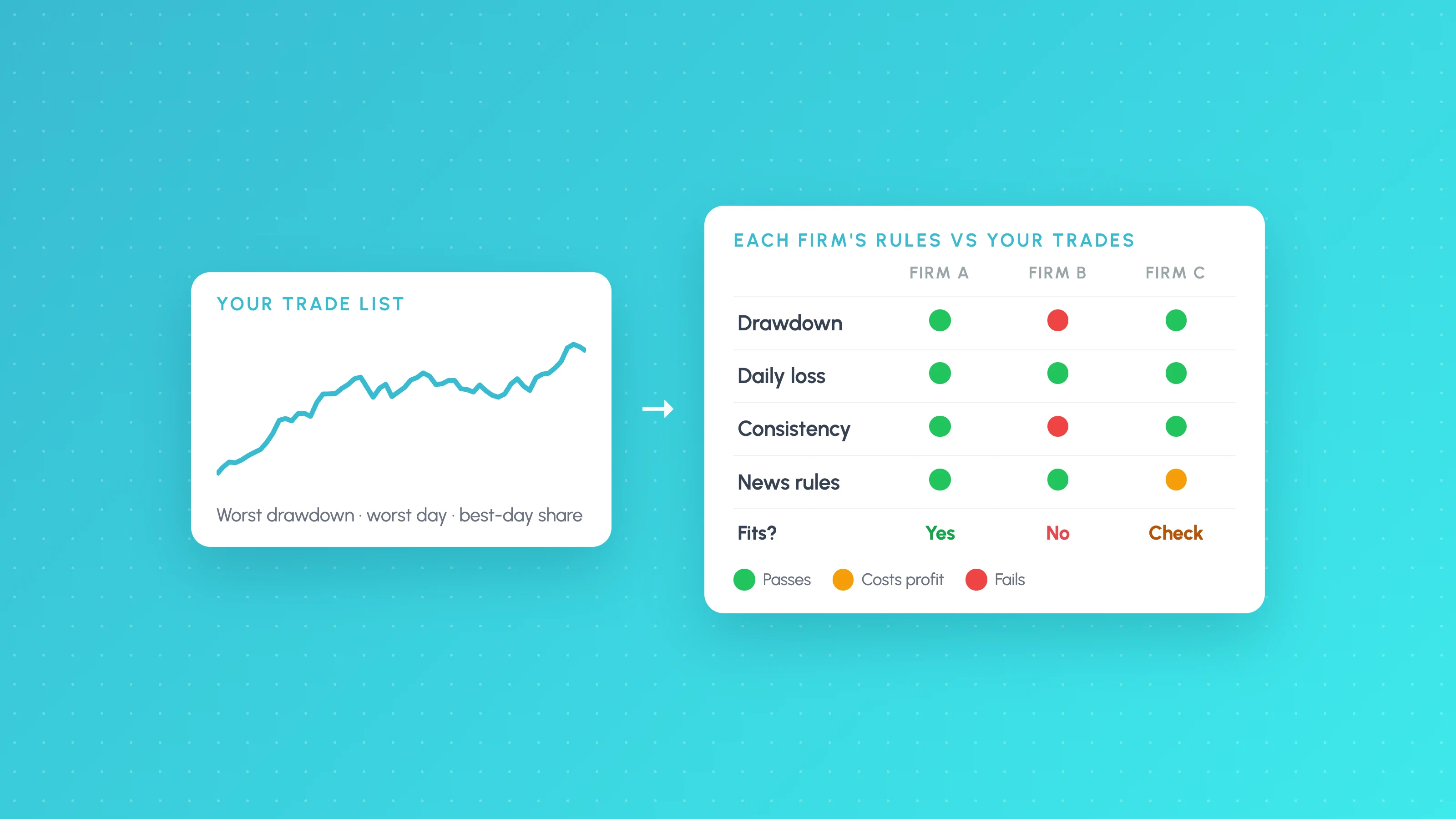
The best prop firm for algo trading is the one whose rules your strategy's real trade history would have passed. Start with firms that allow your kind of automation, then test your trade list against each firm's drawdown type, daily loss limit, consistency rule, news restrictions and payout rules. A firm's position in a ranking table tells you much less than one afternoon with your own equity curve.
This guide explains why paid rankings are a weak signal, which rules matter most for algos, how to measure each one from a trade list, and a worked example comparing three rule sets.
*Prop firm evaluations are paid products and most traders don't pass them. Nothing here suggests any firm or strategy will be profitable.*
Why rankings are a weak signal
Comparison sites are a quick way to see which firms exist, but most earn money when you buy through them, and their order is not a test of anything.
That came into focus at the end of October 2026. On 29 October a trader posted a video alleging that Prop Firm Match, one of the largest comparison sites, sent visitors through its affiliate links when they clicked firm profiles or promo-code buttons. Prop Firm Match says it disabled that behaviour on 29 October, and on 31 October it said: "We take full responsibility for it." By then about 21 firms had ended their partnerships, according to Finance Magnates, including Apex Trader Funding, Tradeify, Lucid Trading, FundingPips and Goat Funded Trader; counts differ between reports and dates. Topstep's founder said Topstep had no affiliate code but paid a monthly fee for its listing, and that it was dropping Prop Firm Match (Finance Magnates).
The general point holds whatever the outcome of that story: when listings are paid for, or rankings sit next to affiliate commissions, a high position can reflect a commercial relationship rather than fit for your strategy. Ratings also average over thousands of traders who trade nothing like your bot. Use rankings to build a shortlist, then decide with your own data.
Step 1: Filter by automation rules
Before anything else, check that the firm allows what your strategy does. Rules differ on:
- Full automation vs semi-automation. Some firms allow bots and EAs; some allow signal indicators only if you place each trade; some ban automation entirely.
- Which platform and route. API access, a specific platform only, or a paid add-on.
- Where it runs. Some firms ban VPS or remote servers; others sell a VPS.
- Ownership. Several firms require you to own the strategy and ban bought or shared bots.
- Speed and order limits. High-frequency trading bans, minimum holding times and caps on server requests.
- Evaluation vs funded. Automation allowed in one phase but not the other.
Our list of prop firms that allow algo trading has a dated table of these rules by firm. Anything not clearly allowed in writing on the firm's own help pages should be treated as not allowed until support confirms it.
Step 2: List the rules that decide whether an algo passes
For each firm left on your shortlist, write these down as numbers, from the firm's own pages, with the date you read them.
| Rule | What to find out | Why it matters for algos |
|---|---|---|
| Drawdown type | Trailing intraday, trailing end-of-day (EOD) or static? Does the trail stop at some level? | An intraday trail counts open profit that a trade later gives back, which catches strategies that let winners run |
| Drawdown size | Dollar amount, relative to the account size | Sets how much of your worst losing run you can absorb |
| Daily loss limit | Amount, whether it includes open losses, and when the trading day resets | A bot with one bad day per quarter can still fail on that day |
| Consistency rule | Best day's share of total profit allowed, and in which phase | Trend and news strategies often make much of their profit on a few days |
| News restrictions | Banned window around which events, and whether a resting stop or target filling inside it counts | Bots don't know about news unless you code it in |
| Payout rules | Minimum days, profit buffer, payout consistency rules and caps | Passing the evaluation doesn't help if the payout rules don't fit your strategy |
| Costs | Evaluation fee, activation fee, data and platform fees | Repeated resets add up |
Check each challenge type separately, too. One firm can sell challenges with different drawdown types, daily limits and consistency rules; FTMO 1-Step vs 2-Step for algo traders shows how that choice changes which bots fit.
Step 3: Measure your strategy against each rule
Use a trade list with dates, times and net P&L after commission and slippage: a backtest export, or better, live or forward-test fills. Then calculate the following.
Maximum trailing drawdown from your equity curve
Build a running total of net P&L. For an EOD trailing drawdown, take each day's closing balance, track the highest close so far, and record the largest drop from that high. For an intraday trail you need open profit too: if your platform gives each trade's maximum favourable excursion, add it to the balance before the trade closed to find the intraday peaks. The intraday figure is usually larger than the EOD figure, sometimes by a lot. Compare the worst value with each firm's limit.
Best-day share
Group trades by the firm's trading day, sum net P&L per day, and divide the best day by total profit over an evaluation-length window. Do this for many windows, not just the whole backtest. Prop firm consistency rules explains the formula and how much extra profit a big day forces you to make, and our prop firm consistency calculator does the arithmetic.
Worst day
Take the smallest daily P&L. If the firm's daily limit includes open losses, add each trade's maximum adverse excursion on that day. A worst day that only just fits the limit in a backtest will not fit live, because live fills are rarely better.
Behaviour around news
Flag trades opened or closed inside each firm's news window, using the economic calendar the firm names. Then check how much of your profit, and how many of your worst trades, sit inside those windows. If a large share of profit comes from news minutes, a firm with a news ban removes that profit; if your worst losses do, the ban may actually help.
Profit per period
Divide net profit by the number of trading days to see how long the strategy usually takes to reach each firm's target, and compare that with any time limits and minimum day counts.
The step-by-step guide to passing a prop firm challenge with an algo covers sizing for losing streaks and replaying a backtest as many separate challenges. Before any of this, check the strategy has a positive expectancy after costs: no rule set fixes a strategy that loses on average.
Worked example (illustrative numbers)
These figures are made up to show the method. They are not any real firm's rules or any real trader's results.
Say a futures strategy, sized for a $50,000 account, has this 60-trading-day history after costs:
| Measure | Value |
|---|---|
| Net profit | $6,000 |
| Worst EOD trailing drawdown | $1,700 |
| Worst intraday trailing drawdown (using open profit) | $2,300 |
| Worst day | −$900 |
| Best day | $2,100 (35% of total profit) |
| Trades within 2 minutes of high-impact news | 8% of trades, 30% of net profit |
Now compare three hypothetical rule sets for a $50,000 evaluation with a $3,000 target:
| Rule | Firm A | Firm B | Firm C |
|---|---|---|---|
| Drawdown | $2,000 trailing EOD | $2,000 trailing intraday | $2,500 static |
| Daily loss limit | $1,000 | None | $1,200 |
| Consistency | Best day ≤ 40% | Best day ≤ 30% | None |
| News | Allowed | Allowed | No trades 2 minutes either side |
| Result for this strategy | Fits, with $300 of drawdown room | Fails: intraday drawdown $2,300 > $2,000, and 35% > 30% | Drawdown and daily loss fit, but the news ban removes 30% of profit |
Firm B might top a ranking table and still be the wrong choice for this strategy. Firm C's static drawdown is the most forgiving, but only if the strategy stays worth trading without its news trades, which is a separate test: rerun the numbers with those trades removed. Firm A fits, but $300 of room is thin; the next step is to check how often the strategy's drawdown came within $300 of $2,000 across many 60-day windows, not just once.
If the strategy is built in Tessera's Strategy Lab, the prop firm challenge simulator runs that replay for you: a fresh run starting every week or month of the data, limits checked inside every candle on open equity, and a pass rate and days to pass for each rule set. Its presets (Personal, FTMO 1-Step, FTMO 2-Step, The5ers 1-Step and Topstep 50K) are based on published rules as of October 2026.
A checklist before you buy an evaluation
- The firm allows your automation, platform, hosting and strategy ownership in writing, on its own help pages.
- You've written every rule as a number, with the date you read it.
- Your trade list uses net P&L after commission and slippage, ideally from live or forward-test fills.
- The worst trailing drawdown, measured the firm's way (intraday or EOD), fits with room to spare.
- The worst day fits the daily loss limit, including open losses if the firm counts them.
- The best-day share passes the consistency rule over evaluation-length windows, or you know how much extra profit you'd need.
- You know what share of profit and losses falls inside the firm's news windows.
- The payout rules (minimum days, buffers, payout consistency rules) fit how the strategy makes money.
- You have enough trades for the numbers to mean anything; see how many trades you need.
- You found the firm through your own shortlist, not only a ranking position.
Get your numbers from your own trades
Most of the measures above come from one place: a clean list of your strategy's trades. Upload a TradingView Strategy Tester export, an MT4 or MT5 report, a NinjaTrader or Tradovate file, or sync a live account, and the free Entry Analysis report breaks the results down by session, weekday, time of day and volatility, with the trade count behind each figure. That shows when your strategy makes and loses money, including around the hours when scheduled news lands, before you pay for an evaluation. No card is needed.
Frequently asked questions
- What is the best prop firm for algo trading?
- There isn't one best firm for every strategy. The best fit is a firm that allows your type of automation and whose drawdown type, daily loss limit, consistency rule, news rules and payout rules your strategy's trade history would have passed. A strategy that lets winners run may suit a static or end-of-day drawdown; one that makes most of its profit on a few days needs a loose or no consistency rule.
- How do I compare prop firms?
- Shortlist firms that allow your automation in writing, write each firm's rules as numbers, then measure your trade list against them: worst trailing drawdown measured the firm's way, worst day, best day's share of profit, and profit made inside news windows. Compare the results side by side rather than relying on ratings or rankings.
- Are prop firms legit?
- Many established prop firms do pay out, but the industry has seen closures and frequent rule changes, and evaluation fees are the main revenue for many firms. Read the rules and payout terms on the firm's own site, check how long it has operated and how its rules have changed, and treat paid rankings with caution. Only pay for an evaluation you can afford to lose.
- Can I trust prop firm comparison sites?
- Use them to find firms, not to choose between them. Most earn affiliate commission or paid listing fees, and their order is not a test of whether a firm suits your strategy. Confirm every rule on the firm's own pages.
- Do I need a trading journal for prop firms?
- You need a reliable record of every trade with dates, times and net P&L, because that is what you measure against drawdown, daily loss and consistency rules. A journal that imports your platform's trade history and breaks results down by session and time of day makes those checks quicker and shows which conditions put an account at risk.
- Should I use backtest or live trades to choose a firm?
- Use both if you can. A backtest gives you enough trades, while live or forward-test fills show real slippage and execution. If live results are worse, size the drawdown and daily loss checks from the live numbers.
Keep reading
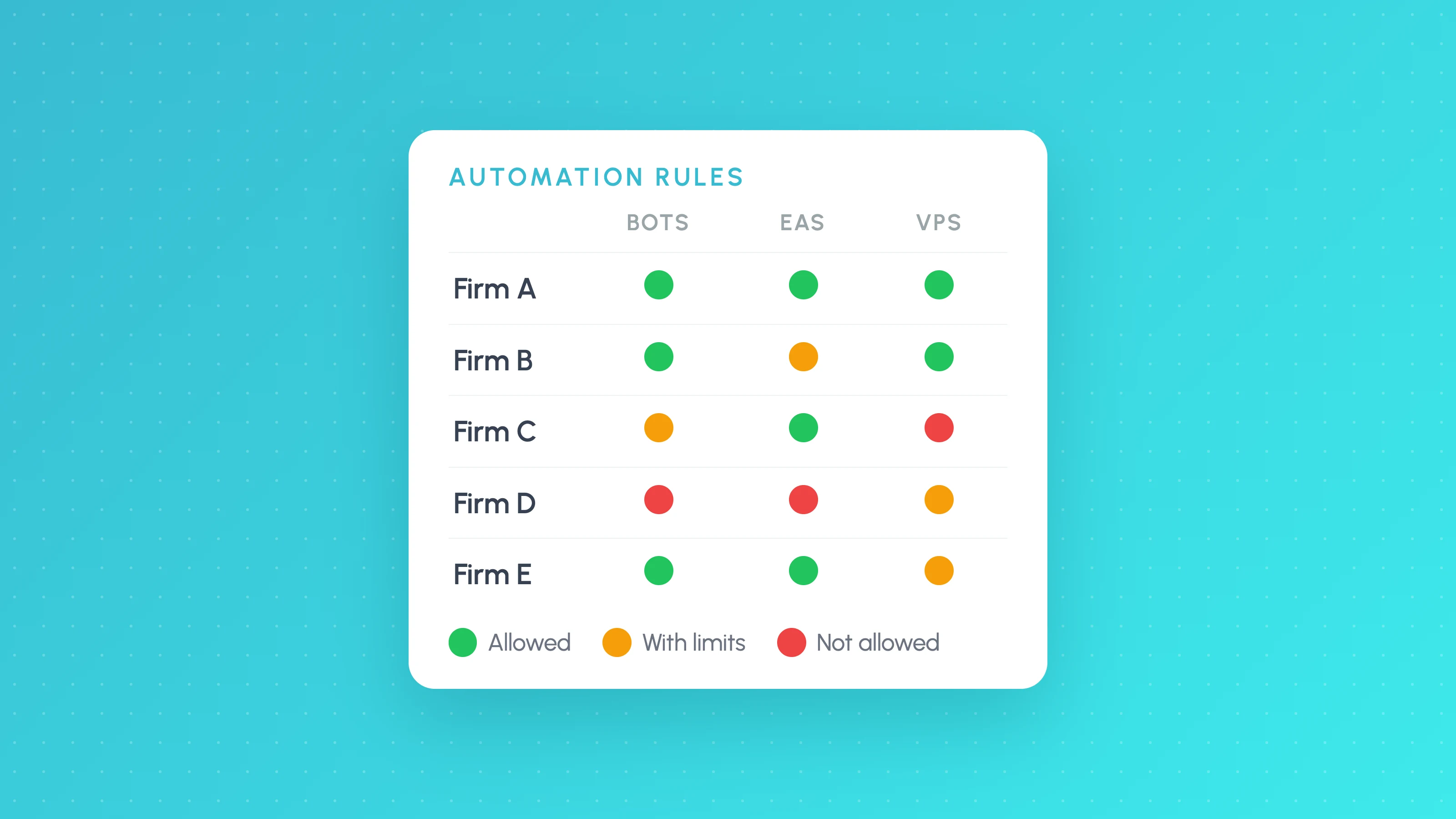 Prop firms
Futures and Forex Prop Firms That Allow Algo Trading in 2026: Rules for Bots, EAs and Automation
Prop firms that allow algo trading as of October 2026: Topstep, Lucid, Tradeify, FundedNext and FTMO allow bots with limits; Apex bans them. Rules table.
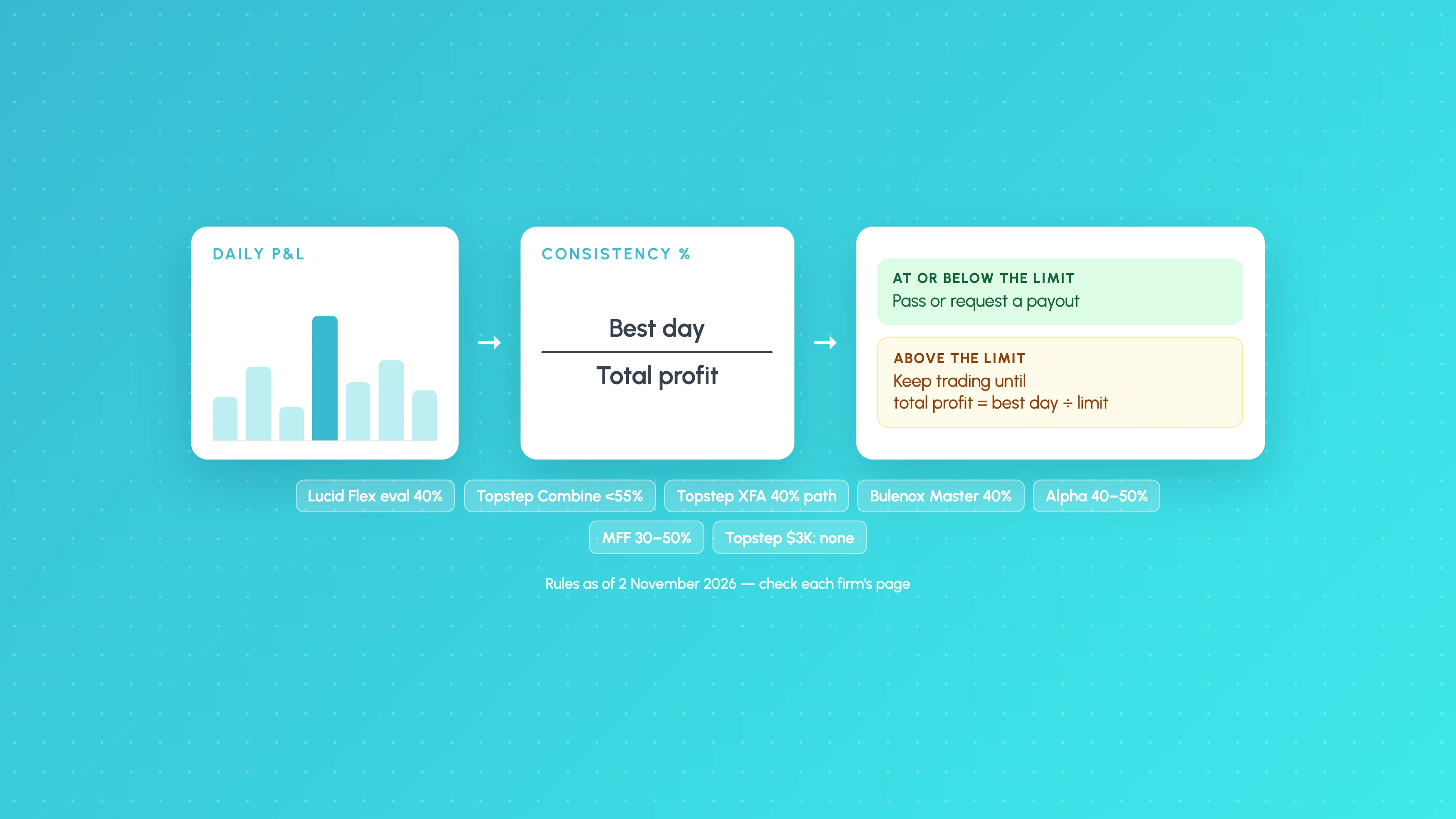 Prop firms
Prop Firm Consistency Rules in 2026: How the 40% Best-Day Rule Works
A prop firm consistency rule caps your best day's share of total profit, often at 40% or 50%. Formula, worked examples and a dated per-firm rules table.
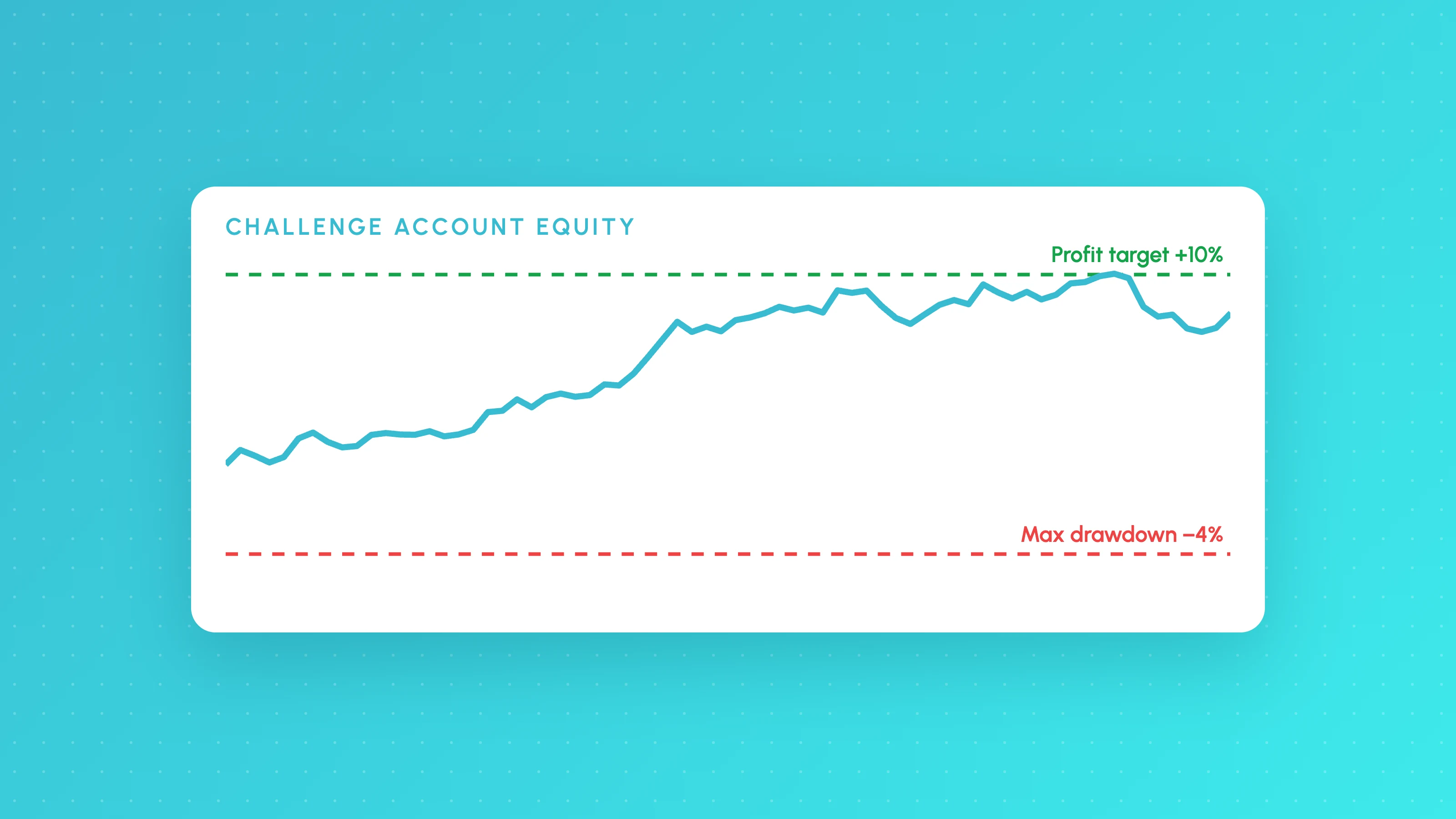 Prop firms
How to Pass a Prop Firm Challenge With an Algo Strategy
Map prop firm rules (daily loss, trailing drawdown, consistency, news) onto your algo's backtest, size for losing streaks, and check automation is allowed.